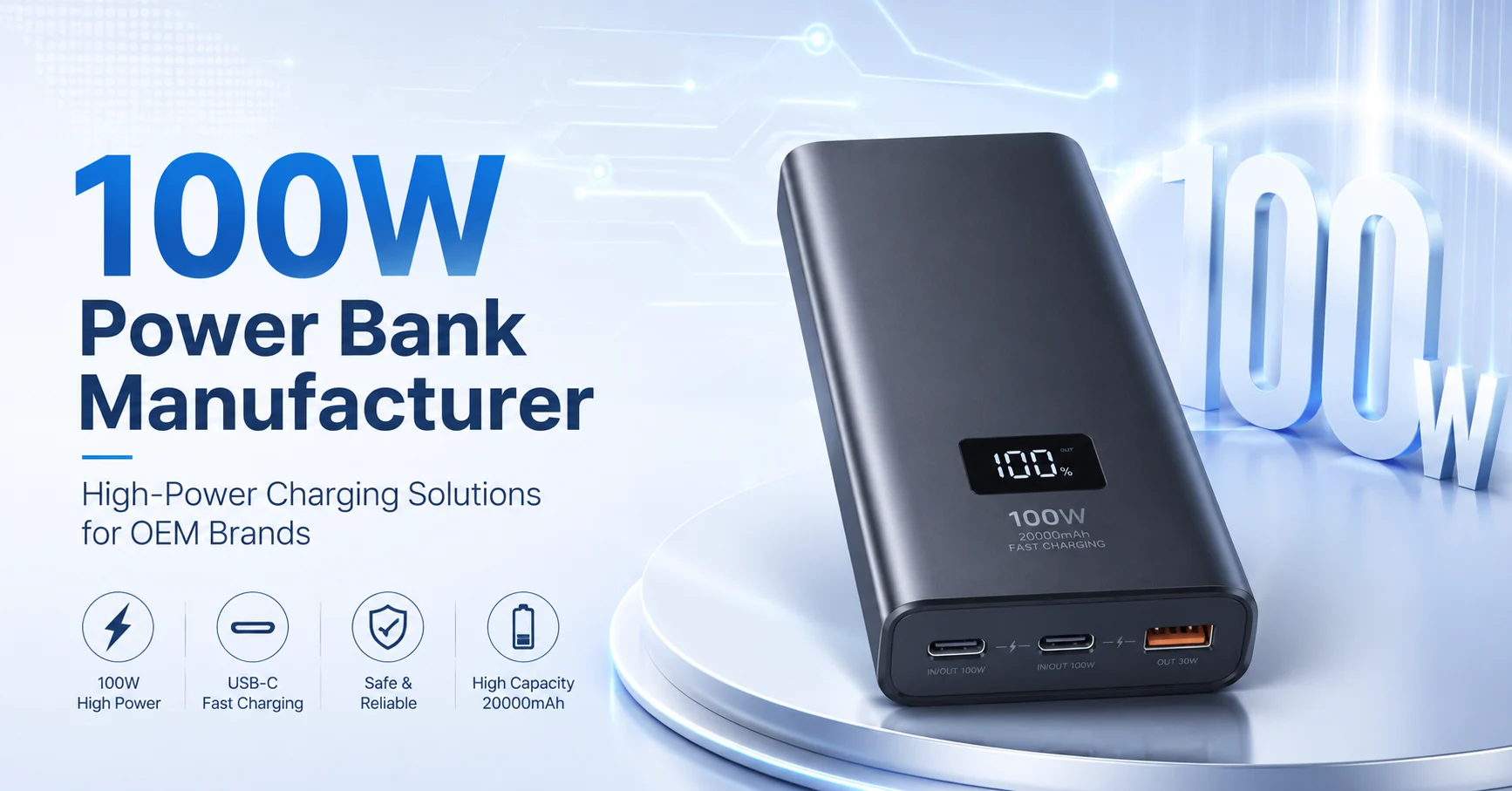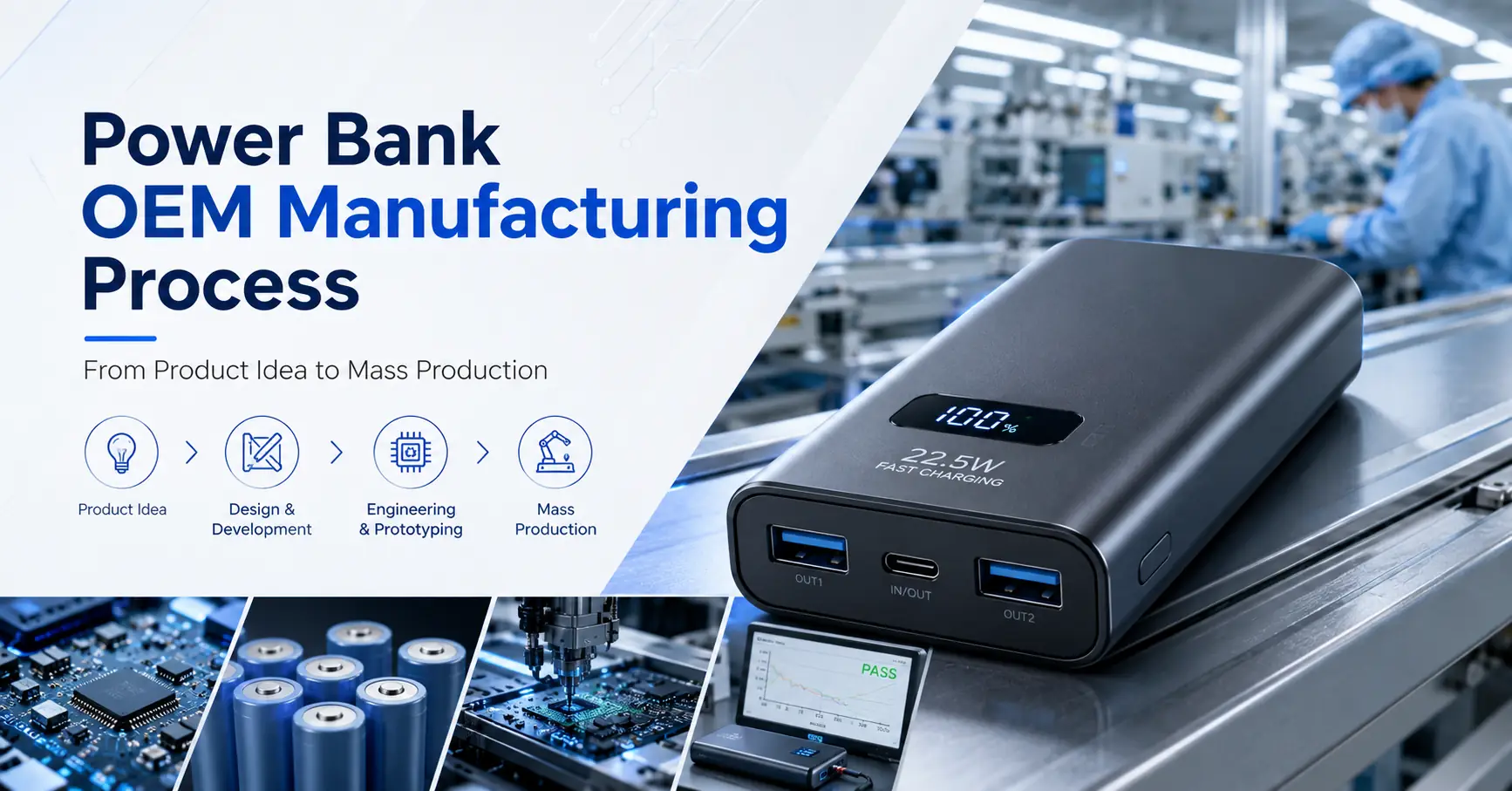

You may see a mobile power bank listed at $49 on Amazon, but its real B2B factory price may not even reach $12. This is the underlying logic of the consumer electronics industry. Here is the 2026 reality check: in Shenzhen or Dongguan OEM factories, a standard 10,000mAh basic power bank has an EXW (ex-factory price) of only 3.50 to 4.80; while a 20,000mAh high-end laptop-grade power bank supporting 100W PD fast charging usually falls in the bulk purchase range of 16.00 to 22.00.
With the full enforcement of the EU Battery Regulation 2026, which mandates battery passports and digital traceability for electronic products, global Wholesale power bank pricing is undergoing a dramatic reshuffle. Higher compliance thresholds have eliminated a large number of workshop-style factories, causing a structural adjustment in high-quality A-grade supply chain pricing. If you are a buyer, brand owner, or cross-border distributor, stop viewing the market through a retail lens. Continue reading as we break through marketing layers and reveal the real material cost floor through a deep Power bank BOM cost breakdown.
2026 B2B Real Factory Average Price Overview of Power Banks
Every cent in the supply chain corresponds to specific materials and technical parameters. Talking about unit price without volume is meaningless.
Capacity Ladder: From 5,000mAh to 30,000mAh
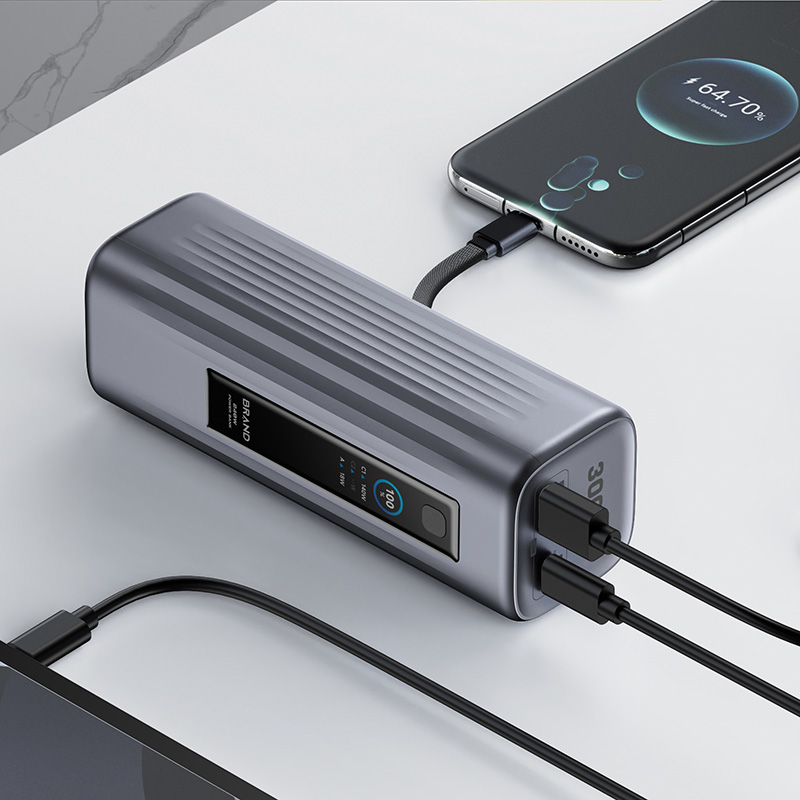
Capacity is the absolute foundation of pricing, but it does not scale linearly. When crossing the 20,000mAh threshold, mold yield challenges and PCB thermal expansion requirements cause a sharp increase in marginal cost. Below are EXW benchmarks based on a 5,000-unit MOQ.
Multi-Dimensional Comparison Table 1: 2026 EXW Base Prices by Capacity and Technology (5K MOQ)
| Capacity | Standard Charge (5V/2A~15W) Avg | Fast Charge (20W–22.5W) Avg | Laptop-Grade High Power (65W–140W) Avg | B2B Recommendation & Positioning |
|---|---|---|---|---|
| 5,000mAh | $2.20–$3.00 | $3.50–$4.50 | N/A (insufficient cell discharge rate) | Extremely high cost-performance. Ideal for promotional gifts or slim magnetic power banks. |
| 10,000mAh | $3.50–$4.80 | $5.00–$7.50 | $12.00–$16.00 | Mainstream product. Avoid basic charging; shift to 20W PD for better margins. |
| 20,000mAh | $6.50–$8.00 | $8.50–$11.00 | $16.00–$22.00 | Travel and business essential. High-power laptop version is the cash cow for e-commerce and retail. |
| 30,000mAh | $10.00–$12.50 | $14.00–$18.00 | $25.00–$32.00 | Niche segment. Restricted by aviation 100Wh limits; logistics clearance risks are high. |
Protocol Gap: The Price Barrier Between Standard and High-Power Fast Charging
Why does a 20,000mAh unit cost $8 in basic charging mode but jump above $20 for a 100W version? The answer lies in step-up/step-down architecture and protocol chip cost differences.
According to BloombergNEF’s global lithium-ion battery price trend report, upstream lithium carbonate prices have bottomed cyclically, compressing cell cost to historical lows (around $110/kWh). This means OEM/ODM manufacturing cost differences are no longer driven by battery capacity alone, but by semiconductor components.
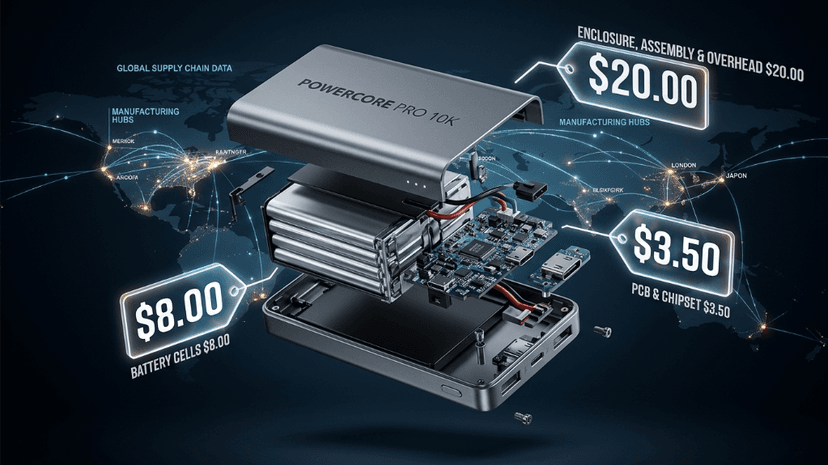
Black Box Breakdown: Deep BOM Cost Structure of Power Banks
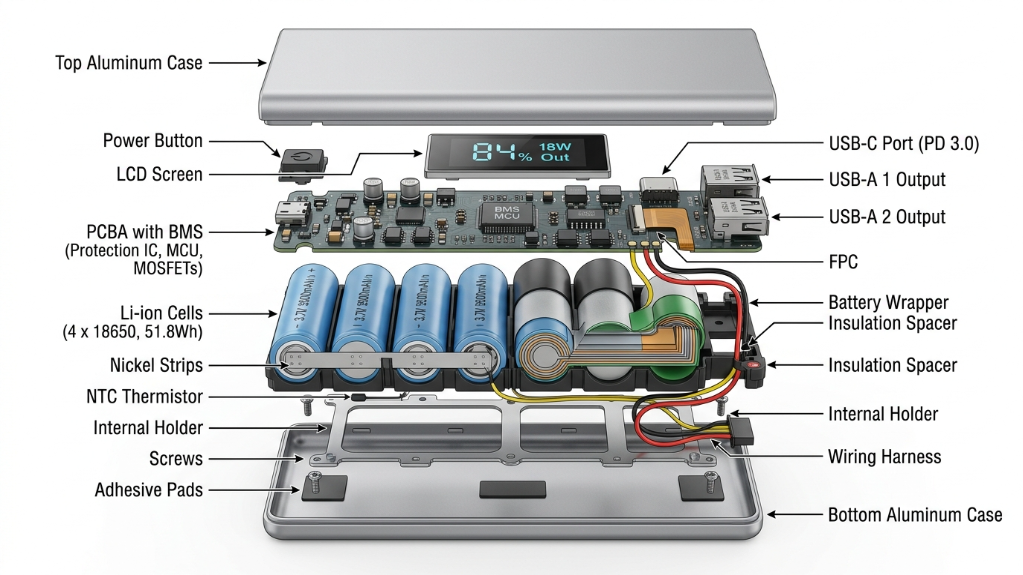
If you only look at total price when negotiating with factories, you will likely be misled. Experienced buyers disassemble the product and break down profit layers piece by piece. A power bank BOM is transparent and consists of four core modules.
Battery Cells: The Heart, Accounting for 50%–60% of Total Cost
This is the deepest and most dangerous cost area, also a major source of fraud. Battery cells mainly come in two physical forms, directly creating a major gap in Lithium-polymer vs 18650 battery price.
Multi-Dimensional Comparison Table 2: Cell Selection & Supply Chain Risks
| Cell Type | Estimated BOM per 10,000mAh | Physical Characteristics | Industry Scam Risks | Commercial Recommendation |
|---|---|---|---|---|
| 18650 cylindrical lithium-ion | $1.80–$2.50 | Fixed cylindrical shape, bulky | Highly prone to recycled/scrap cell fraud, even sand-filled weighting | Only for ultra-low-cost markets. Not recommended. |
| Li-Polymer soft pack | $3.00–$4.50 | Flat, customizable, lightweight, low resistance | B-grade cells may be disguised as A-grade, causing swelling after months | Premium standard. Contract must specify Grade A new cells. |
PCBA & BMS System: The Brain (15%–25% of Total Cost)
For high-wattage units, PCBA board wholesale price can double the total cost.
A basic 5V/2A system may use a low-end SoC chip costing less than $0.50. However, PD 3.1 dual-direction systems require MCU chips, protocol chips, and MOS transistor arrays.
High-power systems generate heat. Cheap boards use diode rectification with poor efficiency. Premium designs use Synchronous rectification technology plus at least two NTC thermistors for millisecond-level temperature monitoring.
Saving a single NTC may save $0.20, but exposes buyers to fire risk and million-dollar liability exposure.
Housing & Structural Parts: 10%–15% of “Aesthetic Cost”
Consumers often pay irrational premiums for appearance. A standard V0 PC+ABS flame-retardant plastic shell costs less than 0.60. However, an anodized aluminum CNC shell similar to Apple-grade design or liquid silicone coating can increase BOM cost to above 2.50.
Whether this is worth it depends entirely on whether your brand targets Walmart clearance shelves or Apple-authorized retail displays.
Profit-Eating Hidden Costs You Cannot Ignore
After calculating hardware BOM, many beginners assume adding 15% margin equals final price. This assumption is often destroyed by logistics and compliance.
Hidden costs of importing electronics are the real profit killers in cross-border trade.
Mandatory Safety Certifications
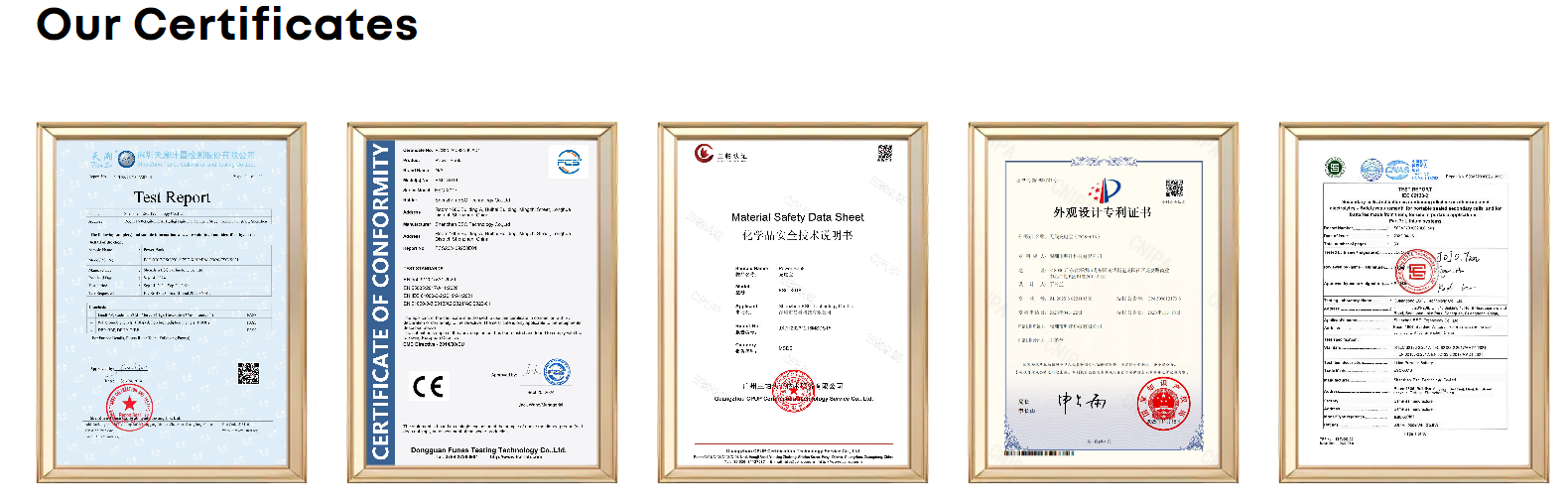
Compliance is never free. According to SGS and TÜV Rheinland guidelines, even a simple power bank must pass strict testing to enter US or EU markets.
UL 2056 certification alone costs between 3,000 to 6,000 per test cycle, lasting weeks. EU CE, RoHS, and REACH add additional costs.
If your factory does not already have certifications, these costs will be absorbed into your first batch, significantly increasing unit price.
Dangerous Goods Shipping Surcharges
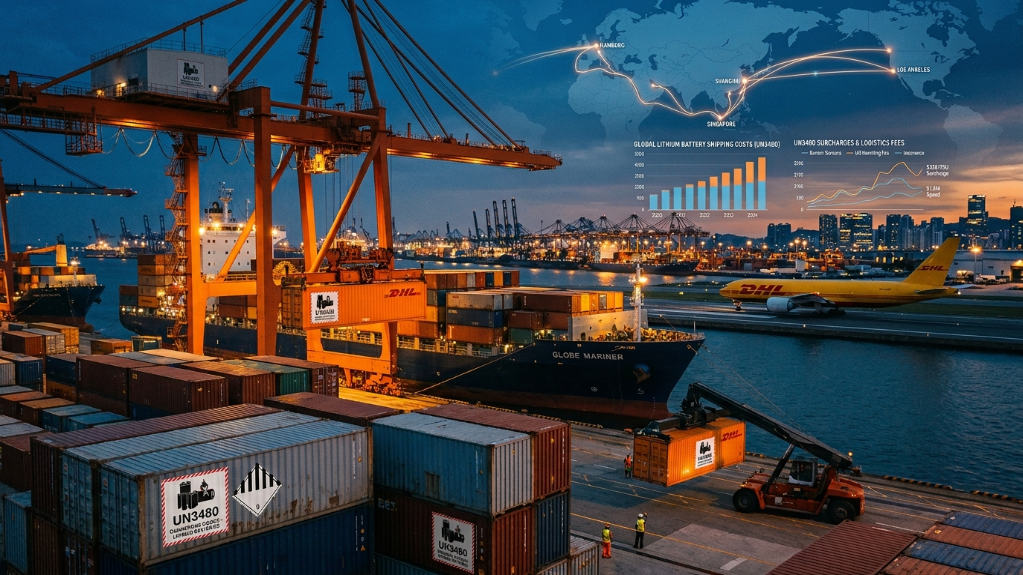
Lithium batteries are classified as Class 9 Dangerous Goods (UN3480). This means shipping costs are far higher than normal consumer goods.
According to Freightos Baltic Index and DG surcharge guidelines, including MSDS/UN38.3 documentation, DG handling fees, and special container costs, logistics per unit is typically 25%–40% higher than standard electronics. Provide you with 3C certified mobile power accessories OEM guide.
Tiered Pricing Logic and Factory Negotiation Strategy
Scale is everything in electronics manufacturing. EXW vs FOB price differences come from amortization of fixed costs.
A South American distributor once planned to purchase 50,000 units of 20,000mAh power banks. Initial BOM exceeded target cost by 12%.
Instead of reducing battery quality (which was rejected), engineers changed the housing process from rubber coating to 3D laser texturing injection molding. This eliminated spraying losses and improved yield, reducing FOB price by 15%.
This is the value of engineering-driven supply chains.
The Only Real Solution: Vertically Integrated Factories
To avoid pricing traps, poor cells, and agent markups, the only solution is to go directly to source manufacturers.
In this regard, AOVOLT in Dongguan stands out as a top-tier B2B supply chain option.
With 15 years of manufacturing experience, AOVOLT focuses on high-value products including magnetic power banks and fast chargers.
While many factories struggle with 65W PD stability, AOVOLT supports 140W ultra-fast charging and full protocol compatibility (PD3.0, PPS, QC3.0, FCP, SCP, AFC, Apple 2.4A, BC1.2).
Its vertically integrated system covers ID design, circuit R&D, mold opening, injection molding, and assembly, removing intermediaries and enabling strong cost flexibility.
Multi-Dimensional Comparison Table 3: Supply Chain Cost Structure & Markup Analysis
| Procurement Channel | Cost Advantage | Customization Depth | After-Sales Support | Overall Evaluation |
|---|---|---|---|---|
| Overseas wholesalers | Very poor (high markup, taxes, logistics, +30% margin) | None | Basic return only | Small-scale retail testing only |
| Shenzhen traders | Medium (10%–15% markup) | Limited | Unstable, quality risk | High volatility |
| Vertically integrated factories (AOVOLT) | Excellent (true BOM pricing) | Full ODM/PCBA customization | Engineer-level support | Best choice for scale branding |
B2B Pricing FAQs
Q1: How much does it cost to start my own custom power bank brand?
For a basic brand using public molds and 1,000 MOQ, initial investment is 5,000 to 8,000.
For full ODM private mold development, mold cost adds 3,000 to 6,000. Total startup capital recommended: $15,000+.
Q2: Are 100W PD fast-charging power banks worth it?
Yes. Basic 5V units are becoming obsolete. Although BOM is 2x higher, retail price can increase 300%–400%, producing strong ROI.
Q3: Does the included cable affect wholesale price?
Yes, significantly. A basic PVC cable costs 0.15. But a 5A MFi-certified E-Marker braided cable costs 1.50 to $3.00, directly impacting FOB price.
Q4: Why are some 20,000mAh units under $5?
Warning: physically impossible. These products usually use sand-filled weighting or scrap 18650 cells, posing fire and legal risks.
Q5: Does aluminum housing increase cost significantly?
Yes. Compared with plastic injection shells, aluminum CNC housing increases cost by 1.50 to 2.50 per unit due to machining and anodizing processes.
Conclusion
Power bank pricing is never determined by capacity alone, but by cell grade, PCBA quality, and supply chain engineering depth.
In an increasingly transparent market, ultra-low pricing always comes with hidden costs such as returns and brand damage.
Eliminate intermediaries and return to manufacturing fundamentals. If you are aiming for higher margins in the next season, it is time to work directly with experienced manufacturers and gain real control over cost structure.
References:
Massachusetts Institute of Technology (MIT) Energy Initiative