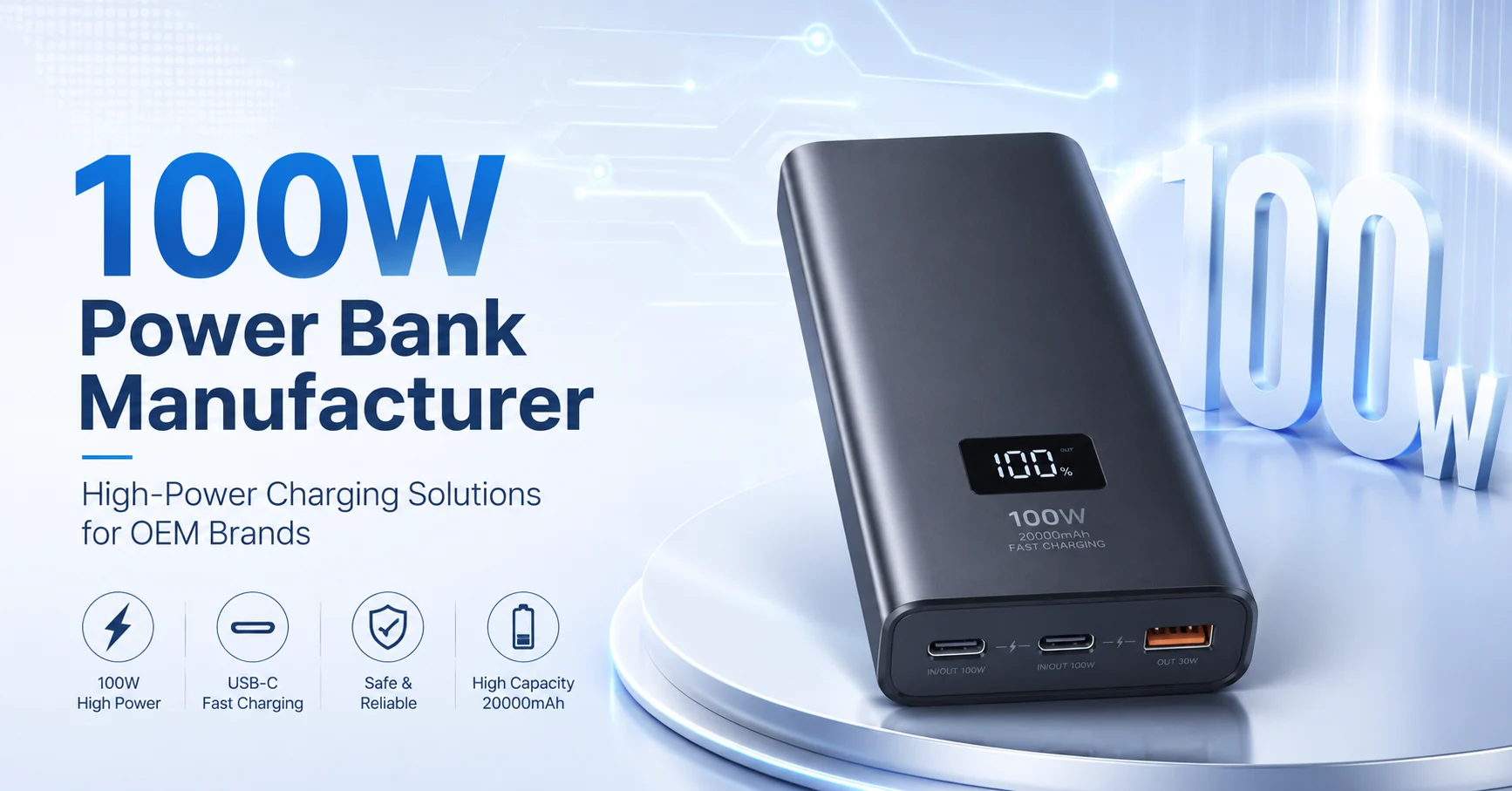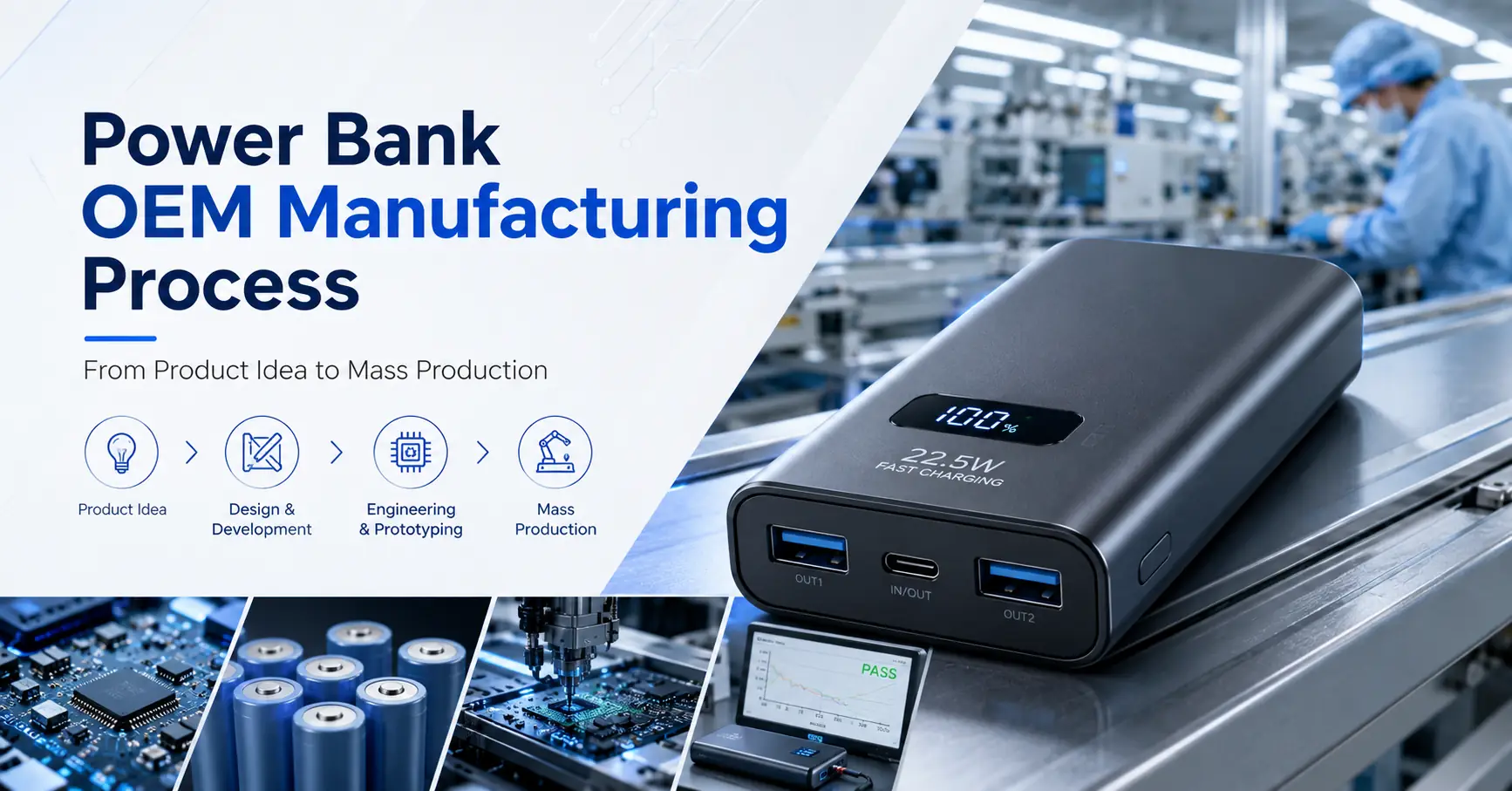

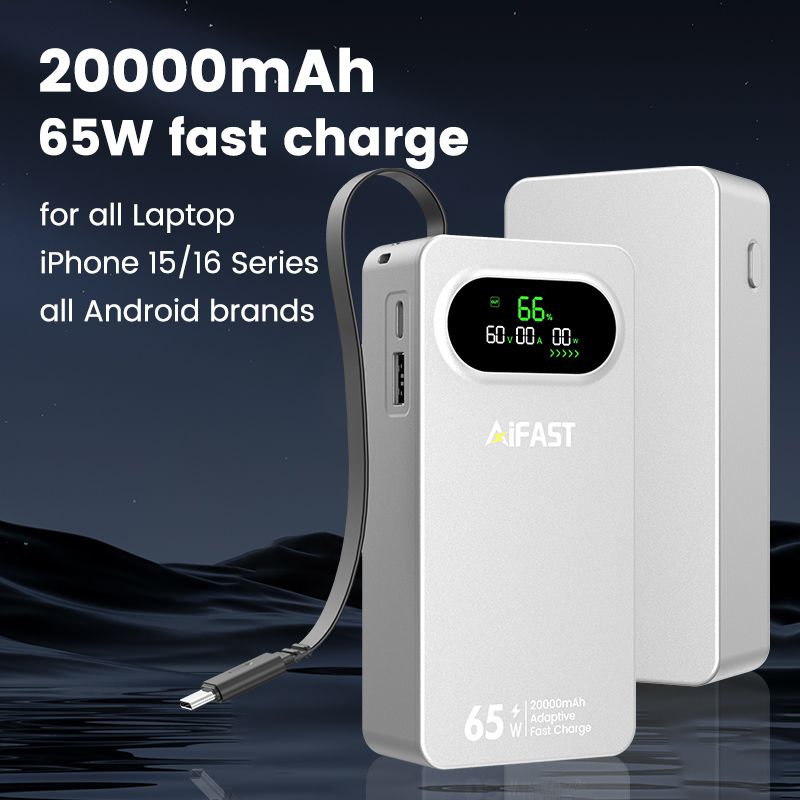
The era of competing solely on raw capacity in the global power bank market is long over. If you are still sourcing low-end, generic products with just four LED indicator lights, you are not only wasting shipping costs—you are also eroding your brand’s long-term value.
Today, the B2B procurement logic in the mid-to-high-end segment has shifted completely: precise LED percentage displays, PD3.0 fast charging at 140W or higher, and underlying chip solutions that ensure full protocol compatibility are now standard requirements.
According to our global cross-border brand supply data, power banks with numeric displays have a conversion rate over 35% higher than traditional models. For OEM/ODM bulk procurement, factory prices for these products typically range from $12 to $48, depending on cell density, the fire-resistance rating of the casing material, and the complexity of the PCB protocol.
This is reality. As a veteran in consumer electronics manufacturing in Dongguan for 15 years, we see more than just a plastic shell—we see a battle between electronic engineering and industrial aesthetics.
From Signal Lights to Numeric Displays: More Than Just an Aesthetic Upgrade

Early Pain Points for Power Bank Users
Early power bank users were most frustrated by those four fuzzy LED lights. When the last light flickered, it was impossible to tell if the remaining charge was 1% or 14%. This “battery anxiety” translates into high return rates and negative feedback in B2B channels.
The Importance of Display Accuracy
Modern LED display power bank factories must ensure display accuracy, which hinges on the choice of coulomb counting solutions. Low-end products estimate capacity via voltage, which is highly unstable. Our numeric display solutions calculate percentages through real-time current integration. Every 1% increment you see is backed by thousands of samples per second from the PCBA main control chip. This precision is exactly why high-end brands can command a premium.
Choosing a High-Quality Factory: Experience and Vertical Integration
Avoid the “Price-Only” Trap
When searching for LED numeric power bank suppliers, many procurement managers fall into the “only look at the price” trap. In electronics manufacturing, there is a rule of thumb: low cost usually means a fragmented supply chain.
Many so-called “factories” are merely assembly lines without in-house mold workshops or core R&D teams. All components—from casings to PCBA boards—are sourced from different markets, making quality control almost a gamble.
The AOVOLT Approach: Full-Chain Vertical Integration
As a Dongguan-based source factory with 15 years of experience, AOVOLT follows a heavy-asset, full-chain vertical integration strategy. Why so “heavy”? Because only this approach can guarantee rapid lead times. Once our industrial designers (ID) finalize a unique exterior, we don’t rely on external sources. From precision mold opening to injection molding, and from metal structure integration to assembly, all processes are completed in-house.
Technical Standards and Procurement Impact
| Technical Dimension | Industry Standard (Tier 2/3) | AOVOLT Flagship Standard (Tier 1) | Procurement Decision Impact |
|---|---|---|---|
| Fast Charging Output | 10W–22.5W | Up to 140W (PD3.0/EPR) | Determines if MacBook Pro or similar devices can be powered |
| Protocol Compatibility | Supports only PD2.0/QC2.0 | Full protocol compatibility (PPS, SCP, AFC, Apple 2.4A) | Determines whether users return products due to fast charging failure |
| Casing Process | Public mold | Custom private mold | Determines whether the brand has market recognition |
| Display Accuracy | Voltage estimation (5%-10% error) | High-precision coulomb counting (<1% error) | Directly affects high-end users’ brand trust |
| Production QC | Spot check (AQL 1.0/2.5) | Fully automated aging + 100% functional inspection | Impacts long-term after-sales costs |
140W and Full Protocol Compatibility: The Invisible Tech Gap
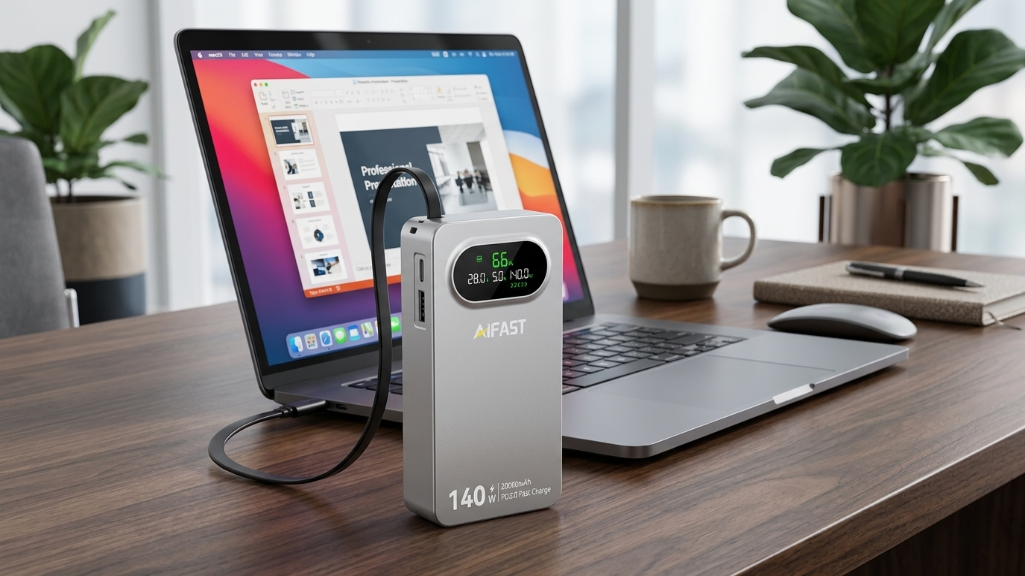
If a discussion on LED display power bank factories ignores 140W high power, the supplier’s tech stack is likely three years behind.
Current market demand is moving toward PD3.1. Developing 140W fast-charging products is not just about increasing output—it’s a thermodynamics and electromagnetic compatibility (EMC) challenge. The biggest challenge is managing the heat generated by high currents in a compact space.
We use multi-layer, high-thermal-conductivity PCBs, synchronous rectification (SR) technology, and high-frequency GaN (gallium nitride) components. To ensure full protocol compatibility, our firmware engineers optimize handshake protocols for nearly a hundred mainstream devices, whether it’s Samsung’s PPS, Huawei’s SCP super-fast charging, or Apple’s 2.4A standard. AOVOLT products complete handshake within milliseconds—a technical moat many small OEMs cannot reach.
Industrial Design Differentiation: Avoiding Public Mold Fatigue
For global cross-border brands, the worst scenario is spending heavily on marketing only to find competitors selling the exact same product with a different logo. This is the cost of relying on public molds.
Some factories in Dongguan still push five-year-old designs. As seasoned professionals, we understand the critical role of differentiation in B2B. Our independent industrial design team scrutinizes product feel, LED screen light transmission, and button feedback to create distinctive, functional aesthetics. Provide you with 5000mAh magnetic power bank factory safe, fast and reliable in 2026.
Custom Power Bank Mold Opening: Creating Visual Ownership

Custom mold design allows clients to own their product’s visual identity. Techniques like dual-color injection molding or metal spray textures can hide the LED display behind a semi-transparent panel, only illuminating when in use. This design ensures products stand out on Amazon or retail shelves.
By combining meticulous industrial design with in-house injection molding and metal integration lines, we reduce concept-to-prototype timelines to 60% of industry averages.
Manufacturing Depth: Automation and Standardized QC
Assembling a power bank seems simple until you must manage temperature rise at 140W and maintain LED accuracy after 500 charge cycles. This becomes a complex system engineering challenge.
At AOVOLT’s Dongguan facility, our automated production lines reduce human error. From SMT assembly, each PCBA mainboard undergoes automated optical inspection (AOI) to eliminate soldering defects.
Aging Test: Core of Quality Control
Ordinary factories may conduct a 2-hour sample test. For our high-end fast-charging series, every unit undergoes a full charge-discharge-charge cycle. This heavy investment in strict quality control reduces long-term B2B after-sales costs significantly.
Supply Chain Efficiency: Achieving Rapid Lead Times
In B2B trade, speed is money. When your brand experiences a surge in orders, supplier replenishment speed directly impacts rankings and profits.
AOVOLT shortens lead times by over 30% compared to competitors through fully in-house metal and injection molding facilities. Once a mold opens, we can run 24/7 production and assembly simultaneously, giving unmatched flexibility for urgent OEM/ODM orders.
Collaboration Models and Typical Lead Times
| Model | Service Depth | Typical Lead Time | Ideal For |
|---|---|---|---|
| Standard OEM (Logo customization) | Ready private mold + logo silk-screen | 7–14 days | Mature sellers testing the market |
| Deep ODM (Scheme customization) | Redeveloped PCBA + LED interaction logic | 30–45 days | Industry leaders pursuing tech advantage |
| Full Development (Private mold) | ID design + structural design + precision mold | 60–75 days | Multinational enterprises building product moats |
Finding the Profit Sweet Spot: From PCBA to Full Customization
Procurement managers often face a choice: expensive branded solutions or low-cost generic options.
Our advice: know your target audience. Professionals like photographers or tech enthusiasts require 140W PD3.1 solutions to power MacBook Pros or mobile workstations. AOVOLT can provide full PCBA solutions—integrating verified, full-protocol-compatible high-power boards into your custom shell, lowering R&D barriers and democratizing high-end design.
Industry FAQs: 5 Key Questions on LED Numeric Power Banks
Q1: Why does the LED display jump inaccurately?
A: Cheap voltage-detection solutions, not high-precision coulomb counters, cause fluctuations. AOVOLT integrates independent coulomb-counting chips, keeping errors under 1%.
Q2: Is overheating at full-load 140W fast charge a safety issue?
A: No. International standards (UL/CE) dictate safe thresholds. Our injection-molded V0 casings with thermal silicone slots and PCBA protection actively regulate power in milliseconds.
Q3: Why does a 20,000mAh numeric power bank cost several times more than others?
A: Differences lie in cell grade (we use A-grade polymer cells), protocol chip licensing (e.g., PD3.1), and conversion efficiency.
Q4: What compliance documents are provided for cross-border B2B?
A: CE, FCC, RoHS, UN38.3, MSDS, and assistance with UL2054 or PSE certification for high-end markets.
Q5: Can small brands do deep private mold customization?
A: Yes. Mold fees are refundable based on order volume. Our goal is brand growth, not just sales.
Conclusion: Mining High-End Blue Oceans in a Red Sea Market
In consumer electronics, mediocrity equals extinction.
As the market shifts from cheap 5V/2A banks to LED numeric display products with real-time energy monitoring, high-power protocols, and minimalist industrial design, brands need a technical partner who delivers results.
From fine-tuning 140W charging efficiency in our lab to precisely controlling raw materials on the shop floor, AOVOLT’s mission remains: make “Made in China” synonymous with global-leading fast-charge energy solutions.
Whether you seek cost-effective OEM manufacturing or an ODM team to transform bold ID designs into mass production, our supply chain depth and heavy-asset vertical integration are your strongest allies in global markets.
Your next “hit” product may already be in our design sketches or PCBA library. In a volatile market, choosing a factory with 15 years of manufacturing heritage may be your most secure investment.
References:
U.S. Consumer Product Safety Commission (CPSC) – Portable Chargers & Batteries