
Why sourcing an iPhone battery supplier is more than a price decision
Choosing an iphone battery supplier is rarely just a matter of finding the lowest unit cost. For repair shops, refurbishers, wholesalers, and private-label sellers, the battery becomes the part that either protects your margin or quietly eats it through returns, complaints, and rework. A phone battery is small, but it carries a lot of risk: customer safety, device reliability, and your reputation at the counter.
That is especially true in the aftermarket. Buyers are often comparing retail-ready replacement batteries, bulk cartons, and OEM-style packaging, while trying to make sense of claims about capacity, safety, and compatibility. Some suppliers are set up for iPhone battery wholesale; others are closer to a general mobile phone battery supplier or smartphone battery supplier. The difference matters. A shop that needs fast-moving service parts has a different buying problem from an e-commerce seller building a branded battery line.
The right supplier should help you do three things at once: keep stock moving, reduce failures in the field, and make installation easy enough that technicians are not fighting the part. That sounds obvious, but in practice the market still contains plenty of batteries with vague labeling, inconsistent packaging, and unclear model coverage. Those are the parts that look fine on the purchase order and become a headache after the sale.
What the available product information suggests
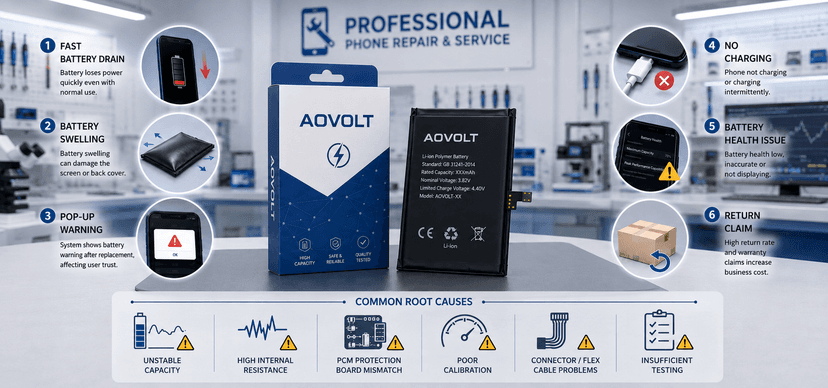
The product data here points to replacement lithium-ion and lithium-ion polymer batteries for consumer electronics, especially phones. The visible battery type is a flexible pouch-style cell, which is common in handheld devices. Printed details mention Li-ion Polymer Battery, a nominal voltage of 3.82V, and a limited charge voltage of 4.40V. The visible packaging also includes retail-style branding, model labeling, barcodes, and carton/tray formats that fit wholesale distribution or private-label fulfillment.
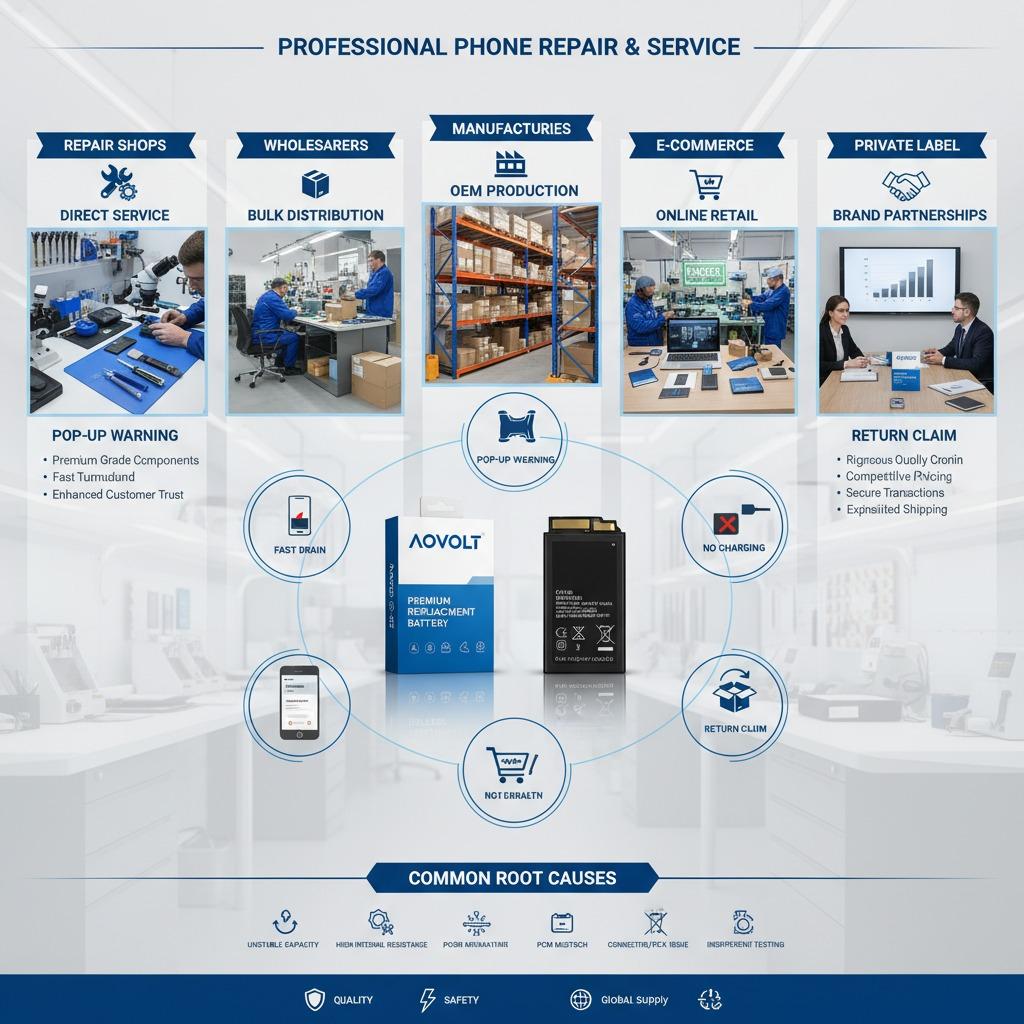
That combination is useful for buyers because it suggests the supplier can serve more than one channel. A repair counter may want plain, functional service parts. A reseller may want an iPhone battery factory that can support branded boxes and clean labeling. A wholesaler may need batch consistency and carton-level packing for faster receiving and storage. The same physical product can travel through very different buying workflows depending on how the supplier handles packaging and order structure.
One caution: the visible marketing language claims things like “high quality cells,” “multiple safety protections,” and “long cycle life,” but those claims are not independently verified by the image alone. Treat them as supplier claims until you see supporting documentation, test summaries, or sample performance in your own application.
Quick comparison: what different buyers usually need
Repair shops
Repair shops usually care about fit, installation speed, and low return risk. They need replacement batteries that arrive with clear labeling and predictable dimensions, not a product that requires guesswork at the bench. If a battery is intended for daily service work, even small inconsistencies can slow technicians down.
Refurbishers
Refurbishers tend to focus on consistency across batches. A phone that passes testing with one batch of parts should behave the same when the next shipment arrives. That is where a stable smartphone battery supplier becomes more valuable than a one-off bargain source. Refurbishment operations also pay attention to packaging and traceability, because mixed stock can be hard to manage.
Wholesalers and distributors
Wholesalers often need broad model coverage, predictable cartons, and the ability to order in volume without worrying that the supplier will change the label format next month. For them, an iPhone replacement battery manufacturer with private-label capability can simplify downstream sales. Clean packaging and organized inserts also matter more than many buyers first expect.
Online sellers and private-label brands
For e-commerce sellers, presentation is part of the product. Retail-ready boxes, model codes, and branded graphics help create a more credible listing. The tradeoff is that packaging must stay aligned with the actual product. Fancy boxes do not compensate for a battery that is hard to install or poorly matched to the device family.
What to look for when evaluating a battery supplier
Start with compatibility coverage. In phone repair, “fits many models” is not a useful promise unless the supplier can show exactly which versions, generations, or service categories are covered. Model ambiguity is one of the easiest ways to create returns. If the supplier uses generic labeling or partially obscured model text, ask for a catalog or compatibility table before placing a larger order.
Next, look at construction and packaging. The available product information shows black pouch-style cells with printed technical text and retail boxes in blue/white or black formats. That tells you the supplier understands both component-level supply and shelf-ready presentation. If you are buying in bulk, trays and cartons matter because they reduce damage in transit and simplify warehouse handling.
Then check how the supplier handles quality communication. You do not need inflated promises. You need practical answers: What battery standard is printed on the pack? What is the nominal voltage? What is the limited charge voltage? Is the capacity stated clearly on the label, and if not, why not? Even when the numbers are not enough to judge performance on their own, they help you compare one source against another.
Finally, ask about order structure and after-sales support. A good battery wholesale partner should be able to support batch orders, replacement claims, and long-term supply cooperation without changing the story every shipment. That sounds simple, but it is often the difference between a usable source and a stressful one.
Common mistakes buyers make with aftermarket phone batteries
The most common mistake is treating all replacement batteries as interchangeable. They are not. Even when the chemistry looks similar, the real-world fit can differ in connector layout, thickness, protection board design, or labeling. A supplier that only sells on broad promises may be fine for one-off purchases and poor for ongoing service work.
Another mistake is focusing only on capacity claims. High-capacity language sells, but it can also distract buyers from more important questions: Does the battery install cleanly? Is the packaging legible? Can your techs identify it quickly? Does the supplier pack it in a way that prevents damage during shipping? In service businesses, the “less exciting” details often save more money than headline claims.
A third issue is ignoring packaging discipline. If your business sells through retail channels, loose labeling creates confusion at the shelf and in the warehouse. If you run a repair operation, mixed or unmarked stock slows technicians and increases the chance of a wrong-part install. Small errors pile up fast in battery work.
Practical buyer advice before you place an order
Ask for sample units before committing to a large run, especially if you are switching suppliers. Inspect the label clarity, connector area, packaging finish, and carton condition. For a pouch-style battery, even modest handling damage can become a problem later, so incoming inspection should be routine rather than optional.
Match the supplier to your business model. A storefront repair shop may want fewer SKUs and quicker replenishment. A distributor may need broader series planning and private-label options. A refurbisher may prioritize consistency and traceability over flashy packaging. If you know which of those you are, you can ask better questions and avoid paying for features you will not use.
Also, keep an eye on documentation. The visible battery markings mention CE and recycling symbols, plus the GB 31241-2014 standard on one example. That is useful context, but it is not a substitute for asking what exactly applies to your order. Buyers should never assume a printed mark covers every shipment, every model, or every destination market.
FAQ for sourcing replacement iPhone batteries
Can one supplier cover both repair-shop and wholesale needs?
Yes, but only if the supplier has enough product breadth and packaging flexibility. Some vendors are strong at service parts; others are stronger at branded bulk supply. The best fit depends on whether you need open-stock batteries, retail boxes, or private-label cartons.
Is an OEM iPhone battery the same as an aftermarket replacement?
Not necessarily. The term OEM is often used loosely in the market, and buyers should be careful. Ask for precise product origin, model compatibility, and packaging details rather than relying on the label alone.
What matters more: capacity or consistency?
For most commercial buyers, consistency matters first. A battery with a good headline number but uneven performance creates more problems than a slightly less ambitious product that arrives stable and installable across batches.
A sensible next step
If you are sourcing from an iphone battery factory or evaluating a new supplier, start with the basics: model coverage, packaging format, label clarity, and order stability. Then compare the parts in your own workflow, not just on paper. A battery is only as good as the experience it creates for the technician and the end customer.
For buyers building a service-parts program, the best supplier is usually the one that makes the line simpler: fewer surprises, cleaner cartons, and clearer communication when you need a repeat order. That is not glamorous, but it is what keeps a repair or resale business running without constant interruptions.