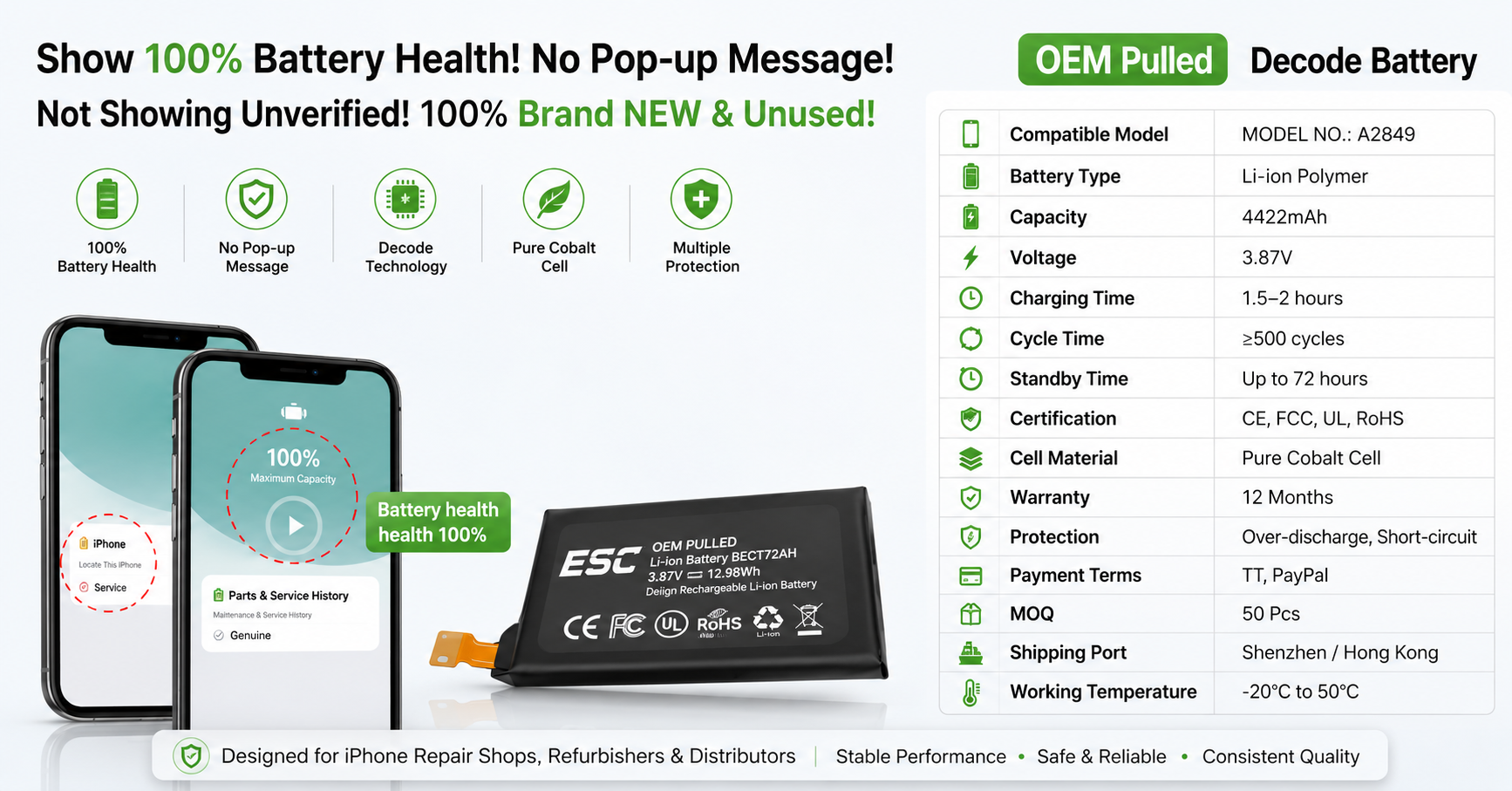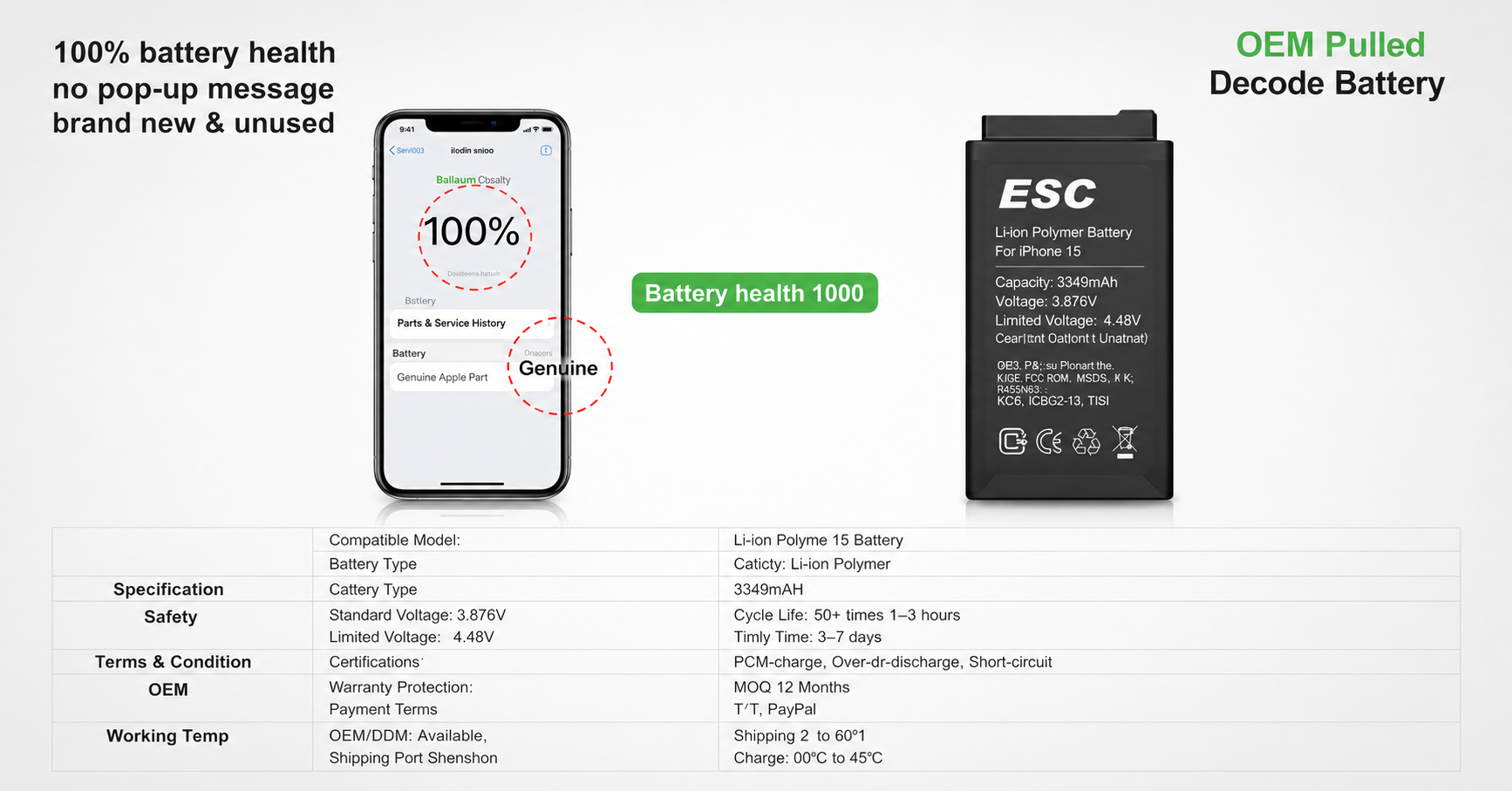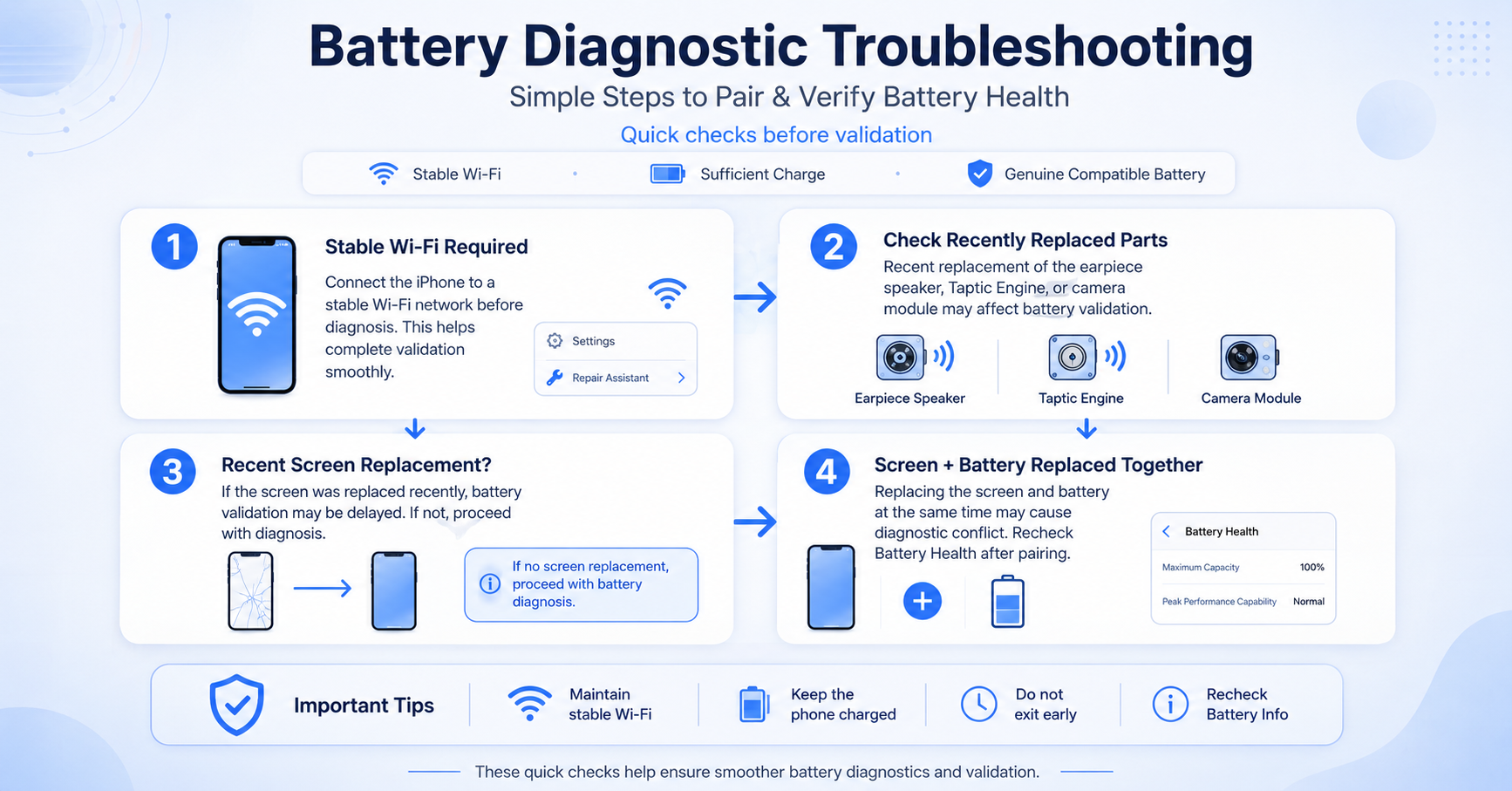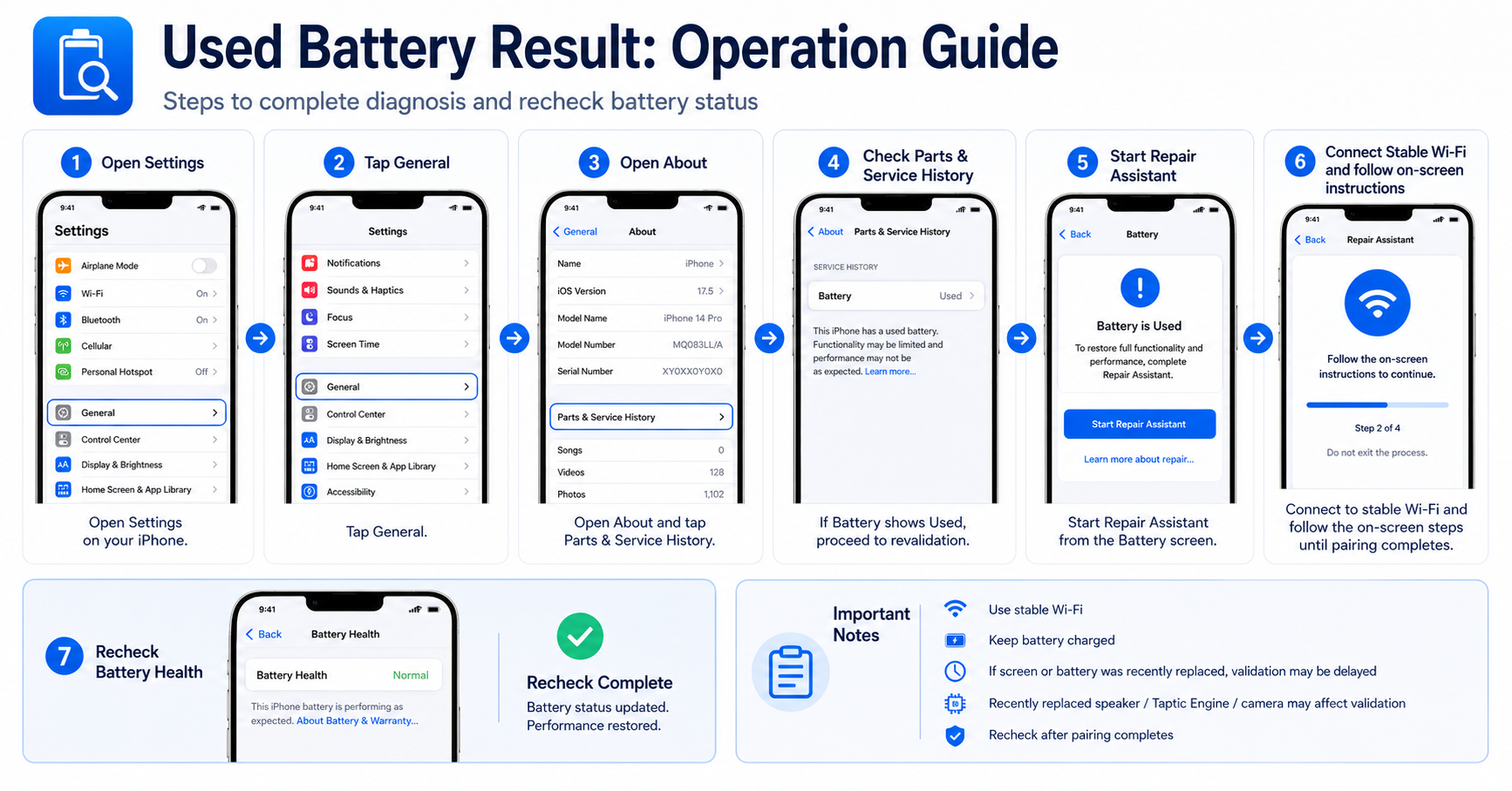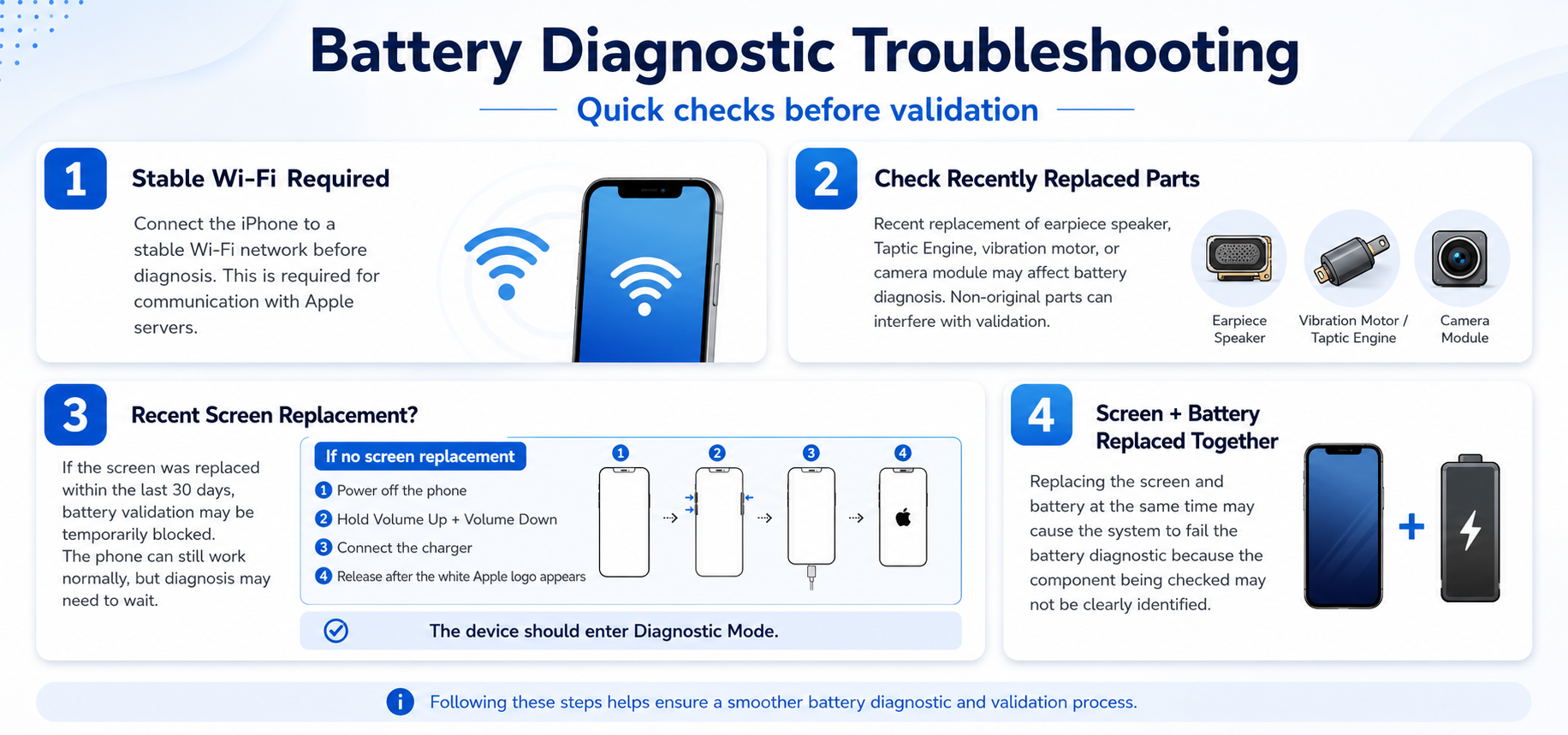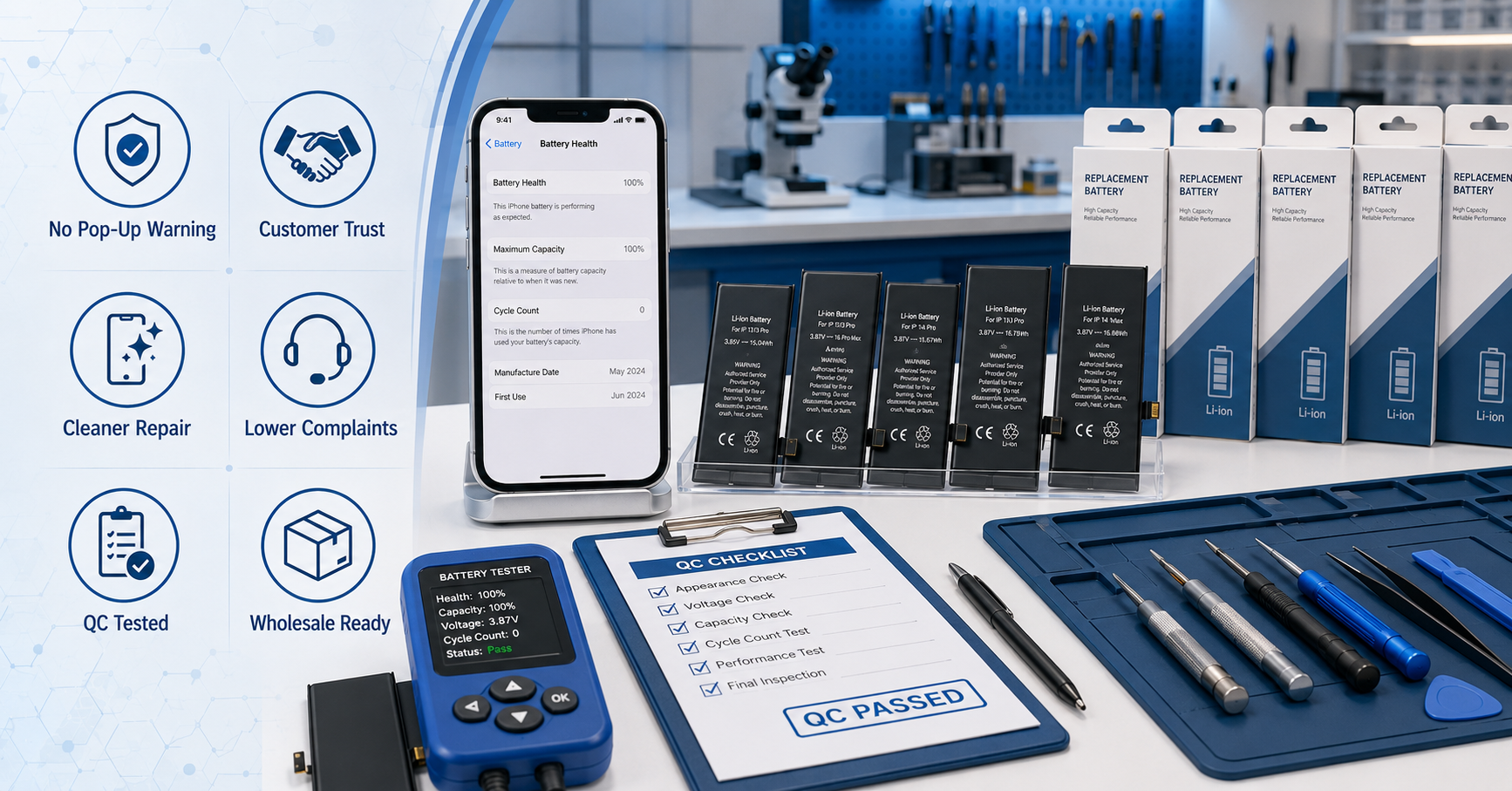

An iPhone battery pop-up warning solution is becoming important for repair shops, wholesalers, repair chains, refurbished phone suppliers, e-commerce sellers and private label battery brands because the iPhone repair experience is no longer judged only by whether the phone powers on. After battery replacement, customers may check Battery Health, Parts and Service History, warning messages and battery performance immediately. If the phone shows an Unknown Part message, Battery Health issue or battery service notification, the repair may be questioned even when the battery can charge and discharge normally.
Product Pain Points: Why a Battery Warning Message Can Break Customer Trust
For repair shops, the pop-up warning is not only a technical message.
It is a customer confidence problem.
The customer sees a warning after replacement and starts asking uncomfortable questions.
Is this battery fake?
Is the phone unsafe?
Did the technician install it incorrectly?
Will the phone lose value?
Will the battery drain fast?
Should I ask for a refund?
For wholesalers, these questions become repeated complaints from downstream repair stores.
For refurbished phone suppliers, warning messages affect resale confidence.
For e-commerce sellers, unclear repair expectations become return requests and negative reviews.
For private label brands, the warning message damages the trust of the battery line because the customer remembers the brand printed on the packaging.
The most common business pain points include Unknown Part notifications, Battery Health not showing, customer doubt, longer repair explanation time, higher return risk, weaker premium service positioning and unclear model support.
This is why buyers searching for an iPhone battery pop-up warning solution are not simply looking for a battery.
They are looking for a repair result that is easier to explain, easier to sell and easier to repeat.

Working Principle: What Causes iPhone Battery Pop-Up Warnings After Replacement
An iPhone replacement battery is not only a lithium-ion cell.
It is a battery system involving cell performance, PCM protection, flex cable connection, battery data communication, iPhone model support, iOS recognition behavior and repair process.
The lithium-ion cell provides energy.
The PCM board helps manage protection behavior.
The flex cable and connector provide the physical and electrical connection.
The battery data path affects what the iPhone can read after replacement.
The iPhone system then displays battery-related information based on device model, software version, battery status and repair condition.
For newer iPhone models, battery replacement can trigger customer-facing information in Settings.
This may include Parts and Service History, Unknown Part status, Used message, Battery Health display changes or battery service notifications.
The important point for B2B buyers is this:
A pop-up warning is not always the same as a bad battery.
It may be caused by part verification behavior, model compatibility, repair process, data transfer method, original board handling, connector issue, iOS behavior or a battery solution that does not support the expected display result.
So a professional supplier must explain what each model can support, what repair method is needed and what the customer should expect after replacement.
Comparison: Standard iPhone Battery vs Pop-Up Warning-Aware Solution
A standard iPhone replacement battery is mainly designed to restore basic power function.
It should fit the phone, charge normally, discharge stably and support daily use.
For older models or price-sensitive repair markets, this may be enough.
An iPhone battery pop-up warning solution is designed for repair businesses that care about the customer-facing result after replacement.
Its value is not only in power supply.
Its value is in reducing repair uncertainty.
A standard battery competes mainly on price, model availability and basic performance.
A warning-aware solution competes on repair confidence, customer communication, premium positioning and lower complaint pressure.
For repair shops, it helps reduce long explanations after service.
For wholesalers, it creates a higher-value battery category for professional repair customers.
For refurbished phone suppliers, it helps improve resale communication.
For e-commerce sellers, it supports product differentiation, but only if compatibility and repair requirements are described accurately.
For private label brands, it helps build a more professional iPhone battery product series.
But buyers must stay realistic.
A warning-aware battery solution does not mean one universal battery can remove every message on every model under every repair condition.
Supported models, repair process, iOS behavior, Battery Health display, original board handling and sample testing all matter.
Solution: How to Evaluate an iPhone Battery Pop-Up Warning Solution
Check 1: Confirm Supported iPhone Models
Different iPhone generations behave differently after battery replacement.
Before buying in bulk, buyers should confirm which models are supported.
For example, the supplier should clearly explain support by model series such as iPhone X series, iPhone 11 series, iPhone 12 series, iPhone 13 series, iPhone 14 series, iPhone 15 series and newer models where applicable.
A serious supplier should not say “all models are supported” without details.
That is lazy.
And in battery sourcing, lazy explanations usually become expensive after-sales problems.
Check 2: Clarify the Expected Repair Result
Buyers should ask what exactly the solution can do.
Does it reduce pop-up warning pressure?
Does it support Battery Health display?
Does it require original battery board transfer?
Does it require a programmer?
Does it require tag-on flex?
Does it behave differently after restart?
What happens after iOS update?
What should the repair shop tell the customer before service?
If a supplier cannot answer these questions clearly, the buyer is not buying a solution.
They are buying uncertainty.
Check 3: Separate Battery Quality From Display Behavior
A battery may show good Battery Health behavior but still perform poorly if the cell quality is weak.
A battery may also power the phone normally but still show a warning message depending on repair condition.
These two issues must be separated.
Professional buyers should evaluate both electrical performance and display behavior.
Electrical performance includes real capacity, internal resistance, voltage consistency, discharge curve, heat behavior and cycle stability.
Display behavior includes Battery Health information, warning messages, Parts and Service History, customer-facing repair status and model-specific support.
A real B2B solution must control both sides.
Check 4: Verify Cell Quality and Internal Resistance
No warning-message solution can save a bad cell.
If the battery drains fast, heats abnormally or shuts down under load, customers will complain anyway.
Buyers should check rated capacity, typical capacity, voltage, watt-hours, internal resistance and discharge behavior.
Internal resistance is especially important because it affects voltage drop, heating and peak power delivery.
A battery with unstable internal resistance may create fast-drain or shutdown complaints even if the warning message is controlled.
Check 5: Check PCM Protection and Safety Design
The PCM board remains critical.
Buyers should confirm protection functions such as overcharge protection, over-discharge protection, over-current protection and short-circuit protection.
Poor PCM matching can cause no charging, overheating, unstable percentage, sudden shutdown or warranty claims.
A professional iPhone replacement battery should not focus only on warning messages and forget basic battery safety.
That would be stupid.
The pop-up warning is visible.
But poor protection is more dangerous.
Check 6: Test Installation Fit and Repair Process
A warning-aware battery solution still needs correct installation.
Buyers should check thickness, length, width, flex cable direction, connector alignment, adhesive area, edge sealing and cable flexibility.
Repair process must also be clear.
Some solutions may require board transfer, programming, welding, special flex, specific tools or technician training.
If the repair process is too complicated for the buyer’s customer base, the solution may create more problems than it solves.
Check 7: Test Samples Before Bulk Orders
Sample testing should happen before bulk purchasing.
Useful checks include open-circuit voltage, internal resistance, capacity, charge-discharge behavior, installation fit, Battery Health behavior, warning-message behavior, restart behavior, heat observation and standby drain.
One sample is not enough.
Wholesalers and repair chains should test multiple samples from the same batch and across several real devices.
A good sample proves possibility.
A stable batch proves supplier capability.
Shenzhen ESC Solution: iPhone Battery Pop-Up Warning Support for B2B Buyers
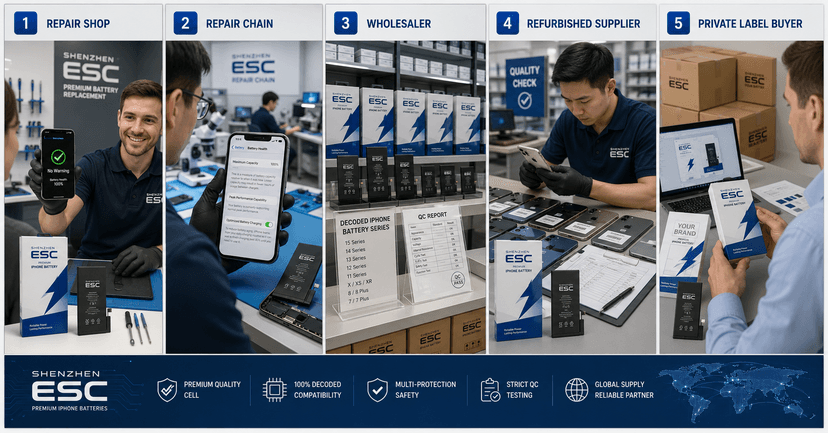
Shenzhen ESC supports repair shops, wholesalers, repair chains, refurbished phone suppliers, e-commerce sellers and private label brands with iPhone replacement battery solutions.
For buyers looking for an iPhone battery pop-up warning solution, Shenzhen ESC can support product discussions around standard iPhone batteries, high capacity iPhone batteries, Battery Health display options, decoded battery solutions, no pop-up warning options, sample testing and OEM packaging.
Shenzhen ESC focuses on practical B2B requirements: model support, realistic capacity, internal resistance control, PCM protection, installation fit, Battery Health behavior, packaging customization and after-sales analysis.
The goal is not to overpromise.
The goal is to help buyers understand which solution fits which model, which repair process is required and what result can be reasonably expected after replacement.
Core Advantages: Why This Solution Is Mission-Critical for Repair Businesses
The first advantage is customer confidence.
When the repair result is easier to explain, customers are less likely to doubt the service.
The second advantage is lower communication pressure.
Technicians spend less time defending the repair and more time completing real work.
The third advantage is premium service positioning.
Repair shops can offer standard batteries for price-sensitive customers and warning-aware solutions for customers who care about post-repair display behavior.
The fourth advantage is stronger wholesale differentiation.
Wholesalers can stop competing only on low price and build a technical product category for professional repair stores.
The fifth advantage is private label value.
A private label brand with Battery Health display or decoded options has a stronger technical story than generic low-price batteries.
The sixth advantage is better after-sales analysis.
When the supplier understands model support, battery data behavior, PCM protection and repair process, complaints can be analyzed more accurately.
Application Scenarios: Where iPhone Battery Pop-Up Warning Solutions Create Value
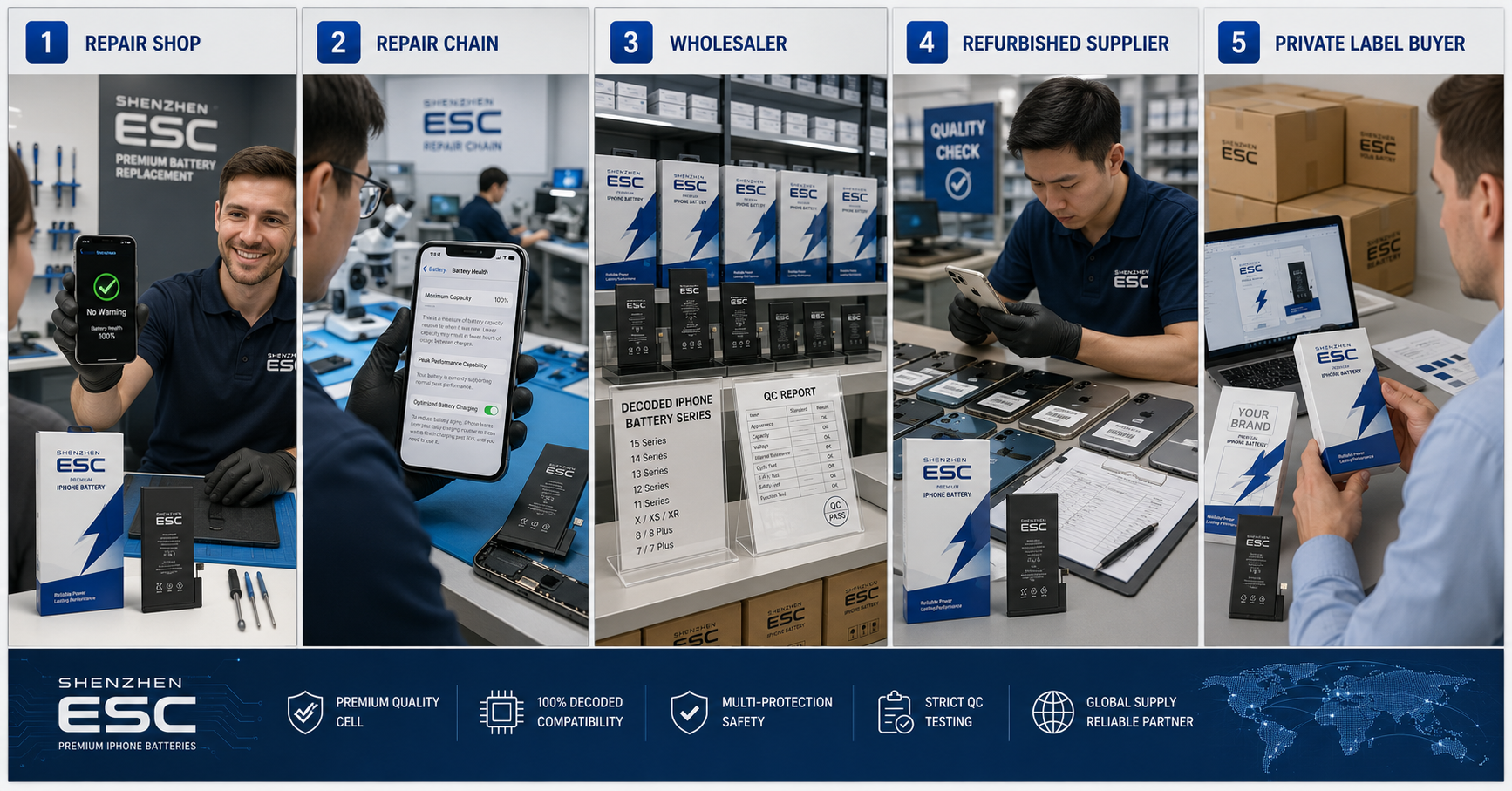
Repair shops use warning-aware iPhone batteries for customers who care about Battery Health, unknown part messages and visible repair results.
Repair chains use them to standardize repair communication across multiple stores.
Wholesalers use them to build a premium battery line for professional repair customers.
Refurbished phone suppliers use selected solutions to improve resale confidence and reduce buyer hesitation.
E-commerce sellers use them in advanced repair kits, but compatibility and repair requirements must be stated clearly.
Private label brands use them to build a more professional iPhone replacement battery product line.
Selection Advice: How Different Buyers Should Choose
Repair shops should choose based on customer expectation.
If customers only care about basic replacement and low cost, standard batteries may be enough.
If customers care about Battery Health display and warning messages, a warning-aware solution should be offered as a premium option.
Wholesalers should separate standard, high-capacity, Battery Health display and decoded series clearly.
Do not mix product positioning.
That creates confusion.
Repair chains should test supported models and create technician SOP before using the solution across stores.
Refurbished phone suppliers should test real devices and confirm how the battery behaves after reset, update and final QC.
E-commerce sellers should avoid exaggerated claims.
Do not promise universal no-warning results unless the solution and model support are clearly confirmed.
Private label buyers should combine the solution with packaging, warranty language, model labels and after-sales documentation.
FAQ
What is an iPhone battery pop-up warning solution?
An iPhone battery pop-up warning solution is a replacement battery approach designed for selected iPhone repair scenarios where buyers want to reduce customer-facing warning-message pressure and improve post-repair confidence.
Why does an iPhone show a battery warning after replacement?
An iPhone may show a battery warning because the part cannot be verified, the repair process is incomplete, the battery was used before, the part does not function as expected, or the device recognizes replacement information through Parts and Service History.
Does a pop-up warning mean the battery is defective?
Not always.
A warning may appear even when the battery can charge and power the phone.
However, the message can still affect customer confidence, resale value and repair-shop communication.
Can a no pop-up iPhone battery remove all warnings?
Not universally.
Warning behavior depends on iPhone model, iOS version, battery solution, repair process, original board handling and installation quality.
Buyers should test samples before bulk orders.
What is the difference between decoded iPhone battery and Battery Health display battery?
A Battery Health display battery focuses on showing battery information where applicable.
A decoded iPhone battery may focus more broadly on recognition-related repair behavior.
The exact support depends on model and supplier solution.
What should wholesalers test before buying this solution?
Wholesalers should test supported models, Battery Health behavior, warning-message behavior, voltage, internal resistance, capacity, installation fit, restart behavior and batch consistency.
Can Shenzhen ESC support OEM packaging for this product line?
Yes.
Shenzhen ESC can support battery labels, retail boxes, barcode labels, model stickers, warranty cards, user manuals, carton marks and private label packaging.
Who should buy iPhone battery pop-up warning solutions?
This solution is suitable for repair shops, repair chains, wholesalers, refurbished phone suppliers, e-commerce repair-kit sellers and private label iPhone battery brands that serve customers who care about the visible repair result.
Conclusion
Choosing an iPhone battery pop-up warning solution is not just about removing a message.
It is about controlling customer confidence, repair communication, product positioning, Battery Health behavior, model support, battery quality, installation process and after-sales risk.
Professional B2B buyers should evaluate supported models, expected repair result, real capacity, internal resistance, PCM protection, installation fit, sample testing and supplier explanation before bulk purchasing.
Shenzhen ESC supports repair shops, wholesalers, repair chains, refurbished phone suppliers, e-commerce sellers and private label brands with iPhone replacement battery solutions, including Battery Health display options, decoded battery solutions, no pop-up warning options, OEM packaging and sample testing support.
Contact Shenzhen ESC to request iPhone battery pop-up warning solution details, supported models, samples, packaging options and wholesale pricing for your repair or distribution business.