
The Growing Popularity of Magnetic Charging
The MagSafe power bank has become one of the most convenient accessories for modern iPhone users.
It snaps perfectly onto the device, charges wirelessly, and fits easily into a pocket. But behind this simplicity lies a wide gap in quality among products in the market.
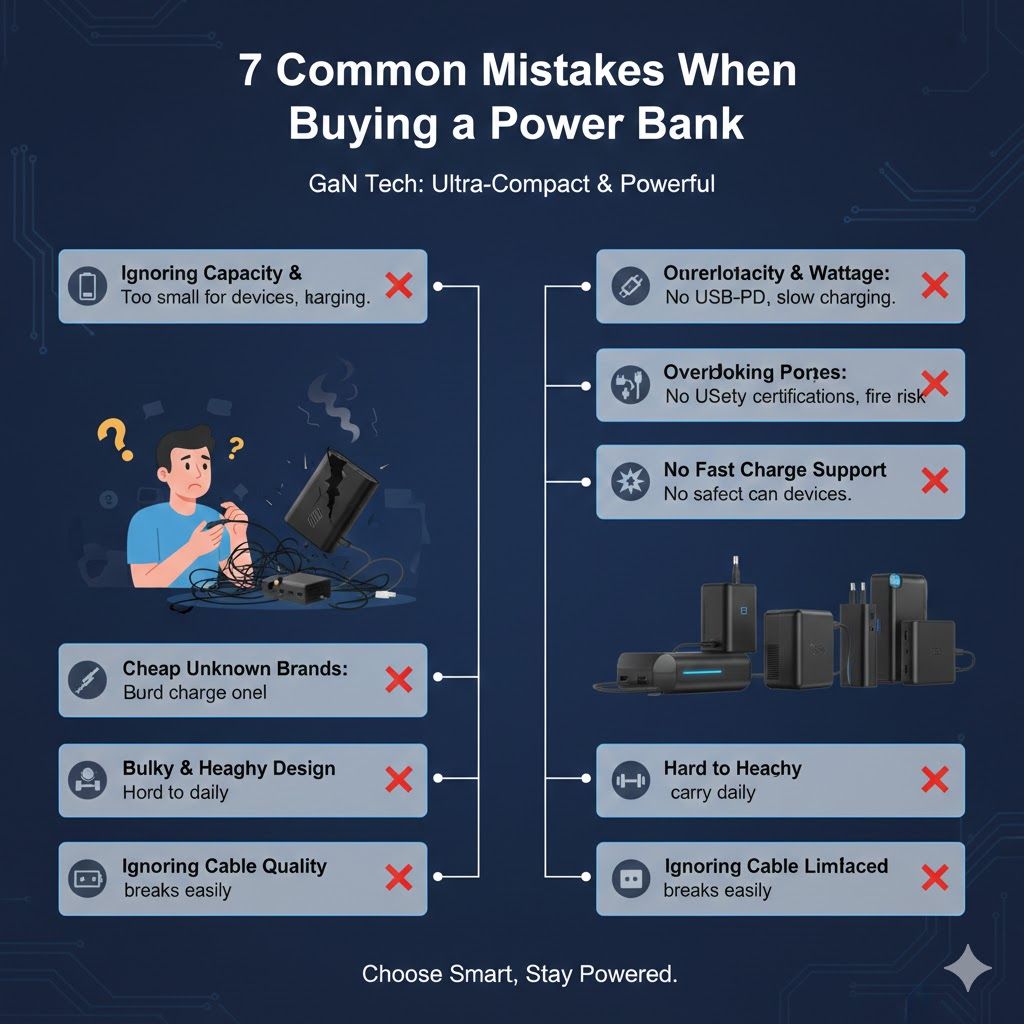
Not all MagSafe chargers are created equal. Many buyers—both individual consumers and OEM purchasers—overlook critical factors such as certification, capacity accuracy, and heat control. The result? Slow charging, overheating, or even device damage.
This guide outlines seven common mistakes you should avoid to make sure your next MagSafe power bank is truly worth it.
1. Ignoring MagSafe Certification and Qi Compliance
Why Certification Matters
A genuine MagSafe power bank must comply with Qi 2.0 wireless charging standards and Apple’s MFi (Made for iPhone) certification.
Uncertified units often use unstable magnetic alignment and non-compliant coils, causing intermittent charging or excessive heat.
What to Check:
-
“Qi Certified” logo on packaging
-
MFi authorization code from Apple
-
Compliance documents: CE, FCC, RoHS
Tip: Always ask your supplier for the certification report and UN38.3 battery transport certificate—a must for international logistics.
2. Choosing Capacity Over Efficiency
The Efficiency Trap
Many assume that a higher mAh rating automatically means better performance. But not all capacity labels are accurate.
Some budget models advertise 10 000 mAh while actually using low-grade 6 000 mAh cells.
How to Verify:
-
Ask for rated vs. actual output capacity (mAh × efficiency %)
-
Prefer suppliers using Grade-A lithium-polymer cells
-
Typical effective output: 6 500–8 000 mAh for a 10 000 mAh pack
A smaller, high-efficiency MagSafe power bank can outperform a larger, poorly built one by delivering stable current and longer lifespan.
3. Overlooking Heat Management
Heat Is the Silent Battery Killer
Magnetic charging generates more heat than wired methods. Without proper thermal design, chargers can reach 55 °C or higher, damaging both charger and phone.
High-quality models use:
-
Graphene cooling layers to disperse heat evenly
-
Aluminum alloy shells for quick dissipation
-
Smart IC temperature sensors that cut off power above 45 °C
According to Battery University, keeping battery temperatures below 45 °C can extend cycle life by up to 35 %—a critical factor for long-term reliability.
4. Ignoring Magnetic Alignment Strength
The Snap-and-Stay Factor
A weak magnetic ring causes misalignment, slower charging, or even accidental disconnection during movement.
Premium MagSafe power banks use N52-grade magnets that deliver precise, stable attachment.
What to Look For:
-
“15 N holding force” or higher in technical specs
-
Centered coil alignment tolerance ≤ 1 mm
-
Protective silicone pad to prevent scratches
If the magnet feels loose or slips easily, it’s not a true MagSafe product—it’s just a wireless charger with a magnet added.
5. Forgetting About Compatibility and Case Thickness
Check Before You Charge
Not all MagSafe-style chargers are universally compatible. Some fail when used through thicker cases or with non-iPhone devices.
Best Practice:
-
Support Qi 2.0 / PD 3.1 standards for Android and Apple devices alike
-
Confirm charging through cases ≤ 6 mm thick
-
Avoid metal or magnetic card holders that interfere with alignment
Choosing a dual-protocol (Qi + PD) MagSafe power bank ensures you can charge not only iPhones but also AirPods, Pixel Phones, and Galaxy devices safely.
6. Ignoring Build Quality and Material Design
Durability Defines Value
A MagSafe power bank is handled daily, often in transit or in pockets. Material quality directly impacts both aesthetics and safety.
Premium construction includes:
| Component | Recommended Material | Function |
|---|---|---|
| Shell | Aluminum alloy + PC blend | Heat resistance, durability |
| Surface | Soft-touch silicone | Prevents slipping & scratching |
| Coil Area | Reinforced copper core | Stable magnetic field |
| Finish | Anodized or UV coating | Long-lasting surface protection |
When in doubt, request a drop-test report (1.2 m standard) or burn-in test data from your supplier.
7. Failing to Verify OEM and Safety Credentials
The Supplier Factor
For brands and distributors, the supplier defines long-term reputation. A low-cost producer may cut corners on batteries, PCB design, or QC testing.
Before placing an order, verify:
-
In-house SMT and assembly capacity
-
Certification records (UL, CE, Qi 2.0, UN38.3)
-
QC process: capacity test → aging test → FOD test
-
Warranty and after-sales policy
A trusted manufacturer like ESCCharge provides transparent test data, customizable molds, and packaging tailored for retail or corporate gifting markets.
How to Choose Wisely
Checklist for Safe and Reliable Purchase
-
Verify Qi 2.0 / MFi certification.
-
Choose efficiency ( > 90 % ) over raw capacity.
-
Ensure heat control ≤ 45 °C.
-
Confirm magnetic force ≥ 15 N.
-
Test compatibility with phone case ≤ 6 mm.
-
Inspect material finish and durability.
-
Source only from certified OEM suppliers.
These seven points help you distinguish a genuine MagSafe power bank from a cheap imitation—saving both money and device health.
Buy Smart, Charge Safer
The MagSafe power bank represents the future of wireless mobility—but only when engineered correctly.
By avoiding these common mistakes, you ensure your device stays safe, efficient, and travel-ready for years.
To explore certified MagSafe power banks and OEM customization options, visit
ESCCharge Official Website
and discover portable charging solutions built for professionals, travelers, and global distributors.