
In cross-border electronics trade in 2026, sourcing power banks is no longer a simple comparison of capacity. When your brand searches for a Safety integrated circuit power bank supplier, there is only one real bottom-line requirement: preservation of brand equity under a zero-incident rate.
Let’s state the industry truth directly—A truly qualified magnetic power bank with industrial-grade safety integrated circuit (IC) protection has its B2B wholesale pricing logic tightly controlled by the tiered cost of high energy-density Li-polymer cells and high-performance multi-protection circuit systems (BMS).
If your supplier attempts to lure you with pricing below standard Bill of Materials (BOM) cost, what they sacrifice is inevitable: fewer NTC temperature sensors or reduced hardware redundancy responsible for overcharge and short circuit protection.
As a professional team with 15 years of manufacturing experience in Dongguan, our core solution is to embed safety logic into the hardware layer. Through a fully closed-loop production system (vertical supply chain manufacturing), we achieve consistent quality control from PCBA assembly to final metal integration. Procurement is not about buying specifications—it is about buying insurance against recall risks.
Safety Anatomy: How Integrated Circuits Protect Your Brand Reputation
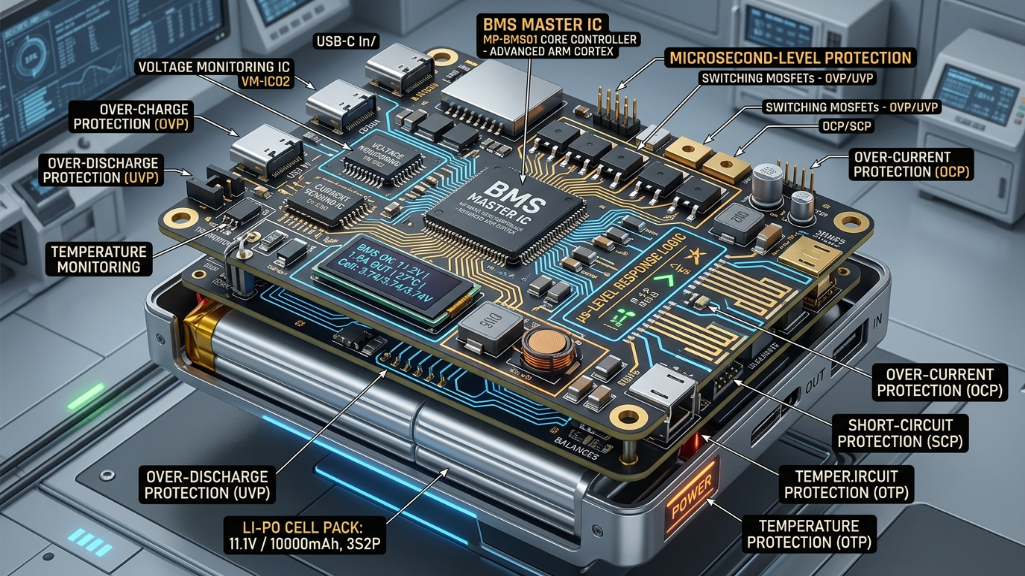
Beyond Basic Charging: The Core Role of Advanced BMS in Power Banks
Many junior procurement managers mistakenly believe a power bank is simply a battery inside a casing. In reality, an advanced multi-protection circuit design (BMS) is the “brain” of the product.
It monitors micro-level fluctuations in voltage, current, and impedance in microseconds. When a device initiates a handshake, the IC must instantly determine the real-time discharge capability of the cell and forcibly shut down the circuit at the first sign of overvoltage (OVP) or overcurrent (OCP) risk.
Thermal Runaway Management: The Technological Frontline of Smart Temperature Sensors
Heat is the natural enemy of all lithium battery products.
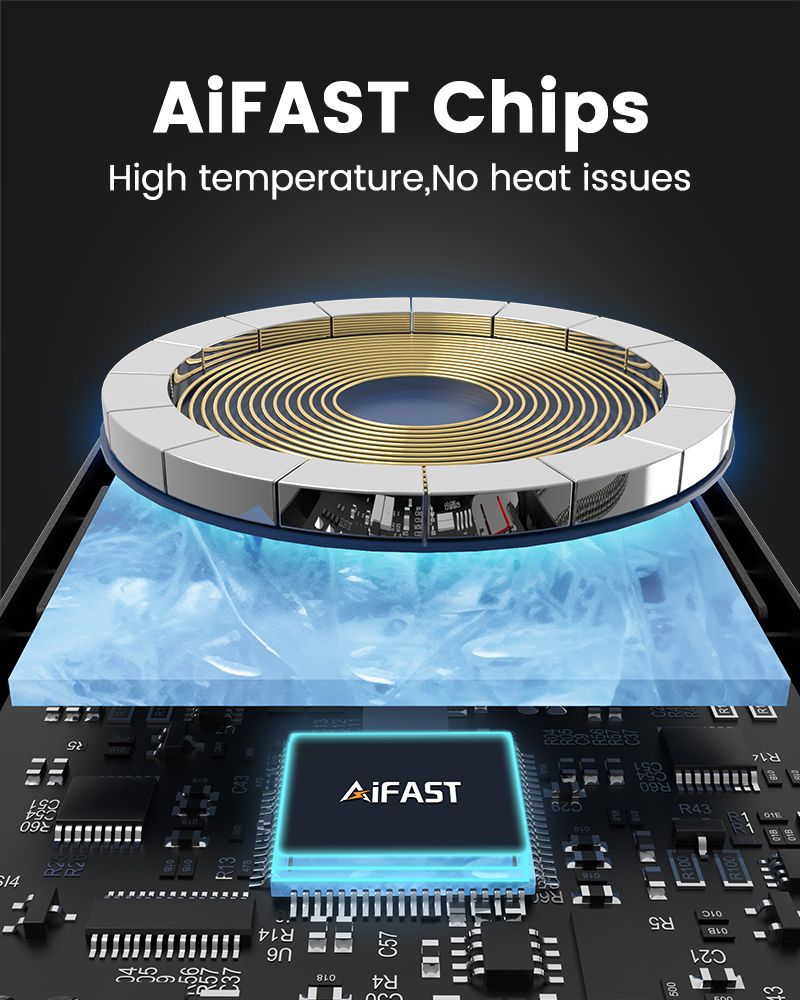
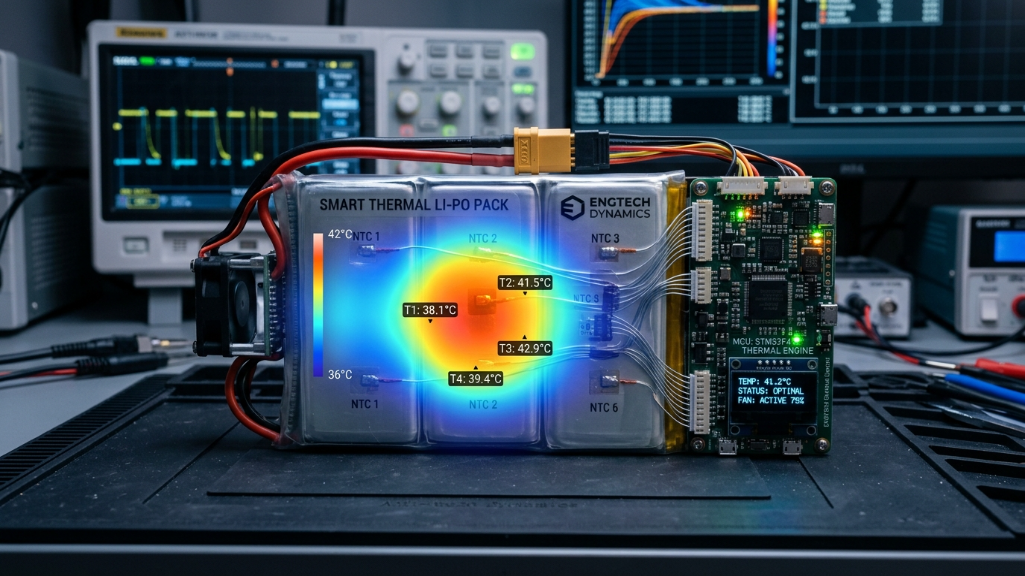
During high-density charging, internal chemical reactions inevitably generate heat accumulation. The core of smart temperature control technology is not “cutting off power after overheating,” but proactive power prediction through high-frequency sampling thermistors (NTC).
If the system detects an abnormal temperature rise curve, the IC should proactively reduce output power—rather than waiting until the casing becomes hot and then taking extreme measures.
Technical Comparison: Cheap Solutions vs Industrial-Grade Safety Design
| Technical Dimension | Generic Low-End Solution | Industrial IC Integrated Solution | B2B Procurement Risk Insight |
|---|---|---|---|
| Cell Specification | Recycled or Grade B Li-polymer | Brand-new Grade A Li-polymer | Impacts lifecycle and swelling risk |
| Protection Board Layers | Single-layer PCBA, simplified components | Multi-layer high-efficiency PCBA with independent IC monitoring | Determines response speed under extreme conditions |
| Temperature Control | No sensor or single-point detection | Multi-point NTC real-time monitoring (Smart Control) | Key defense against thermal runaway |
| Conversion Efficiency | <75% (high heat generation) | 85%–92% (high-efficiency IC) | Higher efficiency reduces battery stress |
| Certification Support | None or fake certificates | UL 2054 / IEC 62133 / CE / FCC | Directly affects global market access |
4 Hard Standards for Selecting a Reliable Safety Power Bank Supplier
Premium Cell Traceability: The Battle Between Grade A Cells and Low-Cost Traps
In the power bank industry, Li-polymer battery safety standards are absolute red lines.
We strictly adhere to Grade A cell procurement. Compared to low-cost workshops using recycled cells, premium cells have fundamental advantages in energy density and internal resistance control.
Lower internal resistance means less heat generation under full load—providing more safety margin for the integrated circuit system.
Hardware-Level Defense: Overvoltage, Overcurrent, and Short Circuit Protection
True safety must be guaranteed by hardware-level circuits, not just software algorithms.
Software can crash—but physical fuses and hardware comparators do not fail.
A qualified OEM magnetic power bank supplier must integrate independent hardware circuit breakers at the PCB design stage.
Technical Accumulation: 15 Years of Engineering to Eliminate Protocol Conflicts
Here’s a real insight from AOVOLT’s R&D frontline.
When developing 140W high-power multi-protocol products, the biggest challenge was not increasing power—but maintaining electrical stability during complex multi-device handshakes.
Integrating PD3.0, PPS, QC3.0, and FCP protocols in a compact space can easily cause IC logic conflicts, leading to voltage surges that damage end devices.
Our team has developed a proprietary “timing handshake algorithm” over 15 years. By optimizing low-level drivers within PCBA hardware integrated solutions, we ensure stable and orderly energy delivery—even under extreme voltage fluctuations—while maintaining backward compatibility with Apple 2.4A and AFC.
This level of protocol engineering is beyond the capability of assembly-only factories.
Strategic Advantages of Vertical Integrated Manufacturing
Why In-House Mold Development Prevents Internal Component Stress
In today’s pursuit of ultra-thin and high power density designs, internal layout tolerances are precise to 0.1mm.
Suppliers relying on generic enclosures often compress internal components to fit PCBA and batteries—creating hidden mechanical stress.
This pressure is a ticking time bomb for separator rupture and short circuits.
Through in-house mold opening, we design enclosures tailored to each battery and IC layout, ensuring proper spacing, heat dissipation, and shock resistance.
From PCBA to Injection Molding: A Closed-Loop Quality Control Ecosystem
Our advantage lies in full vertical integration in Dongguan.
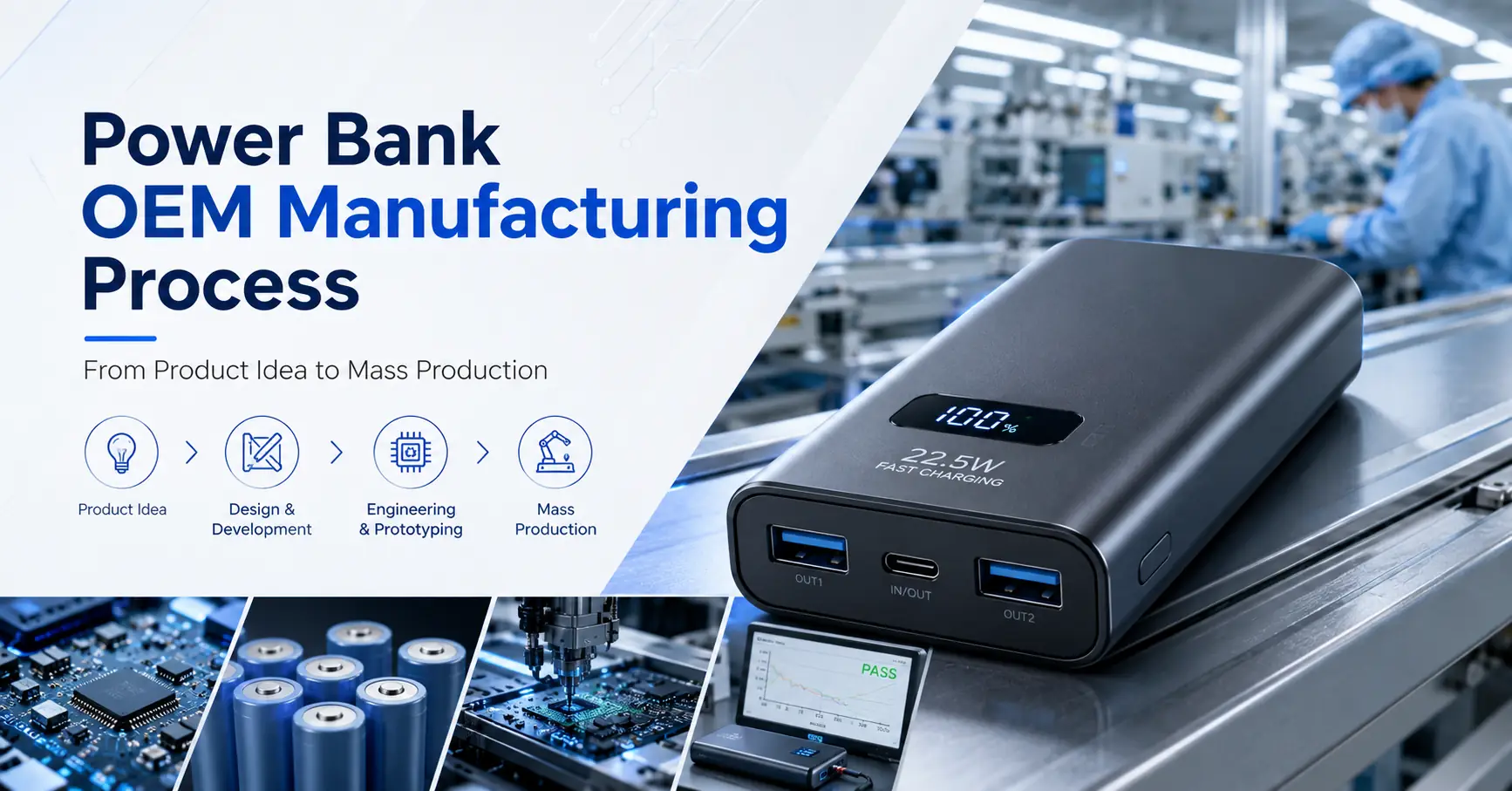
From ID design → mold development → injection molding → final assembly, we control every step.
We directly manage flame-retardant material selection and ensure product integrity under 100% burn-in testing.
This ecosystem guarantees fast delivery and extremely low defect rates for OEM/ODM orders.
Beyond Appearance: Testing the Invisible Details of Quality Control
Automated Test Equipment (ATE): 100% IC Calibration
Manual sampling is outdated.
Every PCBA must pass Automated Test Equipment (ATE) validation, including dynamic calibration of IC protection thresholds.
A 5% deviation in overcurrent protection at 140W can lead to inductor saturation or thermal breakdown.
We simulate extreme scenarios using high-precision electronic loads to ensure millisecond-level response accuracy. Provide you with LED mobile power supply guide 2026: high-speed 140W fast charging B2B.
Global Compliance: UL, CE, FCC, and RoHS Certifications
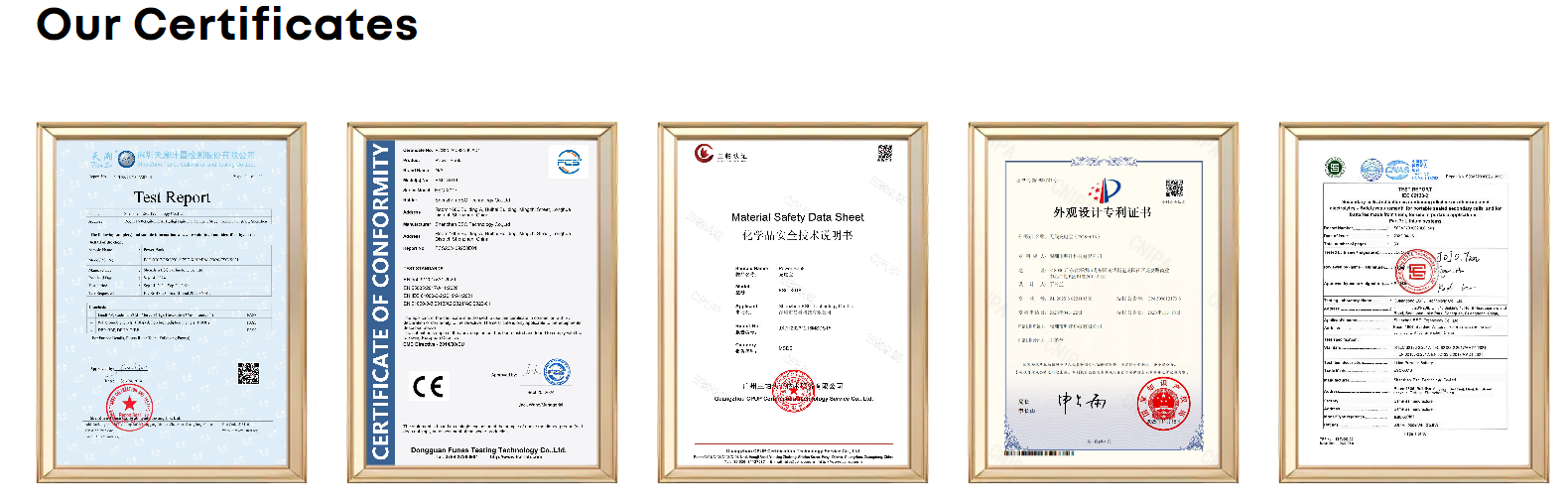
Certifications are not paperwork—they are market entry tickets.
Standards like UL 2054 and IEC 62133 require products to remain safe even under single-point failure conditions.
This forces redundant protection design at the PCBA level.
Our products are pre-validated through witness testing to ensure smooth customs clearance in North America and Europe.
Customization Without Compromise: Safety-Driven OEM/ODM Solutions
Balancing Aesthetics and Engineering: Safety Venting Design
High energy-density power banks require internal pressure management.
Our patented designs integrate hidden pressure relief structures that safely release gas in extreme conditions—preventing explosions.
This combination of safety engineering and industrial design creates real product differentiation.
Custom PCBA Solutions for 140W High-Power Power Banks
With PD 3.1 adoption, 140W has become the new standard.
We optimize magnetic cores and MOSFET switching characteristics to achieve over 92% efficiency—reducing heat and extending runtime.
AOVOLT Safety Technology Matrix
| Product Series | Application Scenario | IC Safety Features | OEM Lead Time |
|---|---|---|---|
| Ultra-Thin Magnetic (20W–35W) | Smartphone charging | Compact single-chip BMS, thermal optimization | 15–20 days |
| Office Power Series (65W–100W) | Laptop & tablet | Dual PD IC, dynamic power allocation | 25–30 days |
| Performance Series (140W+) | High-performance use | PD 3.1 controller, multi-layer hardware protection | 35–40 days |
| Industrial Custom Series | Specialized applications | Protocol-level customization, bare PCBA output | Case-dependent |
Choosing a Partner with a “Safety-First” Engineering Mindset
Selecting a supplier is ultimately about choosing who can absorb supply chain uncertainty for you.
A true safety IC power bank supplier transforms complex engineering challenges into standardized quality control.
With 15 years of vertical integration in Dongguan, we control everything from design to final assembly.
Because in global trade, the most expensive cost is always “quality recall.”
FAQ
Q1: What makes an integrated circuit safer than standard protection boards?
Standard boards only provide basic protection with slower response. IC solutions offer precise current detection, predictive fault response, and advanced features like protocol management and temperature compensation.
Q2: How do you verify IC authenticity in bulk orders?
We source directly from original manufacturers (e.g., TI, Navitas, Injoinic). Each batch has traceable documentation, and IQC performs decapsulation sampling and electrical validation before SMT.
Q3: Can a safety IC power bank handle 140W without overheating?
Yes. By combining GaN technology with high-efficiency PCBA and thermal materials, we minimize heat and maintain safe surface temperatures under full load.
Q4: Is the IC compatible with all fast-charging protocols?
Yes. Our solutions support PD3.0/PPS, QC3.0, FCP, SCP, AFC, and Apple 2.4A with optimized handshake logic.
Q5: What certifications are supported?
We provide UL 2054, IEC 62133, CE, FCC, and RoHS certifications with high pass rates due to design-stage compliance.
Choosing the right supplier is choosing long-term stability.
Whether you need fast OEM delivery or full ODM customization from ID design to hardware integration, AOVOLT is ready to turn 15 years of engineering expertise into your competitive advantage.
References: