
The quality standards for power banks are more than a “ticket to market”—they are the safety net for a brand’s survival in the global marketplace. True compliance involves a closed-loop verification process, covering everything from battery chemistry stability (IEC 62133), circuit protection logic (UL 2054), to global shipping safety (UN38.3). For B2B buyers, ignoring these standards can result in customs seizures, platform bans, or even catastrophic recalls.
As global wholesalers or brand owners, you may face challenges like severe product commoditization, heat risks under high-power fast charging, and frequent changes in regulatory standards across different regions. Leveraging a core R&D team with experience in Xiaomi, OPPO, and other leading smartphone supply chains, AOVOLT integrates proprietary PCBA architecture and multiple safety redundancies to combine “factory-grade” fast charging experience with industrial-level compliance, providing a technical moat to mitigate market risks.
Quality Standards Define Brand Survival: The Logic of Global Market Access
In the 2026 cross-border trade landscape, compliance has shifted from a “bonus” to a “survival requirement.” Products lacking authoritative certification expose B2B buyers to three critical threats:
-
Platform Compliance Redlines: Amazon, Walmart, and other platforms dynamically monitor lithium battery electronics. Non-certified products are instantly delisted, with funds frozen.
-
Legal Liability Exposure: In the event of overheating or fire, importers bear full legal liability without supporting standards.
-
Supply Chain Disruption: Inferior cells degrade rapidly under high-power fast charging (e.g., PD 3.1 140W), driving up return rates.
Core Compliance Framework Overview
| Certification Type | Key Standard | Applicable Regions | Test Focus | Mandatory Rating |
|---|---|---|---|---|
| Battery Safety | IEC 62133 / UL 2054 | Global / North America | Thermal runaway, internal short, overcharge protection | ★★★★★ |
| Electromagnetic Compatibility | CE-EMC / FCC Part 15 | Europe / US | EMI, immunity, circuit stability | ★★★★★ |
| Transport Safety | UN38.3 / MSDS | Global Shipping | Altitude simulation, vibration, impact, thermal tests | ★★★★★ |
| Environmental Directives | RoHS 2.0 / REACH | Europe | Restriction of lead, mercury, cadmium, etc. | ★★★★☆ |
From Lab to Market: In-Depth Analysis of Key Global Standards
Safety Standards: IEC 62133 & UL 2054
These are the “heart” tests for power banks. IEC 62133 focuses on lithium-ion cell chemical stability under extreme stress. UL 2054, widely recognized in North America, requires products to remain safe under single-fault conditions.
AOVOLT Technical Benchmark:
Our proprietary BMS (Battery Management System) responds to abnormal temperature rises or current fluctuations 30ms faster than the industry average, achieving zero fire and zero explosion in laboratory short-circuit simulations.
Transport Safety: UN38.3 & MSDS
Lithium batteries are classified as Class 9 hazardous materials. UN38.3 is a prerequisite for all air and sea shipments. It includes eight rigorous tests: altitude simulation, thermal cycling, vibration, impact, external short circuit, shock, overcharge, and forced discharge.
B2B Insight:
Many low-cost factories use “borrowed certificates” or expired MSDS, leading to indefinite cargo detention at transshipment ports. AOVOLT ensures every batch comes with up-to-date, real-time test reports.
Regional Market Access: CE, FCC & UKCA
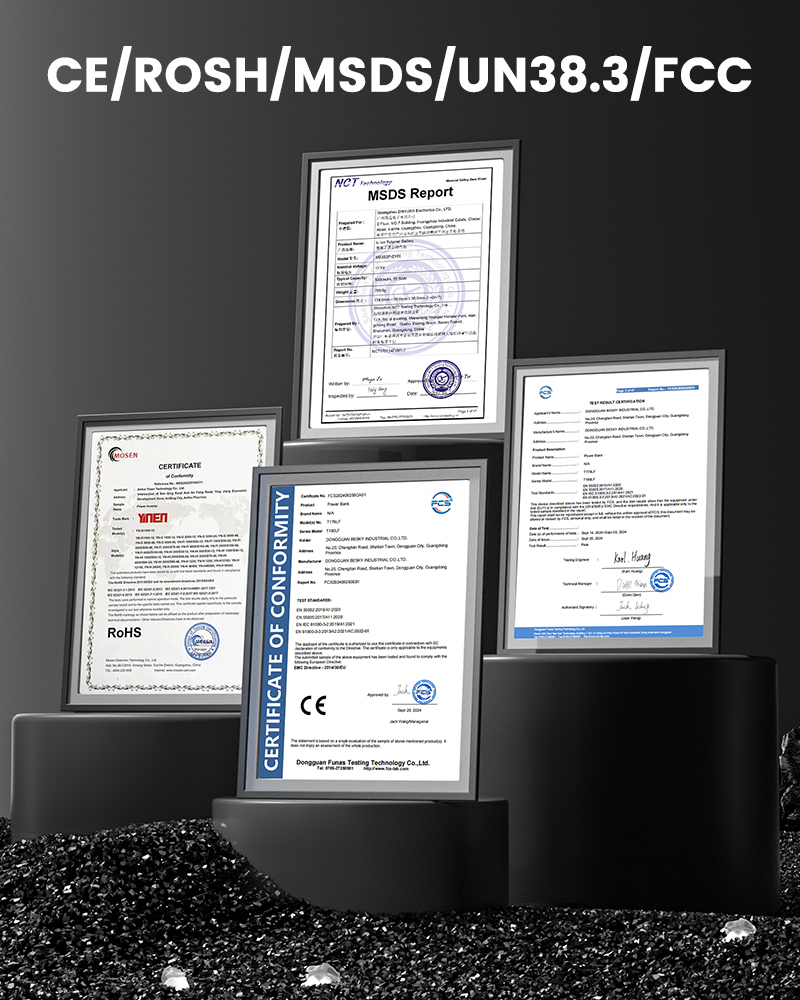
These certifications indicate compliance with health, safety, and environmental regulations in specific economic zones.
-
CE (LVD/EMC): Europe-focused, emphasizing electrical isolation between high and low voltage inputs.
-
FCC: North America-focused, ensuring high-frequency switching of fast-charge chips does not interfere with other radio devices.
The following sections detail how AOVOLT converts these standards into competitive advantages via a four-layer hardware testing system.
AOVOLT Core Standards: Four-Layer Testing for “Factory-Speed” and Safety
As fast charging enters the PD 3.1 (140W+) era in 2026, mere “power-on” no longer qualifies a product. AOVOLT’s R&D team has developed a four-layer quality protection network that exceeds industry benchmarks.
Chip-Level PCBA Logic Verification
The “brain” of a power bank is the PMIC (Power Management IC). With engineers sourced from leading smartphone brands, AOVOLT understands the conflict risks in third-party fast-charging protocols (PD, PPS, SCP, QC 5.0) during multi-port distribution.
-
Precise Current Limiting Test: Ensures power distribution error stays within ±5% across multiple devices, preventing cell damage from instantaneous power spikes.
-
ESD Protection: Ports strengthened to 8kV contact discharge and 15kV air discharge—far exceeding the standard 4kV—to handle static in varying climates.
Battery Cell Consistency Screening
Battery cells are the costliest and most dangerous component. AOVOLT uses only first-tier A-grade cells and enforces:
-
Internal Resistance Matching: Within 5mΩ across cells in the same unit.
-
Capacity Sorting: Ensures nominal vs. actual discharge is consistent, avoiding industry-wide “overstated capacity.”
Thermal Management & GaN Efficiency Monitoring
High temperatures shorten lithium battery life. AOVOLT leverages GaN technology to optimize switching loss, combined with NTC thermistors for real-time monitoring.
| Performance Metric | Typical Industry Standard | AOVOLT Advanced Standard | Buyer Benefits |
|---|---|---|---|
| Surface Temperature | 65°C - 75°C | < 52°C | Improved user comfort, lower fire risk |
| Energy Conversion Efficiency | 75% - 82% | > 90% | Longer battery life, less heat loss |
| Charge/Discharge Cycle Life | 300 - 500 cycles | 800 - 1000 cycles | Minimal returns, enhanced brand reputation |
4. Structural Reliability & Patent Protection
-
V0 Flame-Retardant Casing: High-strength PC+ABS prevents flame spread in extreme failures.
-
Patent Safeguards: Each product has proprietary design patents, mitigating B2B risks from commoditization and infringement-based delistings.
ISO9001 Factory On-Site Quality Control: From Raw Material to Finished Product

AOVOLT integrates strict PDCA loops to embed quality control at every production millisecond.
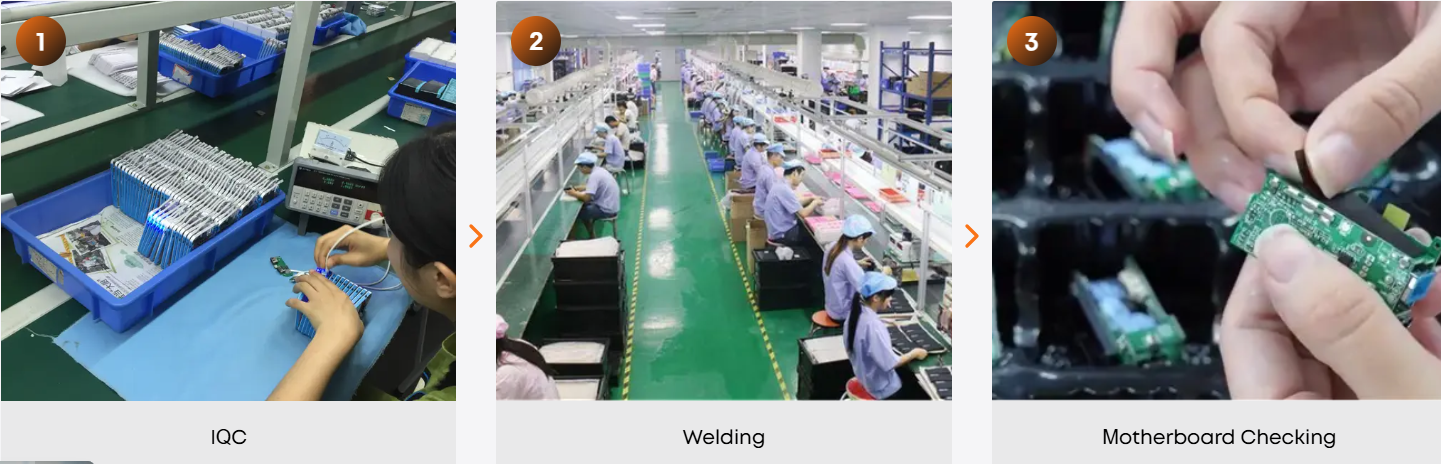
Incoming Quality Control (IQC) – Zero Defects from the Start
All critical components (chips, cells, MOSFETs) undergo 100% sampling. Cells undergo 72-hour high-temperature shelf tests to eliminate micro-short risks.
In-Process Quality Control (IPQC) – Digital Real-Time Monitoring
On SMT and assembly lines, AOI optical inspection identifies soldering defects. Each semi-finished unit is tested with multi-protocol charge/discharge cycles before casing, ensuring PCBA logic integrity.
Final Quality Control (FQC) – 100% Full-Load Aging Test
Every power bank undergoes at least one full 0%-100% load cycle pre-shipment. This costly approach ensures product failure rates below 500ppm.
B2B Buyer Verification Checklist: Identifying Reliable OEM/ODM Partners
When evaluating suppliers, request three key documents and verify authenticity:
-
Live Certification Links: Reputable factories provide UL/CE certificate verification paths.
-
R&D Background: Confirm the team has low-level protocol development capability, not just assembly expertise.
-
Technical Parameter Comparison: Require concrete performance data as in the table below.
AOVOLT Typical Product Performance Reference
| Parameter | AOVOLT 140W High-Performance Series | Typical Market Solutions |
|---|---|---|
| Supported Protocols | PD 3.1 / PPS / SCP / AFC | Only PD 3.0 |
| Protection Mechanisms | OVP, OCP, OTP, SCP (hardware-level) | Software-only (higher risk) |
| Battery Cell Density | 21700 High-Density | 18650 Standard |
| Multi-Port Power Distribution | Smart IC Dynamic Allocation | Fixed Allocation |
Conclusion: Quality as the Most Effective Global Marketing Tool
In 2026, price competition is no longer the key driver. Compliance and performance certainty form the foundation of B2B transactions. Through “factory-grade” R&D standards and rigorous ISO quality control, AOVOLT provides not just a power bank but a “green pass” to global mainstream markets. Choosing a vertically integrated factory with independent R&D is the only way to ensure your brand stays ahead in the fast-charging wave.
References: