
Many Fast Charging Power Banks Advertise High Wattage but Cannot Maintain Output
In the portable charging market, many products claim 20W, 30W, or even 65W fast charging capability, but real-world performance often tells a different story.
Users frequently encounter issues such as:
-
charging speed dropping after a few minutes
-
power banks overheating during high-power output
-
unstable charging across different smartphone brands
These problems usually originate from weak internal architecture rather than insufficient advertised wattage.
A power bank delivering true fast charging performance must coordinate three critical components:
-
battery discharge capability
-
power conversion efficiency
-
charging protocol compatibility
A professional fast charging power bank manufacturer must design the internal system around these engineering constraints rather than simply increasing output power.
At AOVOLT, fast charging power banks are designed using high-rate battery cells, multi-protocol charging controllers, and optimized PCBA layouts to maintain stable charging performance across different devices.
Battery Architecture Determines Whether Fast Charging Is Sustainable
Fast charging requires a battery capable of delivering high current without excessive voltage drop.
Standard lithium batteries used in low-cost power banks often operate at 1C discharge rates, which limits the maximum output current.
High-performance fast charging power banks therefore use high-rate lithium polymer cells.
Typical battery architecture:
| Battery Configuration | Discharge Rate | Capacity |
|---|---|---|
| Standard lithium cell | 1C | 5000–10000mAh |
| High-rate polymer cell | 2C–3C | 10000–20000mAh |
| High density polymer pack | 3C | 15000–30000mAh |
For example, a 10000mAh battery pack with a 3C discharge capability can theoretically deliver 30A output, which supports high power charging protocols such as PD 30W.
Battery density also influences device size.
Modern polymer cells increase energy density by 20–30% compared with cylindrical lithium cells, allowing thinner power bank designs.
When sourcing products from a fast charging power bank manufacturer, buyers should always verify:
-
battery discharge rate
-
cycle life (usually 500–800 cycles)
-
battery safety certifications
Charging Protocol Integration Determines Real Compatibility
Fast charging is not just about voltage and current. It requires intelligent negotiation between the power bank and the device.
Modern smartphones support different charging standards:
| Charging Protocol | Typical Output |
|---|---|
| USB-C Power Delivery (PD) | 20W–65W |
| Qualcomm Quick Charge | 18W–30W |
| PPS Adaptive Charging | 20W–45W |
Without proper protocol integration, devices may fall back to 5W standard charging, even if the power bank claims higher output.
High-quality power banks integrate multi-protocol charging controllers that automatically detect device requirements and adjust voltage and current.
This protocol negotiation ensures that the fast charging power bank manufacturer can deliver stable charging performance across different smartphone ecosystems.
Power Conversion Efficiency and Thermal Behavior
Fast charging generates heat because electrical energy is converted multiple times within the circuit.
Wireless charging and DC-DC conversion both introduce energy loss.
Some of that energy inevitably becomes heat during the process.
High-efficiency power banks therefore use advanced DC-DC conversion circuits.
Typical performance comparison:
| Performance Factor | Generic Power Bank | Optimized Design |
|---|---|---|
| Conversion efficiency | 80–85% | 90–94% |
| Thermal rise (30min fast charge) | +30°C | +20°C |
| Output stability | moderate | high stability |
Thermal management strategies include:
-
copper heat spreaders
-
thermal silicone pads
-
NTC temperature monitoring
These measures allow the power bank to maintain stable output without triggering thermal throttling.
Fast Charging + Wireless Charging Hybrid Architecture
Modern portable charging devices increasingly integrate wired fast charging and magnetic wireless charging.
Wireless charging standards such as Qi currently support up to 15W wireless charging, while newer Qi2 systems introduce magnetic alignment to improve efficiency and speed.
Hybrid power bank architecture typically includes:
| Charging Interface | Output |
|---|---|
| USB-C PD | 30W–65W |
| USB-A Fast Charge | 18W |
| Magnetic wireless charging | 10W–15W |
Magnetic alignment improves coil positioning, which increases charging efficiency and reduces energy loss during wireless power transfer.
This hybrid architecture allows the power bank to charge multiple devices simultaneously while maintaining fast charging capability.
Safety Systems and Certification Requirements
Fast charging power banks operate at higher power levels and therefore require robust safety mechanisms.
Typical protection systems include:
Battery safety protection
-
overcharge protection
-
over-discharge protection
-
overcurrent protection
-
cell balancing systems
Charging safety protection
-
short circuit protection
-
temperature monitoring
-
foreign object detection
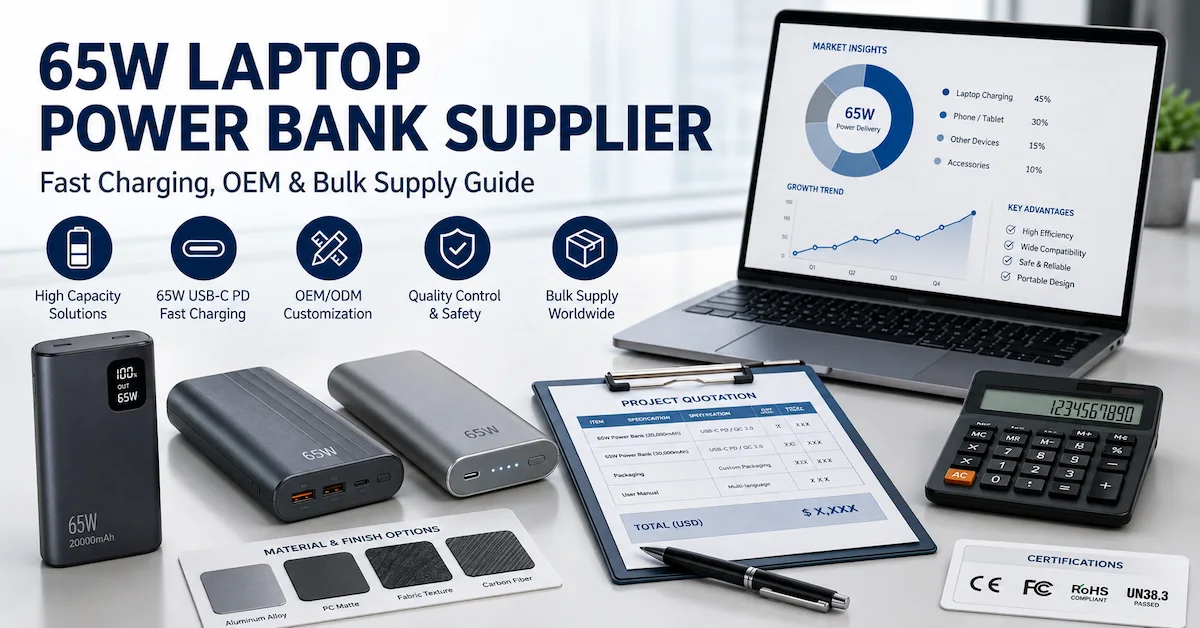
Most international markets require certification compliance including:
-
CE certification
-
FCC electromagnetic compliance
-
RoHS environmental standards
-
UN38.3 lithium battery transport certification
-
MSDS battery safety documentation
These certifications confirm that the product meets international safety standards for consumer electronics.
Cross-Border Shipping Challenges for Lithium Battery Products
Lithium battery products are classified as regulated goods during international transport.
Typical export requirements include:
-
UN38.3 testing report
-
MSDS documentation
-
certified lithium battery packaging
-
proper capacity labeling
Manufacturers must ensure packaging prevents battery short circuits and protects devices during transport.
A professional fast charging power bank manufacturer typically provides these compliance documents to simplify international logistics.
Frequently Asked Questions
Q1: What output power should a fast charging power bank support?
Most modern smartphones support 20W–30W fast charging, while some flagship devices can support 45W or higher charging power.
Q2: Why do some power banks slow down during charging?
Charging speed may drop if the battery cannot sustain high current output or if thermal protection reduces power to prevent overheating.
Q3: What capacity is recommended for fast charging power banks?
The most common capacities are 10000mAh and 20000mAh, balancing portability and multiple device charging cycles.
Fast Charging Power Bank OEM Development
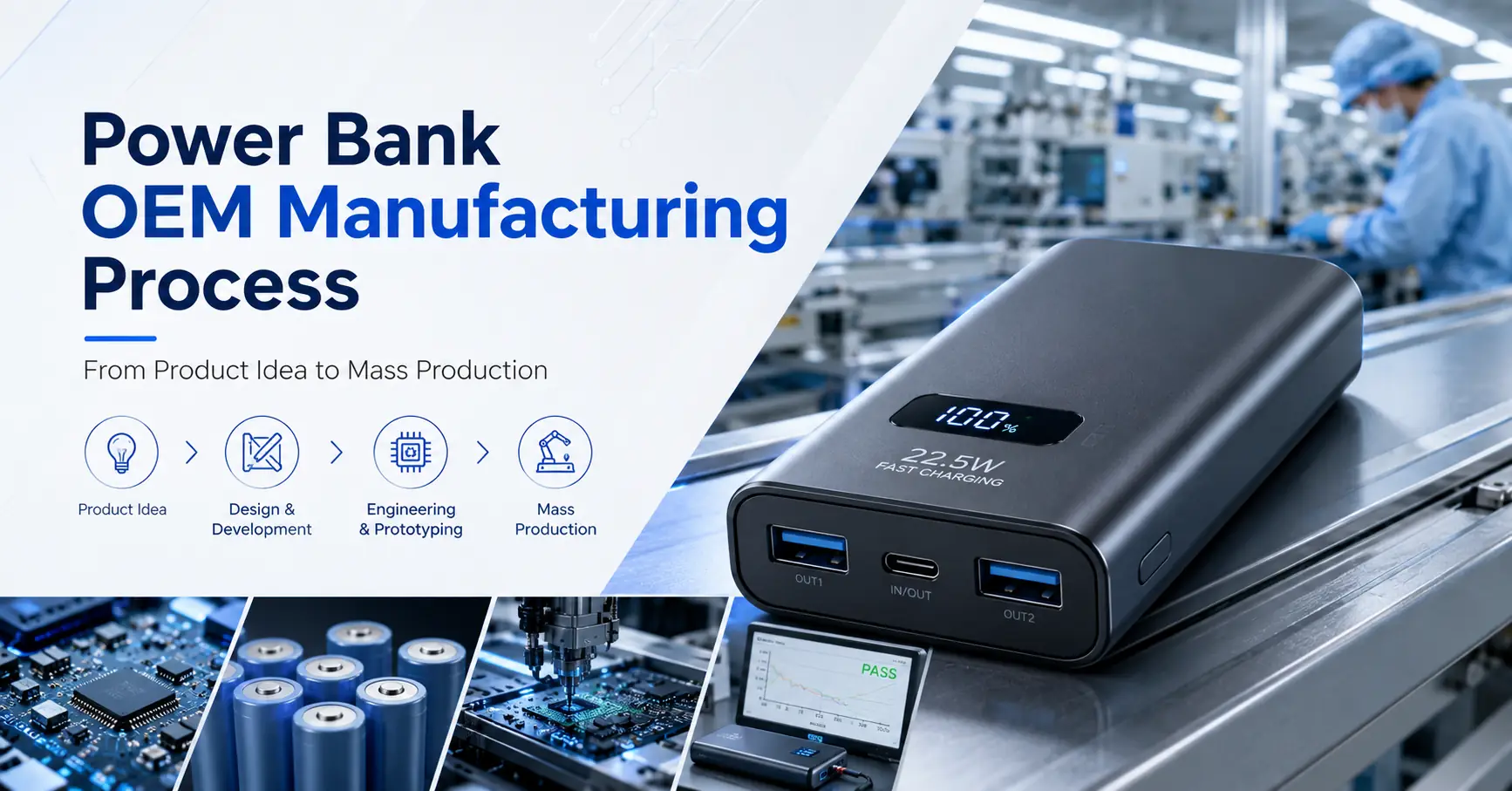
Developing reliable portable charging products requires integration of battery engineering, power electronics, and manufacturing processes.
AOVOLT supports OEM partners through:
-
fast charging power bank architecture design
-
battery configuration optimization
-
prototype validation and testing
-
large-scale manufacturing
Explore power bank products:
https://www.esccharge.com/products/power-bank
OEM charging solutions:
https://www.esccharge.com/solution/customized-solution