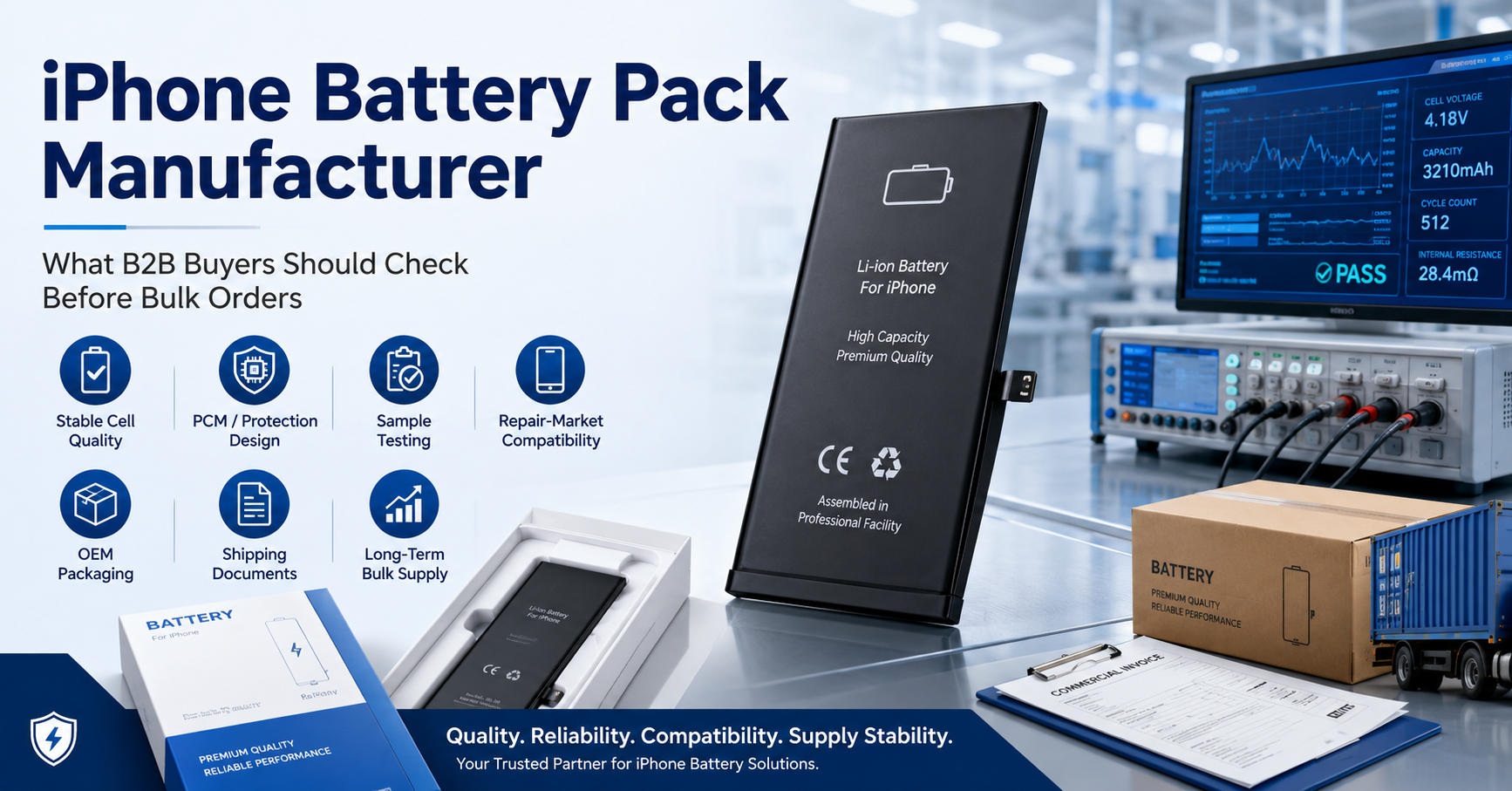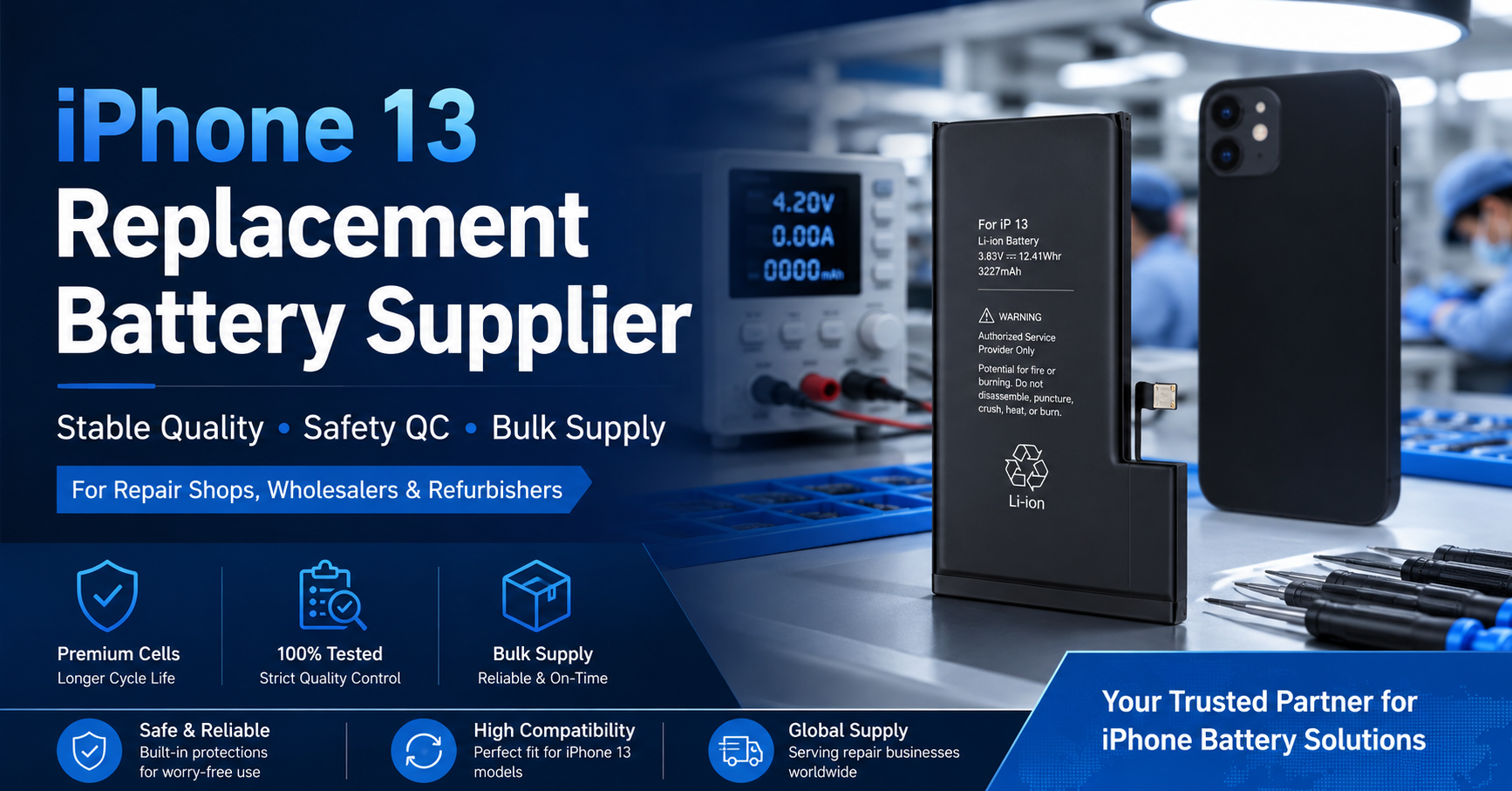

For repair shops and refurbished phone sellers, an iPhone battery swelling case is not just a product defect. It can lift the screen, damage the housing, scare the customer, create return claims and hurt the repair shop’s reputation. A swollen battery is one of those problems that buyers remember for a long time.
That is why many repair buyers search for why iPhone battery swelling happens. They do not only want a scientific explanation. They want to know what caused the problem, how dangerous it is, how to handle it safely, and how to reduce the risk when buying replacement iPhone batteries in bulk.
ESC supplies iPhone replacement batteries for repair shops, refurbishment facilities, wholesalers and private label customers. From our side, battery swelling is not something to explain casually. It is a safety, quality-control and supplier-selection issue.
Battery Swelling Is Gas Build-Up Inside the Cell
An iPhone battery is a rechargeable lithium-ion battery. As lithium-ion batteries chemically age, Apple explains that the amount of charge they can hold decreases, and battery impedance can increase. Higher impedance can reduce the battery’s ability to deliver power when the device needs it.
Swelling is different from normal capacity aging. A battery can lose capacity without swelling. Swelling usually means gas has built up inside the pouch cell. The University of Reading’s lithium battery safety guidance explains that swelling of lithium-ion batteries is caused by heat and gas build-up, and that a swollen battery should not be punctured because it may lead to fire or explosion.
In simple repair-market language: when internal chemical reactions generate gas faster than the cell can safely tolerate, the soft pouch structure expands. On an iPhone, that expansion may push the screen upward, deform the housing or create pressure inside the device.
The Main Causes of iPhone Battery Swelling
Battery swelling usually does not come from one single reason. It is often the result of several stress factors working together.
1. Chemical aging
Every lithium-ion battery ages. Over time, the battery loses capacity and internal resistance rises. Apple describes this as chemical aging, which reduces maximum capacity and peak power delivery.
A chemically aged battery is more vulnerable to stress. It may drain faster, charge less predictably or run hotter under load.
2. Heat exposure
Heat accelerates battery degradation. If an iPhone is often used while charging, left in a hot car, exposed to direct sunlight, or used under heavy load for long periods, the battery may age faster.
For repair shops, heat history is difficult to verify. A customer may say, “The phone was normal yesterday.” But the battery may have been under heat stress for months.
3. Overcharge, over-discharge or poor charging behavior
A stable protection circuit should help manage charging and discharging limits. But if the battery cell, protection board or charging behavior is poor, abnormal stress may increase. Over-discharge, long-term storage at very low voltage, or unstable charging accessories can all increase risk.
4. Poor cell quality or manufacturing defects
Battery University notes that pouch cells are more vulnerable to swelling concerns, and that swelling can occur from gas generation during charge and discharge; it also states that much swelling is associated with faulty manufacturing or improper use conditions.
For B2B buyers, this is the brutal truth: a cheap battery may look fine at delivery, but weak cell consistency can become a return problem weeks or months later.
5. Physical damage during repair or installation
If a battery is bent, punctured, pressed too hard, or damaged by sharp tools during installation, the risk increases. This is especially important for iPhone repair because internal space is tight and adhesive removal requires care.
A battery is not a piece of plastic. It is a sealed electrochemical system. Treat it like a dangerous part, not a sticker.
Is a Swollen iPhone Battery Dangerous?
Yes. A swollen iPhone battery should be treated as a safety risk.
The University of Reading advises that a swollen lithium-ion battery should not be punctured and that even if the device still works, the battery should be replaced immediately; continuing to use or charge the device can be dangerous.
A scientific review of lithium-ion battery safety also explains that safety accidents can involve heat and gas generation, which may lead to battery rupture and ignition of combustible materials.
For repair shops, the rule should be simple:
- Do not press the screen back down.
- Do not puncture the battery.
- Do not keep charging the device.
- Do not ship swollen batteries as normal goods.
- Do not let untrained staff remove a swollen battery casually.
- Move the device away from heat and flammable materials.
- Handle removal and disposal through trained repair or hazardous waste channels.
If a customer walks in with a lifted screen and swollen battery, do not treat it like a normal battery replacement. It is a safety job first, repair job second.
Swollen Battery vs Degraded Battery
Not every weak iPhone battery is swollen. Buyers and repair shops should separate two different problems.
| Problem | Main Symptom | Risk Level | Repair Priority |
|---|---|---|---|
| Degraded battery | Fast drain, lower battery health, shorter runtime | Medium | Replace when performance is poor |
| Swollen battery | Screen lifting, housing pressure, visible bulge | High | Stop use and replace immediately |
| Poor-quality replacement battery | Random shutdown, unstable charging, swelling risk | Medium to high | Check supplier and QC process |
| Damaged battery after repair | Heat, swelling, abnormal behavior | High | Handle as safety risk |
A degraded battery affects performance. A swollen battery affects safety. Don’t mix them up.
Why iPhone Replacement Batteries May Swell After Repair
When swelling happens after a replacement, customers usually blame the repair shop first. Sometimes they are right. Sometimes the real cause is more complex.
Possible reasons include:
- Low-grade cell material
- Poor cell consistency
- Weak pouch sealing
- Inadequate aging test
- Protection board issue
- Heat generated during abnormal use
- Physical damage during installation
- Incorrect adhesive removal or pressure
- Device charging circuit problem
- Poor storage conditions before installation
For repair businesses, this means battery quality must be controlled before installation, not after complaints arrive.
A supplier should not only promise “high quality.” That phrase is too cheap. A serious supplier should talk about capacity testing, voltage testing, internal resistance checking, aging tests, connector inspection, appearance inspection and after-sales feedback tracking.
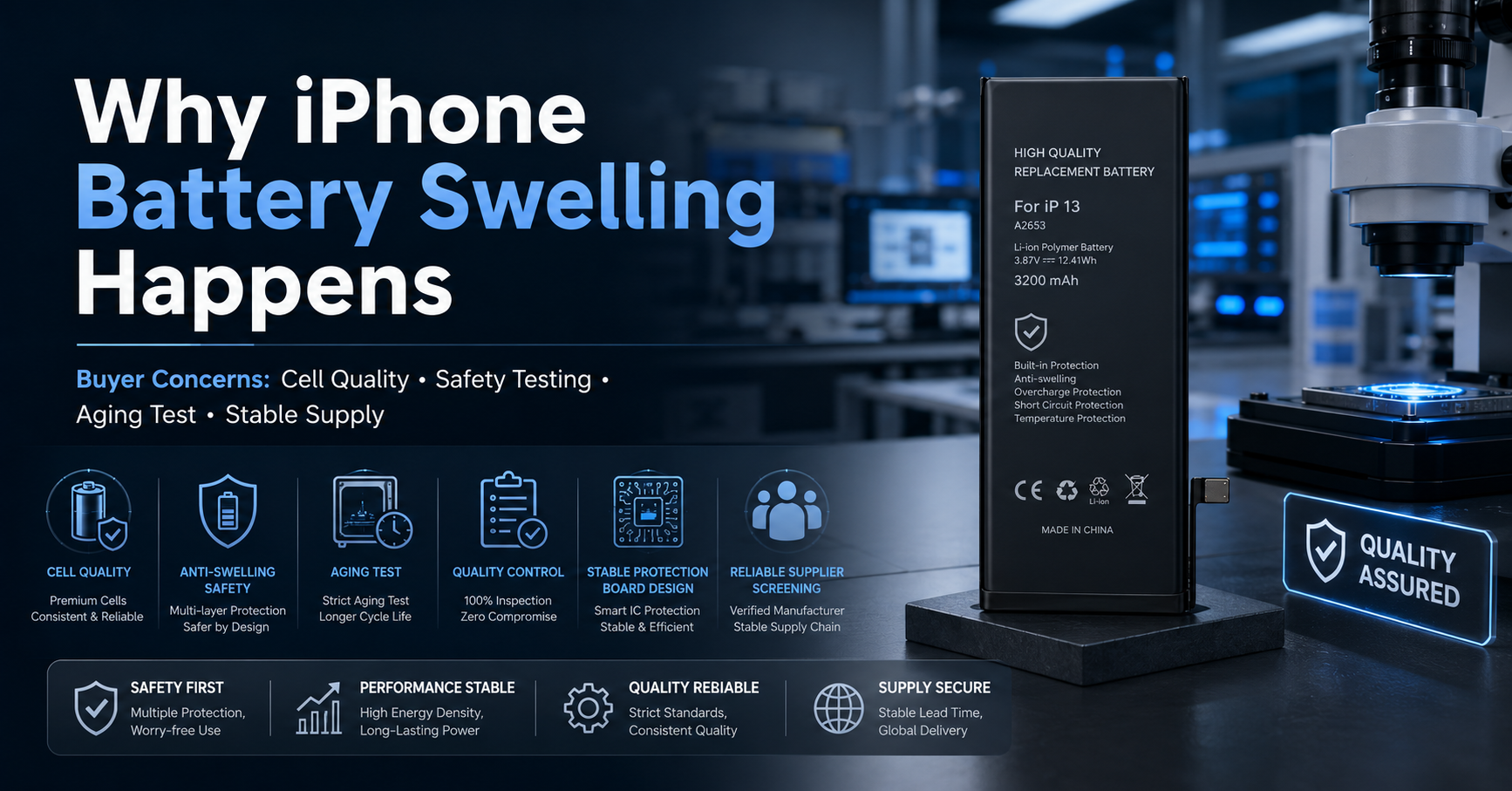
What ESC Checks to Reduce Battery Swelling Risk
ESC cannot claim that any lithium-ion battery has zero swelling risk. No serious battery supplier should say that. Lithium-ion products always require correct design, manufacturing, storage, installation and use.
What ESC can do is reduce avoidable risk through practical quality control.
For iPhone replacement batteries, ESC focuses on:
- Cell voltage inspection
- Capacity testing
- Internal resistance checking
- Protection board function testing
- Charging and discharging test
- Aging test
- Connector and flex inspection
- Appearance and surface inspection
- Thickness and flatness inspection
- Packaging and label inspection
- Batch feedback tracking
The goal is not only to catch defective pieces. The real goal is to protect the buyer’s repair reputation.
For wholesalers, one unstable batch can damage a distribution channel.
For repair shops, one swollen battery can destroy customer trust.
For refurbishers, one swelling issue can turn a sellable phone into a return case.
A Practical Case: Refurbished Phone Seller Facing Battery Swelling Complaints
A refurbished phone seller may process hundreds of used iPhones every month. At first, they may choose batteries mainly by price. The logic seems reasonable: lower battery cost, higher margin.
Then the hidden cost appears.
Some customers report fast drain after resale. A few devices come back with screen lifting. The seller has to pay for return shipping, replacement labor, customer compensation and negative review control. Suddenly the cheap battery is not cheap anymore.
A better strategy is to build a battery quality ladder:
Standard refurbished phones use stable original-capacity replacement batteries with basic QC.
Premium refurbished phones use better-tested batteries with tighter batch control.
Retail repair kits use OEM packaging with clear warning labels and installation notes.
High-risk returned devices are inspected carefully before battery replacement, especially if there are signs of heat, liquid damage, pressure deformation or charging circuit abnormality.
That is how a refurbished phone business controls risk. Not by buying the most expensive battery blindly, and not by buying the cheapest battery like a傻子. The real answer is matching battery quality level with device grade and customer expectation.
How Repair Shops Should Explain Swollen iPhone Batteries to Customers
Customers often panic when they see a swollen battery. Repair shops need simple and professional language.
You can explain it like this:
“Your iPhone battery has swollen because gas has built up inside the lithium-ion cell. This can happen when a battery ages, overheats, is damaged, or has internal chemical instability. Please do not continue charging or pressing the screen down. We need to remove and replace the battery safely.”
This explanation is clear. It does not blame the customer immediately. It also positions the repair shop as professional.
Avoid saying:
“It’s normal.”
“It’s just old.”
“Press the screen back.”
“You can still use it for a few days.”
That is irresponsible. A swollen battery is a safety signal.
How to Choose Safer iPhone Replacement Batteries
Before buying iPhone batteries in bulk, repair shops and wholesalers should ask better questions.
- What cell grade is used?
- Are capacity and internal resistance tested?
- Is aging test performed before shipment?
- Is the battery checked for thickness and flatness?
- Is the protection board tested?
- Are swelling or heat complaints tracked by batch?
- Can the supplier support sample testing first?
- Can the supplier provide OEM packaging with safety warnings?
- How does the supplier handle after-sales feedback?
- Does the supplier understand repair shops and refurbishment buyers differently?
If a supplier only says “best price, best quality,” be careful. That sentence has killed too many margins.
FAQ About iPhone Battery Swelling
Why does an iPhone battery swell?
An iPhone battery may swell when gas builds up inside the lithium-ion cell. This can be related to chemical aging, heat exposure, over-discharge, poor charging conditions, cell defects, physical damage or poor-quality replacement batteries.
Is a swollen iPhone battery dangerous?
Yes. A swollen lithium-ion battery should be treated as a safety risk. It should not be punctured, pressed, charged or used as a normal battery. Professional handling and replacement are recommended.
Can an iPhone battery swell even if battery health is not very low?
Yes. Battery health percentage and swelling are not the same thing. A battery can degrade without swelling, and swelling can happen because of gas generation, heat, damage or internal instability.
Can poor replacement batteries cause swelling?
Yes, poor cell quality, weak pouch sealing, poor protection design, inadequate testing or rough installation can increase swelling risk. This is why B2B buyers should evaluate supplier QC, not only price.
Should a repair shop continue using a swollen iPhone for testing?
No. If the battery is visibly swollen or pushing the screen up, the device should be powered down and handled carefully. Do not keep charging or stress-testing it like a normal phone.
Can ESC guarantee zero battery swelling?
No responsible lithium-ion battery supplier should claim zero swelling risk. ESC focuses on reducing avoidable risk through cell selection, testing, protection board checks, aging tests and batch feedback tracking.
What should wholesalers ask suppliers before buying iPhone batteries?
Wholesalers should ask about cell grade, capacity test, internal resistance test, protection board function, aging test, swelling complaint history, packaging, sample testing and after-sales policy.
Work with ESC
ESC supplies iPhone replacement batteries for repair shops, refurbishment facilities, wholesalers, distributors, e-commerce sellers and private label brands.
If your business wants to reduce iPhone battery swelling complaints, ESC can help you select safer replacement battery options, confirm models, test samples, prepare OEM packaging and build a clearer quality-control purchasing plan.
Explore more iPhone replacement battery options from our iPhone Battery category.
For diagnostic-ready options, visit our iPhone Decode Battery category.
For private label projects, visit our OEM Battery Packaging service page and send us your model list for quotation.