
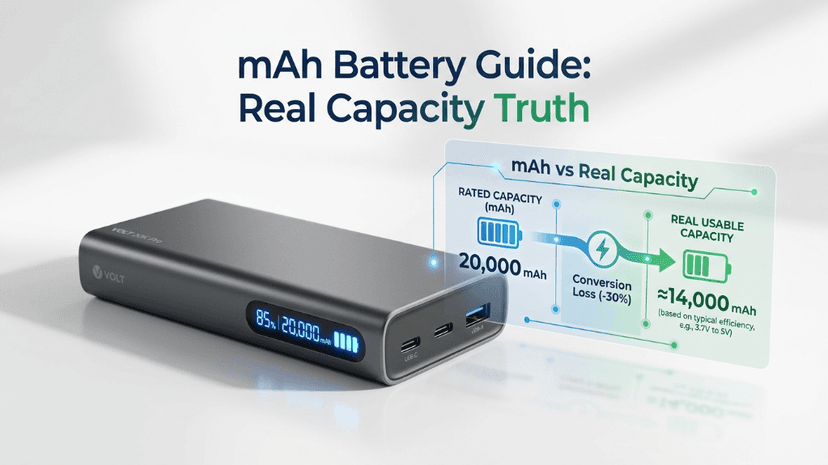
If you are selecting products for a power bank product line, a device labeled as 20,000mAh typically delivers only about 11,000–14,000mAh of usable output to the end user. This is not a supplier typo—it is the combined result of standard industry energy loss and widespread battery cell overstatement. When combined, in the worst case, the actual output capacity of what you purchase may be less than 55% of the labeled value.
In February 2026, the State Administration for Market Regulation of China released a special inspection report on consumer lithium battery products, showing that the non-compliance rate of mislabeled capacity in the power bank category remains high in cross-border e-commerce supply chains. Behind this figure lies the reality that many B2B buyers make sourcing decisions without proper mAh verification tools, relying entirely on supplier specification sheets.
From a wholesale pricing perspective, a 10,000mAh GaN power bank using A-grade original lithium polymer cells is priced at approximately $6–$11/pcs FOB Shenzhen (MOQ 1,000 pcs). Products using B-grade or mixed cells may be priced as low as $4–$5, but real tested output capacity differences can exceed 30%. This price gap is worth reading this guide carefully.
What Exactly Is mAh: A Precise Definition for B2B Procurement
mAh stands for milliampere-hour. Its physical meaning is the product of current (mA) that a battery can continuously output in 1 hour (h). For example, a 3,000mAh battery theoretically can discharge at 3,000mA for 1 hour, or 1,500mA for 2 hours.
However, in procurement contexts, there is a critical hidden assumption: nominal voltage.
Lithium-ion cells have a nominal voltage of 3.6V–3.7V, while USB output voltage is 5V. When a power bank converts internal 3.7V energy into 5V USB output, the boost conversion circuit inevitably causes energy loss. This means:
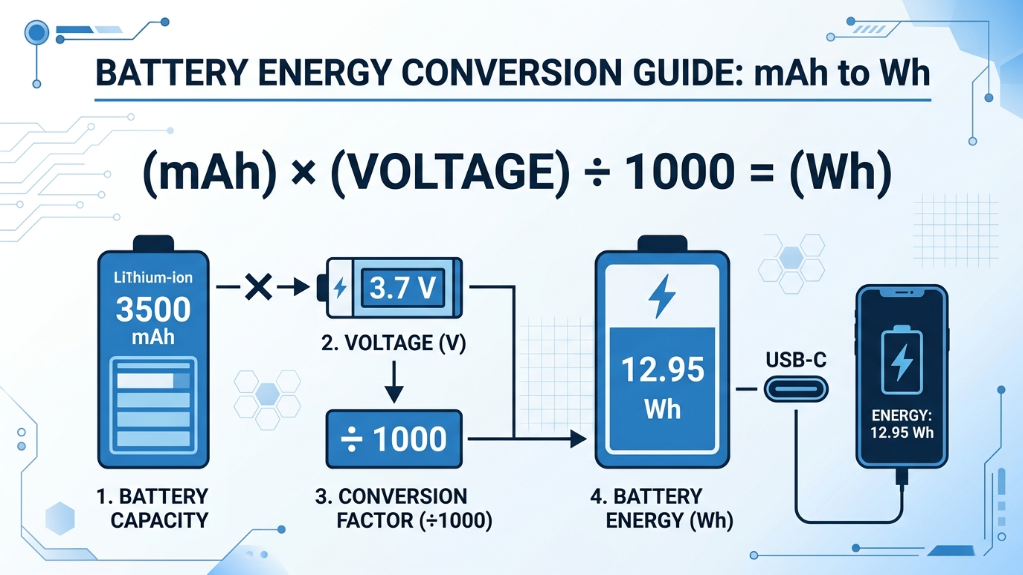
A 20,000mAh lithium cell (based on 3.7V) stores:
74Wh (20,000 × 3.7 ÷ 1000)
After conversion to 5V output, efficiency is typically 65%–92%, so usable energy becomes:
48–68Wh, equivalent to about 13,000–18,400mAh at 5V output—not the labeled 20,000mAh.
This is why B2B procurement should prioritize Wh (watt-hour) rather than mAh when comparing different products. mAh is only valid when comparing batteries with the same voltage and chemistry system. Once cross-product comparison is involved, mAh becomes systematically misleading.
Another important industry concept is C-Rate (discharge rate). 0.2C is the standard test condition, meaning discharge at 20% of rated capacity current. Two cells both labeled 10,000mAh may show up to 15% difference under 0.2C testing. This directly impacts whether your power bank can fulfill promised endurance claims.
mAh, Ah, Wh: Practical Comparison for Procurement
Power banks in the market use three different labeling systems: mAh, Ah, and Wh. Each has different practical value depending on application scenarios.
Table 1: Battery Capacity Unit Conversion and Procurement Application
| Unit | Full Name | Conversion Relationship | Typical Application Scenario | B2B Procurement Value |
|---|---|---|---|---|
| mAh | milliampere-hour | 1 Ah = 1000 mAh | Smartphones, earbuds, same-category comparison | Effective for similar products, misleading across categories |
| Ah | ampere-hour | 1 Ah = 1000 mAh | Car batteries, energy storage, industrial batteries | Preferred for large-scale equipment |
| Wh | watt-hour | Wh = mAh × V ÷ 1000 | Laptop batteries, aviation limits, energy storage products | Most accurate for cross-category comparison |
The most practical scenario for Wh in B2B procurement is aviation compliance.
According to ICAO (International Civil Aviation Organization), lithium batteries carried by passengers are limited to 100Wh. For a 3.7V system:
100Wh ÷ 3.7V × 1000 ≈ 27,027mAh
This means any power bank under 27,000mAh (based on 3.7V labeling) complies with global airline carry-on regulations without special approval. This directly affects product eligibility in travel accessory channels and cross-border e-commerce platforms.
mAh Mislabeling: Verification Logic You Must Know Before Purchasing
This is one of the most systematically ignored topics online, yet one of the biggest sources of B2B procurement loss.
Power bank mAh mislabeling usually occurs through two main methods:
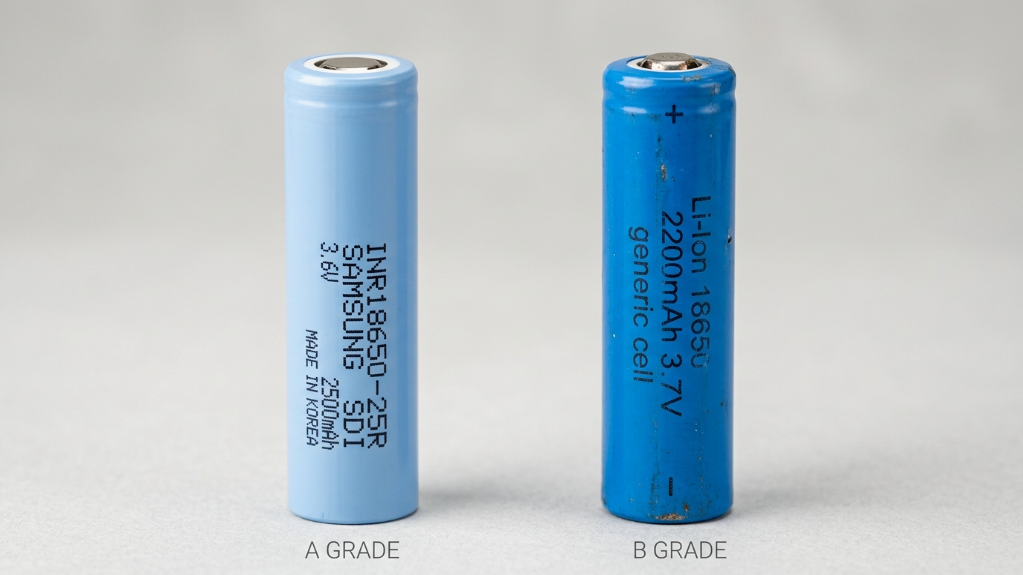
First, battery cell grade fraud: using B-grade or recycled cells instead of A-grade originals while labeling the same mAh value. Actual capacity differences can reach 20%–50%.
Second, confusing labeling standards: using 3.7V-based cell capacity (theoretical capacity) and directly labeling it as product output capacity without disclosing conversion loss at 5V output.
When combined, actual usable energy delivered to the end user may be nearly half of what is printed on the packaging.
Table 2: Impact of Battery Cell Grade on Actual mAh Output
| Cell Grade | Supplier Type | Label Accuracy | 0.2C Tested Retention | After 500 Cycles | Return Risk |
|---|---|---|---|---|---|
| A-grade original | Panasonic / Samsung SDI / CATL / ATL | ≤2% error | ≥98% | ≥80% | Low (<2%) |
| B-grade secondary | Sorted factory rejects | 5%–15% error | 85%–93% | 60%–75% | Medium (3%–8%) |
| Recycled cells | Disassembled reused cells | 20%–50% error | 50%–75% | Unpredictable | High (>15%) |
| Mixed OEM pack | Mixed loose cells | Unpredictable | Not measurable | Unpredictable | Extremely high |
The only reliable verification method is to request a 0.2C discharge test report from suppliers, including cell brand, batch number, and test date. Without this document, any mAh number in a spec sheet is a claim, not a commitment.
mAh and Fast Charging: Two Independent Variables, One Combined Decision
After understanding capacity, a common procurement misconception must be corrected: mAh does not determine charging speed.
Charging speed depends on output power (W = V × A) and fast charging protocols, not battery capacity. A 10,000mAh power bank with 100W PD output can charge a laptop much faster than a 20,000mAh device limited to 18W output.
These are independent parameters but deeply connected in user experience.
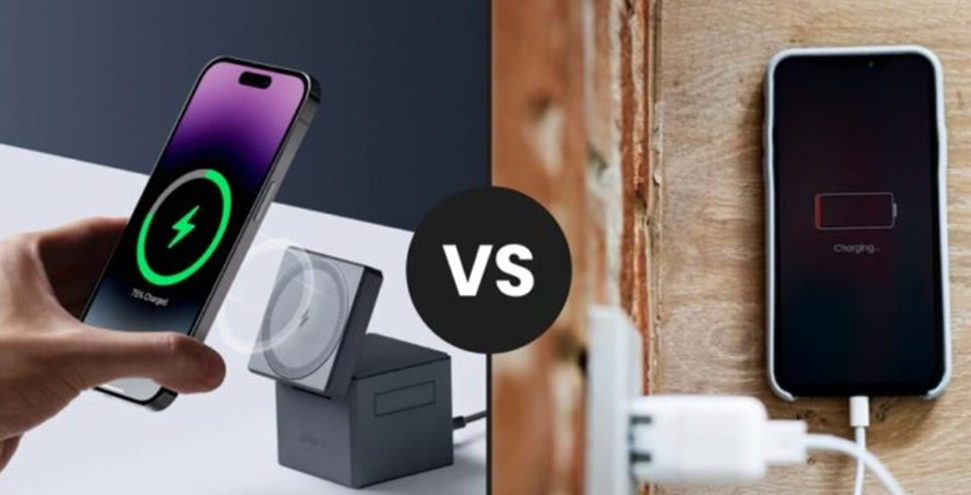
In magnetic power banks, this difference is even more significant. Qi2/MagSafe wireless efficiency is typically 70%–80%, lower than wired PD output efficiency of 85%–92%. Take you to understand Qi2 and Qi2.2 wireless charging: 2026 B2B buying guide.
Therefore, for the same mAh specification, magnetic versions deliver about 15%–20% fewer charging cycles.
If your target market is iPhone users in a premium accessory segment, magnetic power banks should be upgraded by one capacity tier compared to wired versions. For example:
- Wired competitor: 10,000mAh
- Your magnetic version: 12,000–15,000mAh
mAh and protocol selection directly affect repeat purchase rate and complaint rate. High capacity with slow charging is for emergency use. Mid capacity with high power is for business travel. Magnetic products with only 5W output will always lead to buyer regret.
mAh and Airline Compliance: Red Lines for Cross-Border Sellers
Table 3: Power Bank mAh vs Airline Transport Compliance (3.7V basis)
| mAh Specification | Wh Equivalent | Carry-On | Checked Baggage | Airline Approval | Channel Suitability |
|---|---|---|---|---|---|
| ≤10,000 mAh | ≤37 Wh | ✓ Allowed | ✗ Prohibited | Not required | All channels |
| 10,001–20,000 mAh | 37–74 Wh | ✓ Allowed | ✗ Prohibited | Not required | All channels |
| 20,001–27,027 mAh | 74–100 Wh | ✓ Allowed | ✗ Prohibited | Not required | All channels |
| 27,028–43,243 mAh | 100–160 Wh | ⚠ Approval required | ✗ Prohibited | Max 2 units/person | Professional/industrial |
| >43,243 mAh | >160 Wh | ✗ Prohibited | ✗ Prohibited | Not allowed | Freight only |
The most important conclusion: 27,000mAh is effectively the upper limit for consumer power banks in carry-on luggage.
Beyond this threshold, products enter a regulatory gray zone requiring airline approval, increasing return rates and logistics disputes in air-shipped e-commerce channels such as Amazon and AliExpress.
Most mature cross-border sellers keep main SKUs under 20,000mAh and ensure Wh labeling is clearly displayed for compliance and customs clearance efficiency.
FAQ: Top 5 Practical mAh Questions from B2B Buyers
Q1: A 20,000mAh power bank only delivers about 13,000mAh. Is this normal?
Yes, but you must verify the loss source.
20,000mAh (3.7V basis) = 74Wh. After 5V conversion at 80% efficiency, usable output is about 11,840mAh.
If a supplier reports 13,000mAh, it indicates ~88% efficiency, which is normal for high-quality GaN solutions.
Below 11,000mAh suggests either low efficiency or cell mislabeling.
Q2: For the same 10,000mAh capacity, lithium-ion or lithium polymer—which is better for B2B sourcing?
Lithium polymer (Li-Po): higher energy density, flexible shapes, no leakage risk—mainstream for consumer OEM.
Lithium-ion cylindrical cells (18650/21700): lower cost, better consistency—suitable for high-capacity or rugged products.
For branding or gift customization, Li-Po usually provides higher design value and pricing flexibility.
Q3: How do I verify real mAh during inspection without trusting supplier data?
Use a USB power meter (e.g., FNIRSI or Chargerlab POWER-Z series).
Fully charge the power bank, then discharge using a constant load (recommended 5V/2A).
Record total output in mWh, then divide by 5V to get real mAh at 5V output.
Products below 65% efficiency should be excluded from your supplier list.
Q4: What is the best mAh for corporate gift power banks?
The core trade-off is capacity vs portability.
10,000mAh is the golden standard: enough for daily smartphone use while remaining pocket-friendly.
If budget allows, 10,000mAh + dual 30W fast charging significantly increases perceived value and reduces “drawer abandonment” rates.
Q5: How should mAh be adjusted for magnetic power banks compared to wired ones?
Magnetic (Qi2/MagSafe) efficiency is 10%–20% lower than wired PD.
Therefore, compared to a 10,000mAh wired model, magnetic versions should be 12,000–15,000mAh to deliver similar real-world endurance.
For iPhone-focused markets, this is not optional—it is the minimum requirement for user satisfaction.
Conclusion

mAh looks simple, but in B2B procurement it hides multiple traps: cell grade fraud, labeling ambiguity, conversion inefficiency, and aviation compliance boundaries. Every small oversight can translate into higher return rates, platform penalties, or customs delays.
Successful B2B buyers in this category usually share three traits:
- A clear, enforceable battery acceptance standard
- Ability to convert mAh into Wh for cross-product comparison
- A supplier that provides 0.2C discharge test reports
AOVOLT is one manufacturer worth serious consideration in this space. This Dongguan-based OEM factory with 15 years of experience covers power banks, magnetic chargers, and fast chargers with up to 140W output. Its protocol support includes PD 3.0, PPS, QC 3.0, FCP, SCP, AFC, Apple 2.4A, and BC 1.2—one SKU compatible across iPhone, Samsung, Huawei, and Xiaomi ecosystems.
More importantly, AOVOLT’s vertically integrated supply chain—from product design, R&D, mold opening, injection molding to hardware integration—operates fully in-house. This means what you see is not a generic template design, but an original mold-developed product, which is rare in a highly commoditized category like power banks.
If your next product line requires transparent mAh data, traceable battery cell grading, and true fast charging across Samsung and iPhone devices, then before comparing prices, ask every supplier for a 0.2C discharge test report. That single document can filter out most factories that are not worth further discussion.