
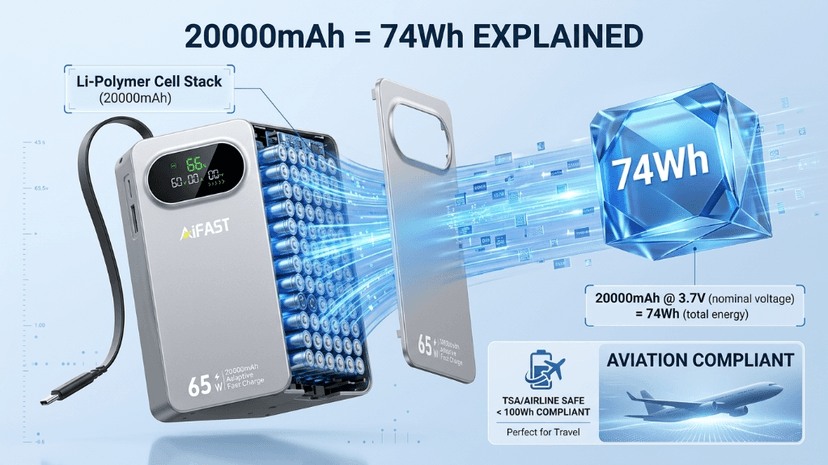
A 20,000 mAh power bank converts to 74Wh—assuming a nominal voltage of 3.7V. This figure is below the aviation limit of 100Wh allowed by most airlines for carry-on batteries, making it one of the most optimal capacity points for B2B gifts, corporate procurement, and retail selection that balances capacity with global compliance.
However, 74Wh is only a theoretical value. After internal boost conversion losses (typically 85%–92%), the actual energy delivered to your devices is about 63–68Wh. In bulk procurement scenarios, this gap directly determines end-user experience and your after-sales complaint rate.
In January 2026, IATA released the 65th edition of the Dangerous Goods Regulations (DGR), further tightening air transport documentation requirements for lithium batteries. Several major express carriers also updated their lithium battery declaration formats simultaneously. If you are planning bulk export or promotional procurement of power banks this year, this guide covers everything you need: conversion formulas, capacity inflation detection, global aviation regulations, transport compliance documents, and B2B product selection logic.
mAh to Wh Conversion: The Formula Is Simple, But Variables Are Not
The conversion itself is straightforward. The formula is:
Wh = mAh × V ÷ 1000
20,000 × 3.7 ÷ 1000 = 74Wh.
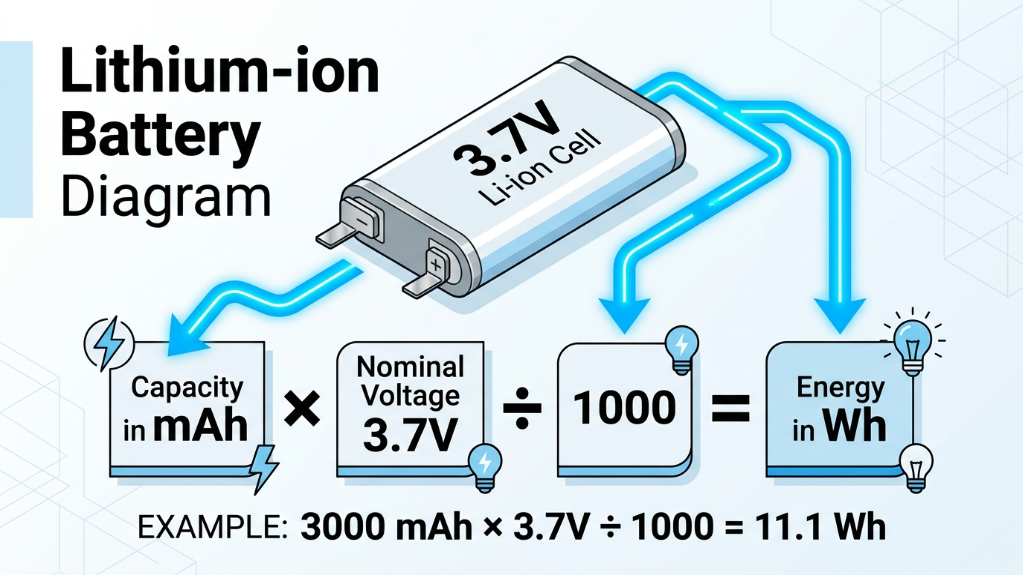
But there is a detail most articles ignore: 3.7V is only the nominal voltage of lithium-ion cells, not the actual operating voltage.
Lithium-ion cells typically have:
- Full charge voltage: 4.2V
- Cut-off voltage: ~2.5V
- Nominal voltage: 3.6V–3.7V (average used for labeling)
Different manufacturers interpret this “average value” differently. Using 3.6V vs 3.7V leads to a difference of about 2.7%. For individual users, this is negligible. For B2B buyers, it affects whether the labeled Wh matches lab test results, which directly impacts customs declarations and certification audits.
Lithium polymer (Li-Po) cells are even more complex. Some Li-Po cells have a nominal voltage of 3.8V, which increases Wh for the same mAh rating. This is not an advantage—it is a variable. If your supplier switches cell types without updating labeling, your actual Wh changes while the label remains the same.
Conversion Table Under Different Voltage Standards
| Rated Capacity (mAh) | 3.6V (Wh) | 3.7V (Wh) | 3.8V (Wh) | 5V Output (Wh)* |
|---|---|---|---|---|
| 10,000 | 36.0 | 37.0 | 38.0 | 50.0 |
| 20,000 | 72.0 | 74.0 | 76.0 | 100.0 |
| 26,800 | 96.5 | 99.2 | 101.8 | 134.0 |
| 30,000 | 108.0 | 111.0 | 114.0 | 150.0 |
*Note: 5V is the USB output-side voltage, not the internal cell voltage. It should NOT be used for internal capacity calculation. Some non-compliant suppliers may use it to exaggerate Wh ratings.
This last column deserves attention. Using 5V for 20,000mAh gives exactly 100Wh, right at the IATA aviation threshold, while 3.7V gives 74Wh, comfortably compliant. Some low-cost suppliers intentionally use higher voltage references to inflate Wh ratings, but this creates compliance ambiguity and may result in confiscation at strict airports (e.g., Singapore, Australia). Lightweight 20000mAh Power Bank for You: 2026 OEM Sourcing and Profit Guide.
Rated Capacity vs Actual Output: Where Does the 15–20% Loss Go?
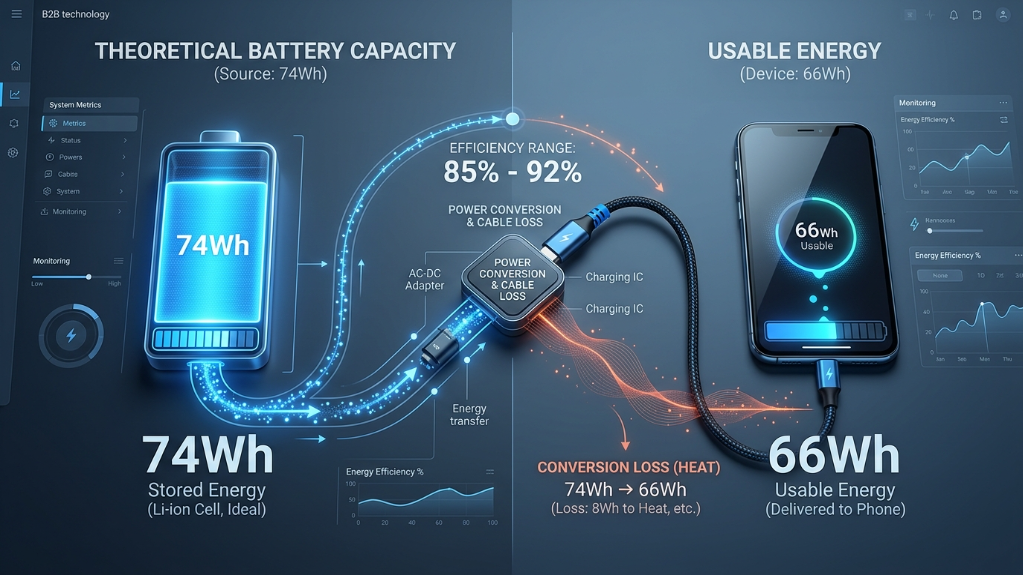
The battery stores 74Wh, but your phone does not receive 74Wh.
A power bank involves two energy conversion stages:
- Cell voltage (3.7V) boosted to USB output (5V/9V/12V/20V)
- Fast charging protocol conversion and regulation
These conversions typically result in 85%–92% efficiency, depending on circuit design and load conditions.
Usable Energy Calculation
- Conservative efficiency (85%): 74Wh × 0.85 = 62.9Wh
- Typical efficiency (90%): 74Wh × 0.90 = 66.6Wh
- High efficiency (92%): 74Wh × 0.92 = 68.1Wh
This is the real energy available for end-user device charging.
For a smartphone with a 15Wh battery (approx. 4,000mAh × 3.7V):
- High-efficiency 20,000mAh power bank: ~4.4 charges
- Low-efficiency product: ~4.2 charges
The difference seems small, but if your product claims “4 full charges” and only delivers 3.8 in real use, customer complaints begin to appear.
Capacity vs B2B Application Evaluation Table
| Capacity | Theoretical Wh (3.7V) | Usable Wh (90%) | Aviation Compliance | iPhone 16 Charges (~15Wh) | Recommended B2B Use Case |
|---|---|---|---|---|---|
| 5,000mAh | 18.5Wh | ~16.7Wh | ✅ No restriction | ~1.1 | Small promotional gifts |
| 10,000mAh | 37.0Wh | ~33.3Wh | ✅ No restriction | ~2.2 | Exhibition gifts / entry-level corporate use |
| 20,000mAh | 74.0Wh | ~66.6Wh | ✅ Fully compliant (<100Wh) | ~4.4 | Corporate travel / premium gifts |
| 26,800mAh | 99.2Wh | ~89.3Wh | ⚠️ Borderline safe | ~5.9 | Maximum airline-compliant capacity |
| 30,000mAh | 111.0Wh | ~99.9Wh | ⚠️ Requires approval | ~6.7 | Non-travel use |
| 50,000mAh | 185.0Wh | ~166.5Wh | ❌ Not allowed | ~11.1 | Outdoor / fixed power backup |
20,000mAh is the most commercially balanced point in this table. It offers 26Wh of safety margin below aviation limits, sufficient runtime for most business travel scenarios, and a mature wholesale price range. In 2026, high-quality dual-port PD fast-charging versions typically cost $8–15/unit (MOQ 200 units), about 15–20% cheaper than 26,800mAh models.
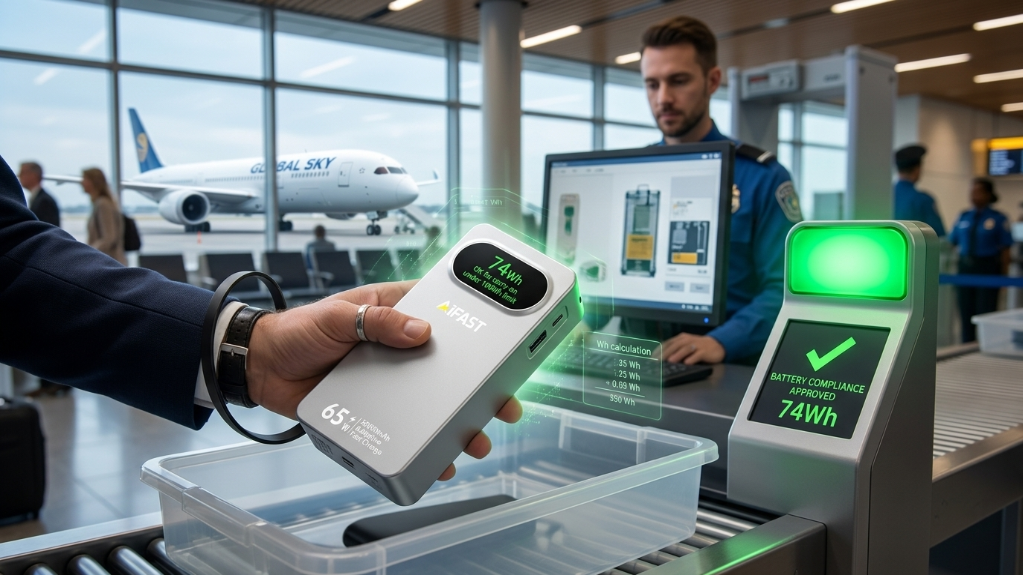
Global Aviation & Transport Compliance: The Real Barrier in B2B Export
Once conversion is clear, the real challenge begins: how do you ship it, prepare documents, and pass customs?
Different transport methods have completely different Wh rules. Misunderstanding these is the leading cause of shipment detention.
| Transport Method | Wh Limit | Key Documents | 20,000mAh Status | Notes |
|---|---|---|---|---|
| Passenger aircraft cargo | ≤160Wh per unit | IATA Section II + UN3481 label | ✅ Compliant | State of charge ≤30% required |
| Dedicated cargo aircraft | ≤300Wh | Full DG docs + packaging certificate | ✅ Compliant | Confirm carrier policy |
| Sea freight (FCL/LCL) | No unit limit | UN38.3 + MSDS + DG declaration | ✅ Compliant | Must be stored separately |
| DHL/FedEx/UPS | Usually ≤100Wh | Li-ion Battery Document + UN38.3 summary | ✅ Compliant | >100 units may require DG shipment |
| Postal small parcels | Usually ≤100Wh | Varies by country | ⚠️ Caution | Some countries reject lithium batteries |
UN38.3 certification is the fundamental pass for all transport methods. It is a UN-recommended lithium battery test standard covering:
- Altitude simulation
- Vibration
- Shock
- External short circuit
- Overcharge
- Forced discharge
Without this report, DHL and FedEx will refuse shipment, and EU/US customs may detain goods.
OEM labeling compliance is equally critical. EU regulations require direct Wh marking on the product body, not just mAh. Under UL 2056 in the US, similar requirements exist. This means Wh labeling must be considered during mold design—not after production.
B2B Procurement Logic: Use Wh Efficiency Ratio, Not mAh Numbers
Most procurement managers choose based on “highest capacity.” This works in consumer markets but causes unnecessary compliance risk in B2B.
A better framework is:
Use case → compliance constraints → Wh efficiency → protocol compatibility
For corporate travel gifts, compliance is the primary constraint. 20,000mAh (74Wh) outperforms 26,800mAh (99.2Wh) because it provides a wider safety margin under the 100Wh limit and lower customs scrutiny risk.
Fast-charging protocol support is another overlooked factor. A 20,000mAh power bank with only 5V/2A output may take 3× longer to charge modern devices compared to PD 45W models. For corporate branding, charging speed is a direct perceived value indicator.
Why Choose AOVOLT as a 20,000mAh B2B Supplier
Beyond technical definitions, procurement success depends on whether a supplier can consistently reproduce these standards across batches.
AOVOLT is a Dongguan-based manufacturer with 15+ years in consumer electronics, focusing on power banks, magnetic wireless chargers, and fast chargers. Unlike lightweight OEM traders, it operates a vertically integrated production system covering:
- Industrial design
- R&D
- Mold opening
- Injection molding
- Metal integration
Key Advantages for B2B Buyers
Capacity consistency
In-house production ensures stable cell sourcing and unified BMS calibration, keeping batch variance extremely low—critical for passing third-party audits.
Protocol coverage
Supports up to 140W output with PD 3.0, PPS, QC 3.0, FCP, SCP, AFC, Apple 2.4A, and BC 1.2. This ensures maximum charging speed across Apple, Samsung, Huawei, Xiaomi, Lenovo, and more.
Industrial design capability
Independent design team enables full customization from mold stage, including material finishing, shape design, and color differentiation—key for private label branding.
B2B Buyer FAQ
Q1: What documents are required for exporting 20,000mAh power banks?
Minimum requirements:
- UN38.3 test report or summary
- MSDS (Material Safety Data Sheet)
- Dangerous Goods Declaration (IATA DGR format)
- UN3481 label
Express shipments also require a Li-ion Battery Document.
Q2: How can I verify if the supplier is inflating capacity?
Request a discharge test report specifying:
- Test current
- Cut-off voltage
- Measured capacity
If possible, use SGS, TÜV, or Intertek for third-party validation. Deviations above 10% should be treated as suspicious.
Q3: Is Wh labeling mandatory for private label products?
EU: Yes (CE compliance requires Wh marking)
US: Recommended under UL 2056
China: Recommended under GB/T 35590
In practice, Wh labeling is required in any regulated battery market.
Q4: Does 140W fast charging affect Wh calculation?
No. Wh remains mAh × nominal voltage ÷ 1000.
However, higher power systems typically have better conversion efficiency, meaning more usable energy from the same Wh.
Q5: Does MagSafe power bank conversion differ?
No change in formula. However:
- Wireless efficiency is lower (70–80%)
- Some models combine multiple internal batteries
Always separate wired vs wireless output capacity in specifications.
Conclusion
The mAh-to-Wh conversion is not just a formula—it is a supplier qualification tool.
Many can calculate 74Wh. Far fewer can consistently deliver:
- Stable real-world output (63–68Wh usable energy)
- Full compliance documentation
- Accurate labeling
- Reliable fast-charging performance
In B2B procurement, the real variable is not the printed capacity, but which factory can reliably deliver Wh efficiency, compliance, and consistency at scale.
If you are planning your 2026 power bank procurement strategy—whether for corporate gifts, private label products, or retail distribution—AOVOLT’s engineering team can support you from specification design to UN38.3 documentation. Fifteen years of manufacturing experience in Dongguan exists to solve problems before they become costly mistakes.
References: