
Choosing a phone battery supplier for mobile parts distributors is not the same as buying a few replacement batteries for a repair shop. Distributors need broad model coverage, stable batch quality, clear labels, safe packaging, fast replenishment and reliable after-sales support. A weak battery supply line can create fast-drain complaints, wrong-model shipments, warranty claims and customer loss across the whole distribution channel.
Product Pain Points: Why Battery Supply Can Hurt Distributor Profit
Mobile parts distributors usually serve many customer types at the same time.
Repair shops need batteries that fit correctly and reduce customer complaints.
Wholesalers need mixed-model stock and stable replenishment.
E-commerce sellers need retail-ready packaging and clear compatibility information.
Refurbished phone suppliers need consistent batteries for repeated installation.
Private label buyers need branded packaging and predictable product quality.
The problem is that phone battery quality issues are often invisible before installation.
A battery may look normal, but still cause fast drain, no charging, swelling, shutdown, poor capacity, connector mismatch or unstable battery percentage.
For a distributor, one unstable batch does not affect only one customer.
It can spread across many repair shops, resellers and local dealers.
That is why a phone battery supplier for mobile parts distributors must provide more than a price list.
It must support model accuracy, batch consistency, packaging clarity and complaint analysis.

Battery Principle: What Distributors Need to Understand Before Bulk Supply
A replacement phone battery is a compact lithium-ion battery system.
It is not just a black pouch with a capacity label.
The main structure usually includes lithium-ion polymer cell, PCM protection board, flex cable, connector, insulation layer, pouch film, adhesive structure, product label, barcode label and packaging.
The lithium-ion cell determines stored energy, runtime and discharge performance.
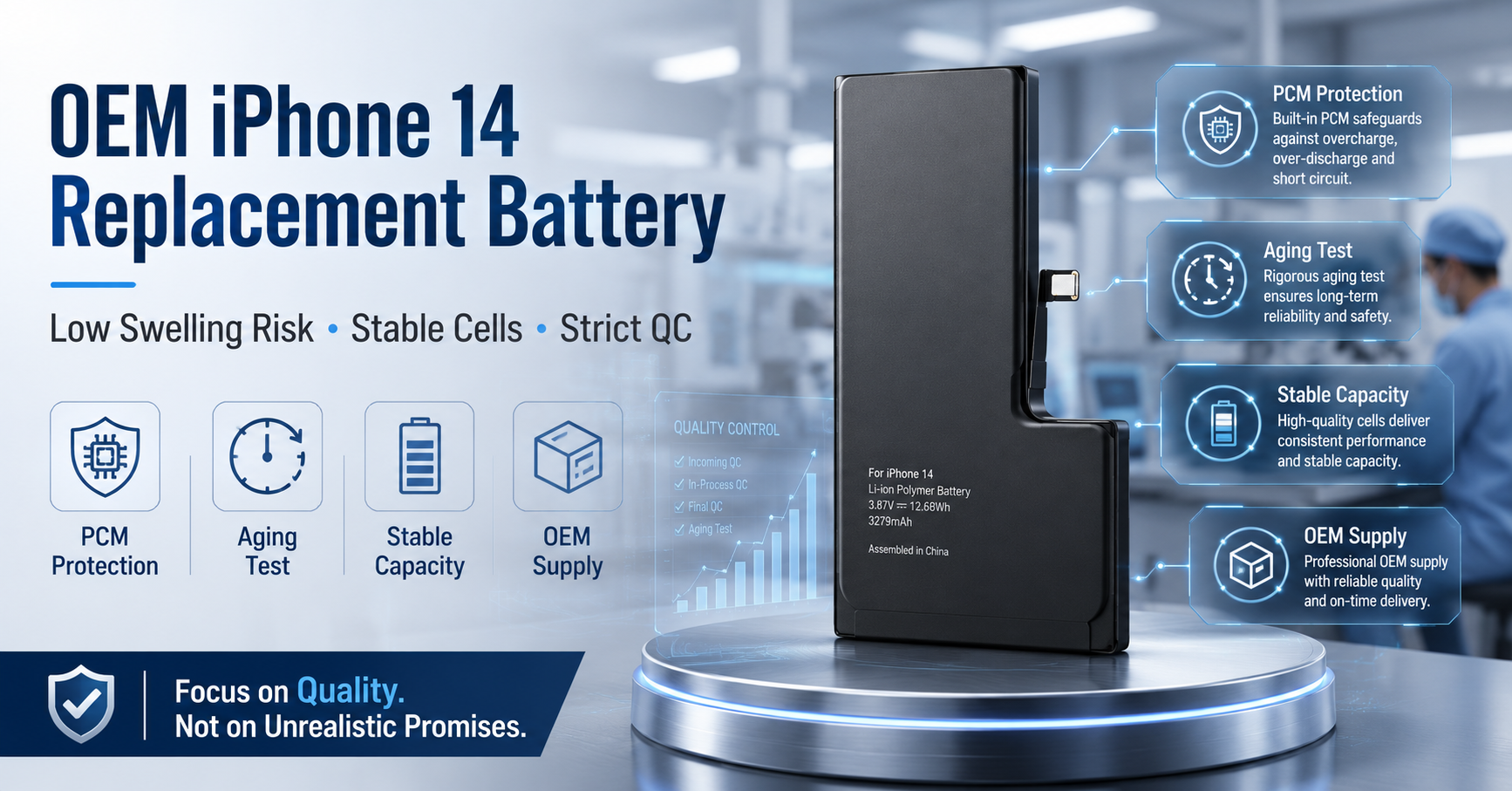
The PCM protection board helps manage overcharge, over-discharge, over-current and short-circuit protection.
The flex cable and connector determine installation fit and electrical contact.
The insulation layer and pouch film affect safety, sealing and mechanical stability.
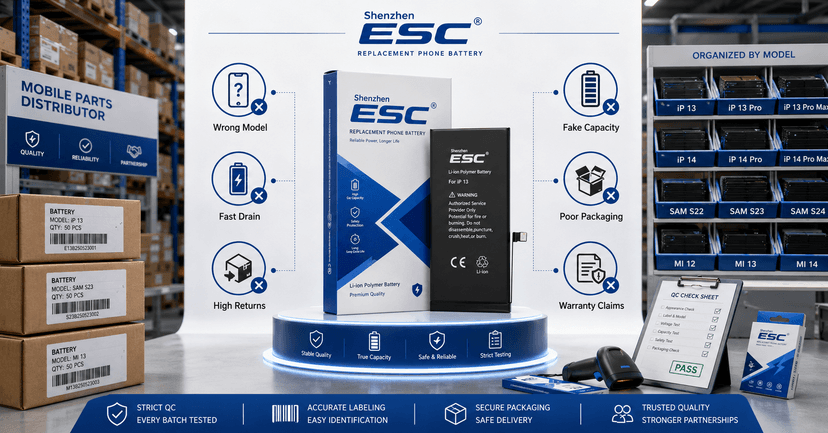
The product label, barcode and carton packaging help distributors manage inventory and reduce wrong shipments.
For distributors, the key technical indicators are real capacity, internal resistance, voltage consistency, discharge stability, connector fit, flex cable direction, PCM function, packaging strength and batch consistency.
One perfect sample is not enough.
A distributor needs repeatable quality across cartons, models and monthly replenishment.

Supplier Comparison: General Battery Trader vs Distributor-Focused Supplier
A general battery trader usually competes on low price, fast quotation and a long model list.
This may look attractive at first, but it is not enough for mobile parts distributors.
A distributor-focused supplier must support model coverage, model accuracy, stable capacity, batch control, packaging labels, barcode management, OEM options and after-sales response.
A general trader may sell many SKUs, but may not control model labels clearly.
A professional supplier helps separate models by battery code, compatible phone model, barcode, carton mark and batch number.
A general trader may promote high-capacity products without test logic.
A professional supplier should explain rated capacity, typical capacity, internal resistance and discharge behavior.
A general trader may disappear after shipment.
A reliable supplier should help analyze fast drain, no charging, swelling, connector issues, packaging damage and batch complaints.
For distributors, the cheapest battery is often not the lowest-cost battery.
Returns, replacement freight, credit notes, customer disputes and lost repeat orders are all hidden costs.
Solution: How Mobile Parts Distributors Should Evaluate a Phone Battery Supplier
Check Product Coverage and Model Accuracy
A distributor usually needs batteries for multiple brands.
A practical catalog may include iPhone, Samsung, Huawei, Xiaomi, Redmi, OPPO, Vivo, Realme, iPad and selected long-tail models.
Model coverage is important, but model accuracy is more important.
Buyers should confirm compatible model, battery code, connector position, flex cable direction, voltage, rated capacity, packaging label and carton mark.
A wrong model creates warehouse confusion and customer complaints.
Check Real Capacity and Internal Resistance
Distributors should not rely only on printed mAh values.
Real capacity should match the battery size, cell structure and voltage platform.
Internal resistance affects heat, voltage drop, fast drain and sudden shutdown risk.
Before bulk supply, buyers should test several samples from the same batch.
The goal is not to find one good battery.
The goal is to confirm whether the batch is stable enough for channel sales.
Check PCM Protection and Safety Design
The PCM protection board is a key part of replacement battery stability.
It helps manage overcharge, over-discharge, over-current and short-circuit risks.
Poor PCM matching may cause no charging, overheating, shutdown, unstable percentage or higher warranty claims.
A professional supplier should explain how basic protection functions are checked before shipment.
Check Installation Fit and Repair-Shop Feedback
Distributors sell to repair professionals.
If a battery is hard to install, repair shops will complain quickly.
Buyers should check thickness, length, width, connector alignment, flex cable direction, adhesive area and edge sealing.
A battery that saves a few cents but wastes technician time is not a good distributor product.
Check Packaging, Barcode and Carton Labels
For mobile parts distributors, packaging is inventory control.
Good packaging should support model identification, barcode scanning, batch tracking, storage protection and safe shipping.
Important packaging details include retail box, bulk tray, model sticker, barcode label, warning label, carton mark and inner protection.
Poor labeling causes wrong picking, wrong shipping and unnecessary disputes.
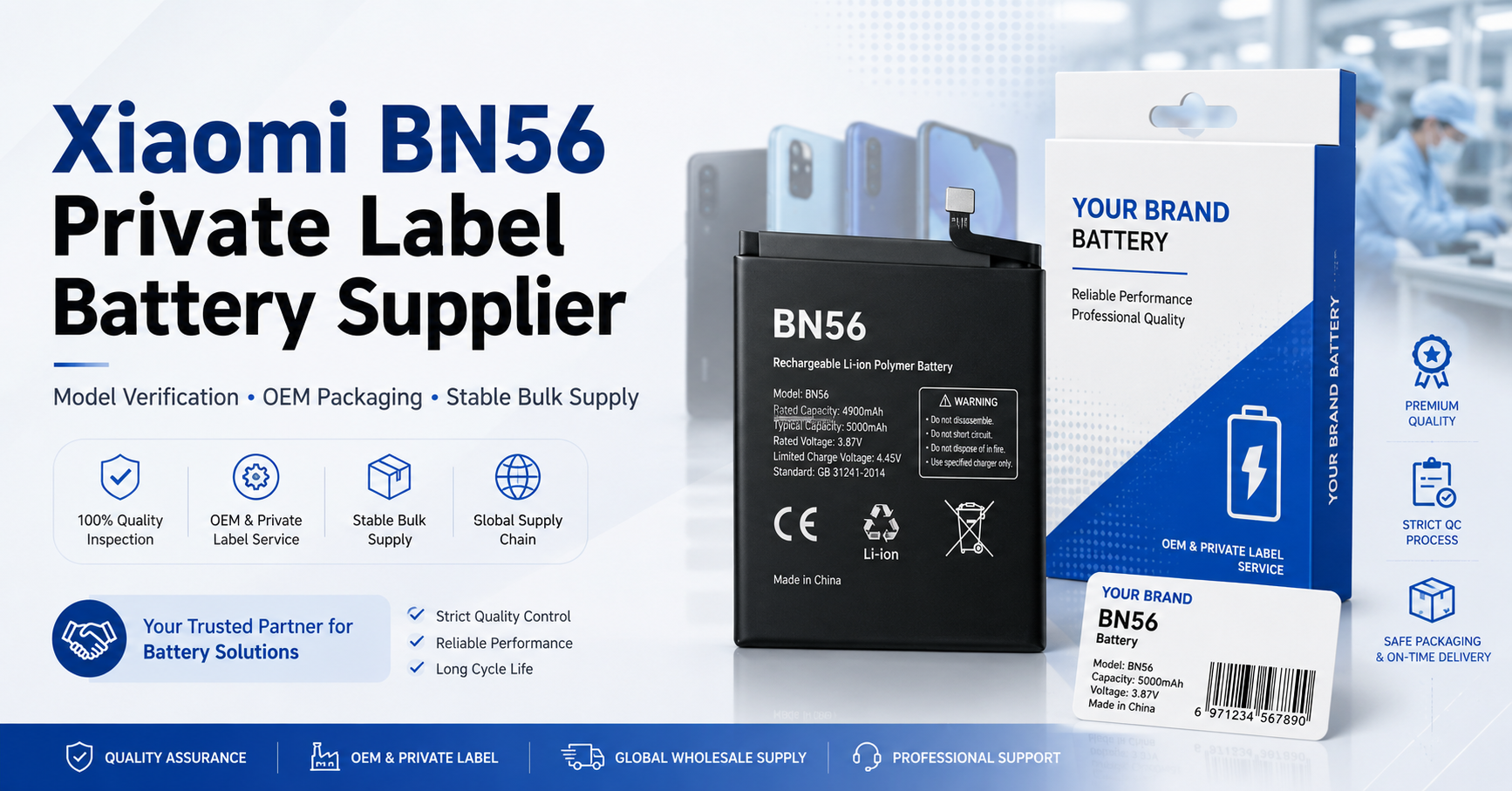
Check OEM and Private Label Support
Many distributors eventually want their own battery brand.
A professional OEM phone battery manufacturer should support battery label, retail box, barcode, warranty card, user manual, carton mark and product series planning.
Private label is not only logo printing.
It helps distributors reduce price comparison, improve customer loyalty and build long-term market recognition.
Check After-Sales Analysis Ability
After-sales support is part of supplier quality.
A reliable supplier should help analyze whether a complaint comes from the battery, phone motherboard, charger, installation, storage condition, packaging damage or user behavior.
For distributors, this matters because they must protect downstream repair-shop relationships.
A supplier who only says “send back defective goods” is not enough.
Shenzhen ESC Solution: Replacement Phone Battery Supply for Distributors
Shenzhen ESC supports mobile parts distributors, wholesalers, repair shops, repair chains, refurbished device suppliers, e-commerce sellers and private label brands with replacement phone battery solutions.
As a phone battery supplier for mobile parts distributors, Shenzhen ESC can support broad model coverage, sample evaluation, standard-capacity batteries, high-capacity options, iPhone battery health display options, decoded battery solutions, bulk packaging, OEM packaging and quality-control discussion.
Shenzhen ESC focuses on distributor-level needs: model accuracy, stable capacity, internal resistance control, PCM protection, installation fit, clear labeling, packaging protection, mixed-model supply and after-sales support.
The goal is not to sell random battery models.
The goal is to help distributors build a reliable replacement battery catalog for repair shops, wholesale customers, e-commerce sellers and local private label growth.
Core Advantages: Why Shenzhen ESC Fits Mobile Parts Distributors
The first advantage is organized model coverage.
Distributors need a broad but manageable battery catalog.
Shenzhen ESC supports multiple phone brands and model categories, helping buyers build a clearer product structure.
The second advantage is batch consistency awareness.
A distributor cannot rely on unstable supply.
Shenzhen ESC supports sample evaluation and quality-control discussion around voltage, capacity, internal resistance, PCM function and installation fit.
The third advantage is packaging clarity.
Clear model labels, barcodes, carton marks and packaging options help reduce warehouse mistakes and customer disputes.
The fourth advantage is OEM flexibility.
Private label customers can customize battery labels, retail boxes, warranty cards, user manuals and carton marks.
The fifth advantage is B2B after-sales thinking.
A strong supplier should help distributors analyze complaints and protect their channel reputation.
Application Scenarios: Where Distributor Battery Supply Creates Value
Mobile parts distributors use replacement phone batteries to serve repair shops, repair chains, local dealers, online sellers and refurbishment buyers.
Repair shops need accurate model matching, easy installation and stable runtime.
Repair chains need consistent quality across different stores.
Wholesalers need mixed-model inventory, clear labels and fast replenishment.
Refurbished phone suppliers need predictable battery performance for repeated installation.
E-commerce sellers need retail-ready packaging, compatibility information and low return rates.
Private label buyers need customized packaging, product tiers and long-term cooperation.
For every customer type, the distributor’s value is the same.
Reliable battery supply, clear model management and lower after-sales risk.
Illustration Suggestion: Application Scenarios
Create a 1200×628px B2B scenario image divided into five clean panels: mobile parts distributor warehouse, repair shop counter, refurbished phone production line, e-commerce battery kit packing table and private label packaging review. Show Shenzhen ESC replacement phone batteries, mixed model trays, QC sheets, cartons, barcode labels and packaging boxes. Use premium blue-white technical style with short labels only.
Selection Advice: How Different Distributors Should Choose
Small distributors should start with fast-moving models and stable suppliers.
They should not carry too many long-tail SKUs before testing local demand.
Large distributors should focus on model coverage, carton labeling, replenishment speed, warranty terms and batch consistency.
Repair-channel distributors should prioritize installation fit, stable runtime and low complaint rates.
E-commerce-focused distributors should prioritize retail packaging, clear compatibility labels and return-rate control.
Private label distributors should choose a supplier that can help build product series, not only supply loose batteries.
Before launching a battery catalog, distributors should request samples, test multiple pieces, verify model labels, inspect packaging, confirm warranty terms and run a small trial with key repair-shop customers.
FAQ
What should mobile parts distributors look for in a phone battery supplier?
Distributors should check model coverage, model accuracy, real capacity, internal resistance, PCM protection, installation fit, packaging clarity, barcode support, sample testing, OEM capability and after-sales response.
Why is model accuracy important for distributors?
Model accuracy reduces wrong shipments, repair delays, warehouse confusion and warranty disputes. Similar-looking batteries may have different connectors, flex cable directions or dimensions.
How can distributors avoid fake capacity batteries?
Distributors should request samples, test multiple pieces, compare rated capacity with tested capacity, check internal resistance and avoid unrealistic high-capacity claims that do not match battery size.
Should distributors test batteries before adding them to a catalog?
Yes. Distributors should test voltage, internal resistance, capacity, charge-discharge behavior, installation fit, heat behavior and packaging before launching a model to customers.
Can Shenzhen ESC support mixed-model battery orders?
Yes. Shenzhen ESC can support mixed-model replacement battery supply for distributors, depending on model availability, quantity and packaging requirements.
Can Shenzhen ESC support private label packaging for distributors?
Yes. Shenzhen ESC can support battery labels, retail boxes, barcodes, model stickers, user manuals, warranty cards, carton marks and private label packaging.
Why should distributors avoid choosing only the cheapest supplier?
The cheapest supplier may increase total cost through returns, warranty claims, wrong model complaints, negative customer feedback and channel reputation damage.
Who should work with a distributor-focused phone battery supplier?
Mobile parts distributors, wholesalers, repair chains, local dealers, refurbished phone suppliers, e-commerce sellers and private label battery brands can benefit from a distributor-focused supplier.
Conclusion
Choosing a phone battery supplier for mobile parts distributors is a channel strategy decision, not just a product purchase.
Distributors need stable capacity, model accuracy, PCM protection, installation fit, packaging clarity, barcode support, batch consistency, OEM options and after-sales analysis.
A reliable supplier helps distributors reduce warranty claims, improve warehouse control, support repair-shop customers and build stronger long-term channels.
Shenzhen ESC supports mobile parts distributors with replacement phone battery supply, model recommendations, sample testing, quality-control discussion, OEM packaging and mixed-model bulk supply.
Contact Shenzhen ESC to request phone battery model lists, samples, packaging options and wholesale pricing for your distribution business.