
For repair shops, refurbished iPhone sellers and mobile phone battery wholesalers, battery quality is not judged only by capacity. A battery can show a beautiful capacity number on the label, but still create problems if the cell swells, heats up, drains fast, loses capacity too quickly or performs inconsistently across batches.
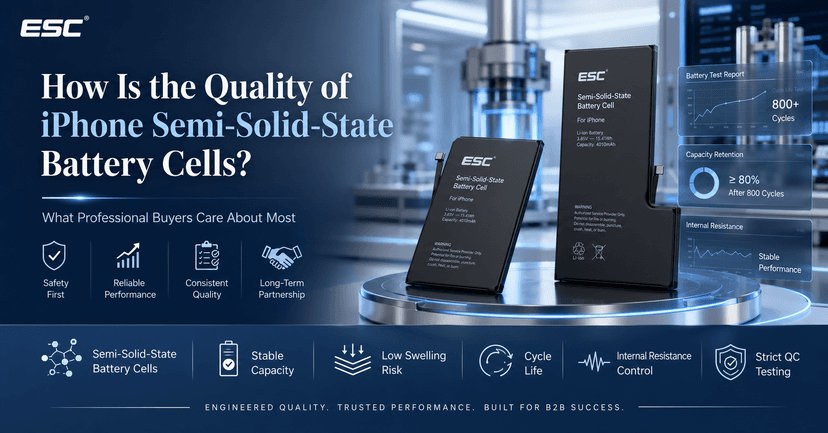
That is why many buyers now ask: How is the quality of iPhone semi-solid-state battery cells?
The honest answer is this: semi-solid-state battery cells can offer better safety potential, stronger stability and premium positioning compared with ordinary low-grade replacement cells, but the final quality still depends on the cell material system, manufacturing consistency, thickness control, internal resistance, cycle life, aging test and protection design.
ESC supplies iPhone replacement batteries for repair shops, refurbishment facilities, wholesalers and private label customers. For semi-solid-state iPhone battery projects, our focus is not empty hype. Our focus is practical quality evaluation: stable cells, lower swelling risk, real capacity testing, batch consistency and safer repair-market supply.
What Does “Semi-Solid-State” Mean in iPhone Battery Cells?
In the replacement battery market, “semi-solid-state” usually refers to a lithium battery cell using a gel-like, quasi-solid or semi-solid electrolyte system instead of relying fully on a traditional liquid electrolyte structure. It is not the same as a fully solid-state battery, and it should not be marketed as magic technology.
A semi-solid-state cell sits between traditional liquid lithium-ion cells and fully solid-state battery technology. Research on quasi-solid electrolytes shows that these systems can combine some advantages of liquid and solid electrolytes, including better electrode contact, improved safety environment and higher thermal stability compared with typical liquid electrolyte systems. One Nature Communications study reported that a quasi-solid electrolyte could provide mechanical stiffness to help block dendrites and create a safer, nonflammable operating environment than typical liquid electrolytes.
For iPhone replacement batteries, the practical meaning is simple: buyers are looking for a cell structure that can reduce risk, improve stability and support premium repair service.
But do not be fooled. The word “semi-solid-state” alone does not guarantee quality. A bad factory can put a beautiful name on an average cell. Buyers must verify the test data.
Why Semi-Solid-State Cells Attract Repair and Refurbishment Buyers
The iPhone repair market is becoming more demanding. Customers care about battery health, runtime, fast charging, heat, swelling and after-sales stability. Apple also explains that iPhone lithium-ion batteries are consumables, and their capacity and performance decline over time; Apple’s battery health page warns that degraded batteries can affect peak performance and unexpected shutdown behavior.
For repair businesses, this creates a brutal reality: a cheap battery can destroy a good repair reputation.
Semi-solid-state iPhone battery cells are attractive because they can support three business goals:
First, they help repair shops build a premium battery service instead of competing only on low price.
Second, they give refurbished phone sellers a stronger selling point when grading devices.
Third, they help wholesalers create a differentiated product line for customers who care about safety and stable performance.
This is why semi-solid-state iPhone batteries should be positioned as premium repair-market batteries, not ordinary cheap replacement parts.
The Real Quality Indicators Buyers Should Check
A serious buyer should not ask only, “Is it semi-solid?” That question is too shallow.
A better question is: “What test results prove that this semi-solid-state iPhone battery cell is stable in real repair use?”
1. Real capacity consistency
Capacity should be tested, not guessed from the label. For iPhone batteries, buyers should check whether the real capacity stays within a stable range across the batch. Fake capacity is easy to print. Real capacity needs testing.
For wholesalers and refurbishers, capacity consistency matters more than one impressive sample. A sample can look perfect. A bulk batch is where bad suppliers expose themselves.
2. Internal resistance control
Internal resistance affects power delivery, heat, voltage drop and customer complaints. A cell with poor internal resistance control may charge and discharge less efficiently, generate more heat or trigger unstable performance under load.
For repair shops, this can become “battery drains fast,” “phone shuts down,” or “battery percentage jumps.”
3. Swelling resistance
One of the main reasons buyers care about semi-solid-state cells is the expectation of lower swelling risk. Semi-solid or quasi-solid electrolyte systems can reduce free liquid electrolyte and improve thermal stability in certain designs. The Nature Communications study on quasi-solid electrolytes reported stable pouch-cell performance even at high temperature and after damage in experimental conditions.
But here is the key: lower risk is not zero risk. No responsible supplier should claim zero swelling. Swelling risk still depends on cell material, sealing quality, charge-discharge stress, storage condition, protection board design and installation handling.
4. Cycle life
Cycle life tells buyers how long the battery can keep useful capacity after repeated charge and discharge. For premium repair shops and refurbished phone sellers, this matters because customers do not judge the battery only on day one.
A serious supplier should explain how cycle testing is done and what retention standard is used.
5. Thickness and flatness
iPhone batteries are installed in tight internal spaces. A cell that is slightly too thick can create pressure inside the phone. A cell that is not flat can create installation difficulty or long-term pressure risk.
Semi-solid-state or premium battery cells still need strict thickness and flatness inspection before shipment.
6. Protection board matching
Cell quality is only one part of battery quality. The protection board must also manage charging, discharging, short-circuit protection and temperature-related risk.
Apple warns that iPhone lithium-ion batteries are sensitive components and should be serviced carefully; damage can cause overheating, fire or injury. This is why replacement battery suppliers must take protection design and technician handling seriously.
Semi-Solid-State iPhone Battery vs Normal iPhone Battery
A normal replacement battery can still be suitable for standard repair. Semi-solid-state batteries are more suitable when the buyer wants premium positioning, better safety story and stronger quality control.
| Comparison Point | Normal iPhone Battery | Semi-Solid-State iPhone Battery |
|---|---|---|
| Main positioning | Standard repair | Premium repair and refurbishment |
| Buyer focus | Price, capacity, fitment | Safety, stability, swelling control, premium value |
| Best use | Daily repair shops | Repair chains, refurbishers, wholesalers |
| Selling point | Affordable replacement | Higher-quality cell structure and QC story |
| Quality risk | Depends heavily on supplier | Still depends on supplier, but positioned for stricter QC |
| Best customer | Price-sensitive market | Customers who care about safety and reputation |
The stupid way is to say semi-solid-state is always better. The professional way is to say: it is better only when the cell system, production process and QC standard are truly better.
Why Semi-Solid-State Does Not Automatically Mean “Best Quality”
Solid-state and semi-solid-state technologies have strong potential, but the industry is still solving manufacturing and commercialization challenges. A 2025 solid-state battery review describes solid-state batteries as promising for safety, energy density and cycle life, but also emphasizes materials, architecture, degradation and commercialization challenges. Another 2025 review notes that solid-state batteries offer potential improvements over conventional lithium-ion batteries, but scaling from lab to industry requires solving electrolyte selection, electrode compatibility, interface engineering, processing and long-term performance challenges.
This is important for your website. Do not write like a clown and say “semi-solid-state battery is perfect.” Serious buyers know better.
A better sentence is:
“Semi-solid-state iPhone battery cells can offer premium safety and stability potential, but buyers should evaluate real performance through capacity testing, internal resistance testing, swelling observation, cycle testing, aging tests and batch consistency records.”
That sentence is not flashy. But it is trustworthy.
Why Choose ESC for Semi-Solid-State iPhone Battery Projects?
ESC supports B2B customers who need more than a low-price replacement battery. For semi-solid-state iPhone battery projects, ESC focuses on premium repair and wholesale channels where safety, consistency and product positioning matter.
ESC can support:
- Semi-solid-state iPhone replacement battery options
- Original capacity and selected high-capacity battery planning
- Battery cell quality evaluation
- Capacity and voltage testing
- Internal resistance checking
- Aging test before shipment
- Thickness and appearance inspection
- Protection board function checking
- Mixed-model wholesale orders
- OEM label and private label packaging
- Export packing and shipment support
- After-sales feedback analysis
For repair shops, ESC helps build a premium battery service line.
For refurbishers, ESC helps match battery grade with device grade.
For wholesalers, ESC helps create differentiated SKUs instead of selling only ordinary replacement batteries.
For private label customers, ESC can support packaging, model labels, barcode labels, warranty cards and outer cartons.
A Practical Case: Repair Chain Upgrading from Normal Cells to Semi-Solid Cells
A repair chain may start with normal replacement iPhone batteries because the price is easier to sell. At first, the business looks fine. But after several months, the shop starts seeing repeated complaints: fast drain, battery health doubt, swelling concern and inconsistent runtime between batches.
The owner has two choices.
The cheap choice is to continue arguing with customers.
The smart choice is to divide the battery service into two levels.
Standard battery service: normal original-capacity replacement batteries for price-sensitive customers.
Premium battery service: semi-solid-state iPhone battery cells for customers who care about safer cell structure, lower swelling risk, more stable performance and better repair confidence.
This gives the repair shop a stronger sales explanation:
“Both batteries can replace the old battery. The premium version uses a higher-grade cell structure and stricter QC testing, suitable for customers who care more about long-term stability and safety.”
This is how a technical product becomes a business tool.

How Buyers Should Test Semi-Solid-State iPhone Battery Samples
Before placing bulk orders, buyers should test samples carefully. Do not buy by brochure.
A practical sample test should include:
- Check open-circuit voltage
- Test real capacity
- Measure internal resistance
- Check battery thickness and flatness
- Confirm connector and flex structure
- Test charge and discharge stability
- Observe heat during charging
- Run aging test if possible
- Install in target iPhone models
- Track runtime and user feedback
- Compare with normal battery samples
- Keep batch records after order
A supplier who refuses sample testing is not worth your time. Battery buyers do not need fairy tales. They need data.
Who Should Buy iPhone Semi-Solid-State Battery Cells?
Semi-solid-state iPhone battery cells are suitable for:
- Premium iPhone repair shops
- Repair chain stores
- Refurbished iPhone facilities
- Used phone wholesalers
- Phone parts distributors
- E-commerce repair kit sellers
- Private label battery brands
- Buyers who want a higher-grade battery line
They are not necessary for every market. If your customers only want the lowest price, normal replacement batteries may be enough. But if your customers complain about swelling, fast drain, inconsistent runtime or poor repair reputation, semi-solid-state cells may be worth testing.
FAQ About iPhone Semi-Solid-State Battery Cell Quality
Are iPhone semi-solid-state battery cells better than normal cells?
They can be better for safety potential, swelling control and premium positioning, but only when the cell design and QC process are truly strong. The name alone does not prove quality.
Do semi-solid-state iPhone batteries never swell?
No. No responsible supplier should claim zero swelling. Semi-solid-state cells may reduce swelling risk under better material and process control, but swelling can still occur due to poor manufacturing, heat, over-discharge, physical damage or incorrect use.
Are semi-solid-state iPhone batteries Apple original batteries?
No. ESC supplies aftermarket replacement batteries for repair, refurbishment, wholesale and private label markets. We do not describe aftermarket batteries as Apple genuine batteries.
What should buyers test before ordering?
Buyers should test capacity, voltage, internal resistance, thickness, flatness, connector fitment, charge-discharge stability, aging performance and sample performance in real devices.
Are semi-solid-state batteries safer?
Semi-solid and quasi-solid electrolyte systems can offer improved safety potential compared with traditional liquid electrolyte systems, but final safety depends on materials, manufacturing, protection design and quality control.
Who should use semi-solid-state iPhone batteries?
They are most suitable for premium repair shops, repair chains, refurbished phone sellers, wholesalers and private label customers who want a stronger quality story and lower after-sales risk.
Can ESC support OEM packaging?
Yes. ESC can support logo labels, retail boxes, barcode labels, warranty cards, manuals and outer cartons for private label iPhone battery projects.
Work with ESC
ESC supplies iPhone replacement batteries, semi-solid-state iPhone battery options, high capacity batteries, diagnostic-ready batteries and OEM packaging support for professional repair and wholesale buyers.
If you are evaluating how is the quality of iPhone semi-solid-state battery cells, ESC can help you compare samples, check real capacity, review internal resistance, confirm model fitment, prepare OEM packaging and build a more reliable premium battery line.
Explore more products from our iPhone Replacement Battery category.
For premium and diagnostic-ready solutions, visit our iPhone Decode Battery category.
For private label projects, visit our OEM Battery Packaging service page and send us your model list for quotation.