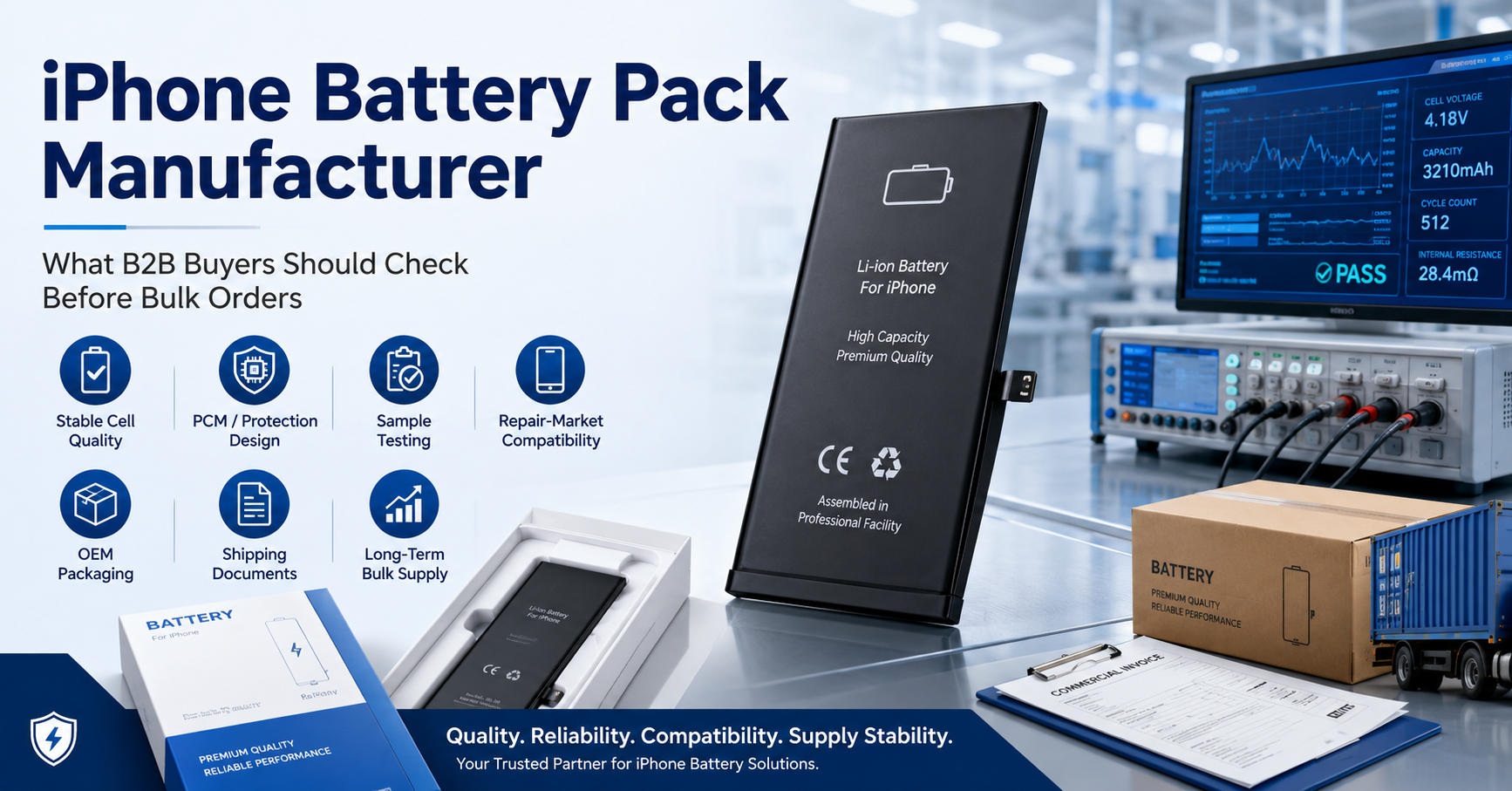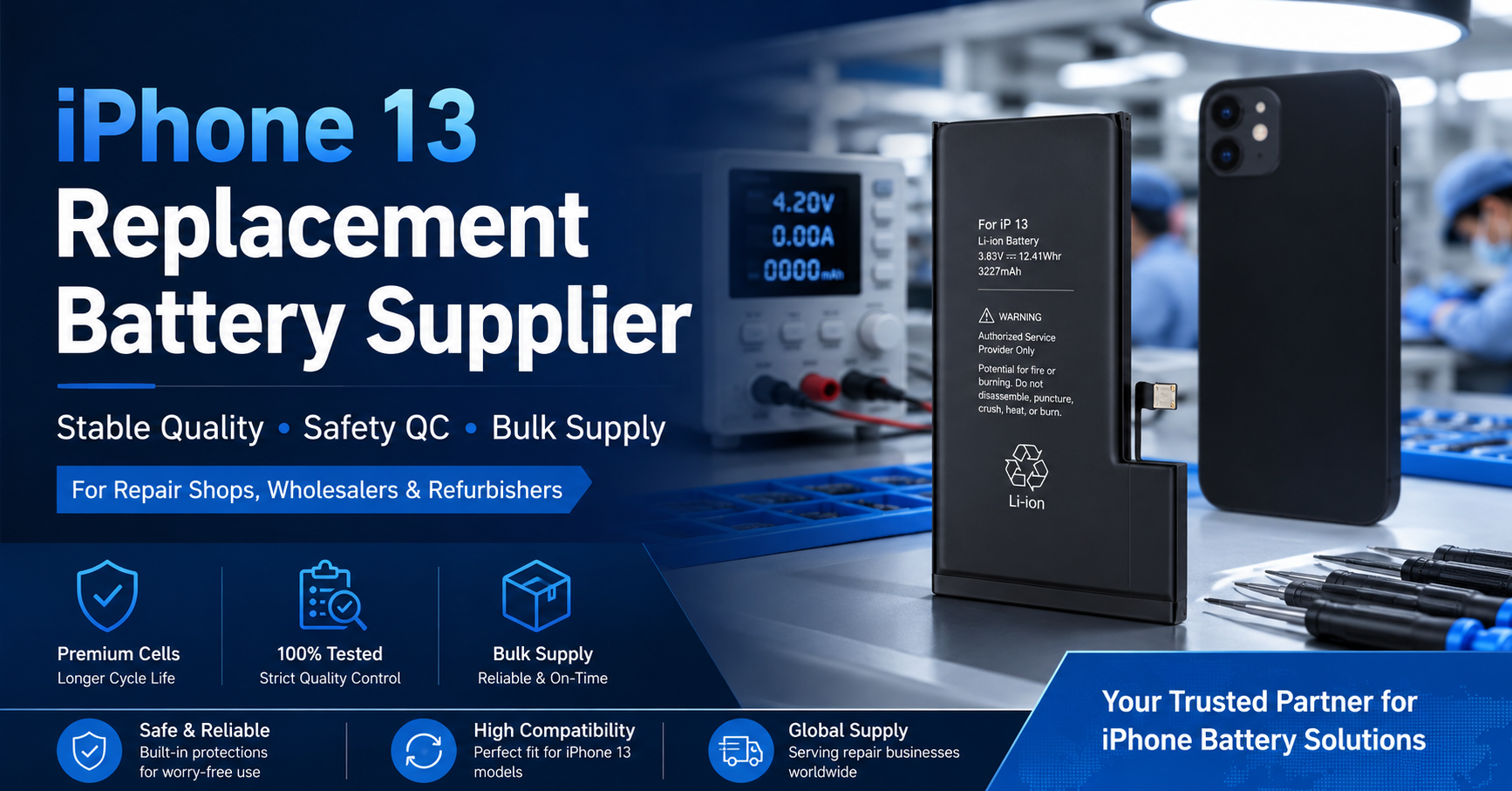

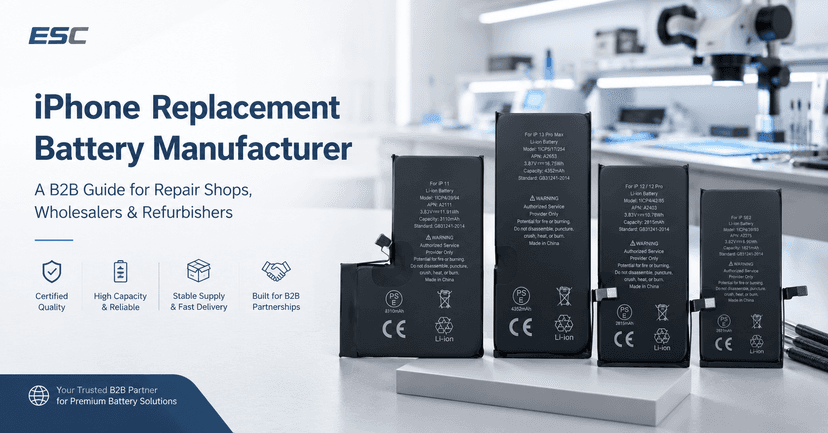
An iPhone replacement battery manufacturer should do more than supply a battery that simply powers on the device. For repair shops, refurbishers, wholesalers, distributors and private label buyers, the real question is whether the battery can match the correct iPhone model, fit cleanly inside the phone, charge safely, perform consistently and reduce after-sales complaints.
iPhone battery replacement is now a professional repair category, not a simple accessory purchase. Buyers care about model fit, capacity consistency, internal resistance, connector quality, PCM protection, Battery Health display behavior, Parts and Service History status, packaging, documents and repeat supply.
That is why a serious sourcing decision should not be based only on the lowest quotation.
A reliable battery manufacturer helps buyers protect repair-shop reputation, reduce warranty claims and build a stronger replacement battery product line.
Quick Answer: What Makes a Good iPhone Replacement Battery Manufacturer?
A good iPhone replacement battery manufacturer provides model-specific iPhone batteries with stable cell quality, accurate connector layout, realistic capacity, reliable PCM protection, clear labels, safe packaging, sample testing support and wholesale-ready documentation.
For B2B buyers, the manufacturer should also support mixed-model orders, diagnostic battery options, no pop-up battery options where supported, Battery Health display solutions, private label packaging, carton marks, repeat supply and after-sales handling.
The best supplier is not always the cheapest supplier.
The best supplier is the one that helps repair businesses reduce total after-sales cost.
Search Intent and Buyer Analysis
The keyword iPhone replacement battery manufacturer has strong commercial and transactional intent.
The searcher is usually not only looking for general iPhone battery knowledge. They may be comparing suppliers, preparing bulk orders, building repair-shop inventory, sourcing refurbishment batteries or developing a private label battery brand.
Main Buyer Types
| Buyer Type | Main Need | Biggest Risk |
|---|---|---|
| Repair shop | Daily iPhone battery replacement | Customer returns after repair |
| Refurbished phone factory | Batch battery replacement before resale | One unstable batch affects many devices |
| Wholesaler | Mixed iPhone battery inventory | Downstream repair-store complaints |
| E-commerce seller | Retail battery kits and online listings | Wrong-model returns and negative reviews |
| Private label buyer | Branded iPhone battery line | Brand damage from unstable quality |
| Repair chain | Standardized battery program | Inconsistent repair results across stores |
Buyer Questions This Article Answers
What should I check before choosing an iPhone battery manufacturer?
Which iPhone battery models should wholesalers stock first?
How can I avoid fake capacity iPhone batteries?
Why does an iPhone replacement battery drain fast?
What is the difference between standard, high capacity and diagnostic iPhone batteries?
What documents are needed for iPhone battery export?
How should repair shops test iPhone batteries before bulk orders?
Can iPhone replacement batteries support private label packaging?
How can I reduce customer complaints after iPhone battery replacement?
What makes a manufacturer better than a trading supplier?
Product Positioning: What ESC Supplies
ESC supplies iPhone replacement battery solutions for repair shops, refurbishers, wholesalers, distributors, e-commerce sellers and private label buyers.
The product category can cover standard capacity iPhone batteries, high capacity iPhone batteries, diagnostic-compatible iPhone batteries, no pop-up battery options where supported, Battery Health display solutions, OEM pulled / used-status battery options and private label battery programs.
The product positioning is clear:
ESC provides iPhone replacement battery solutions for professional repair and resale businesses that need stable quality, accurate fit and lower after-sales risk.
This positioning matters because iPhone batteries are not generic smartphone batteries.
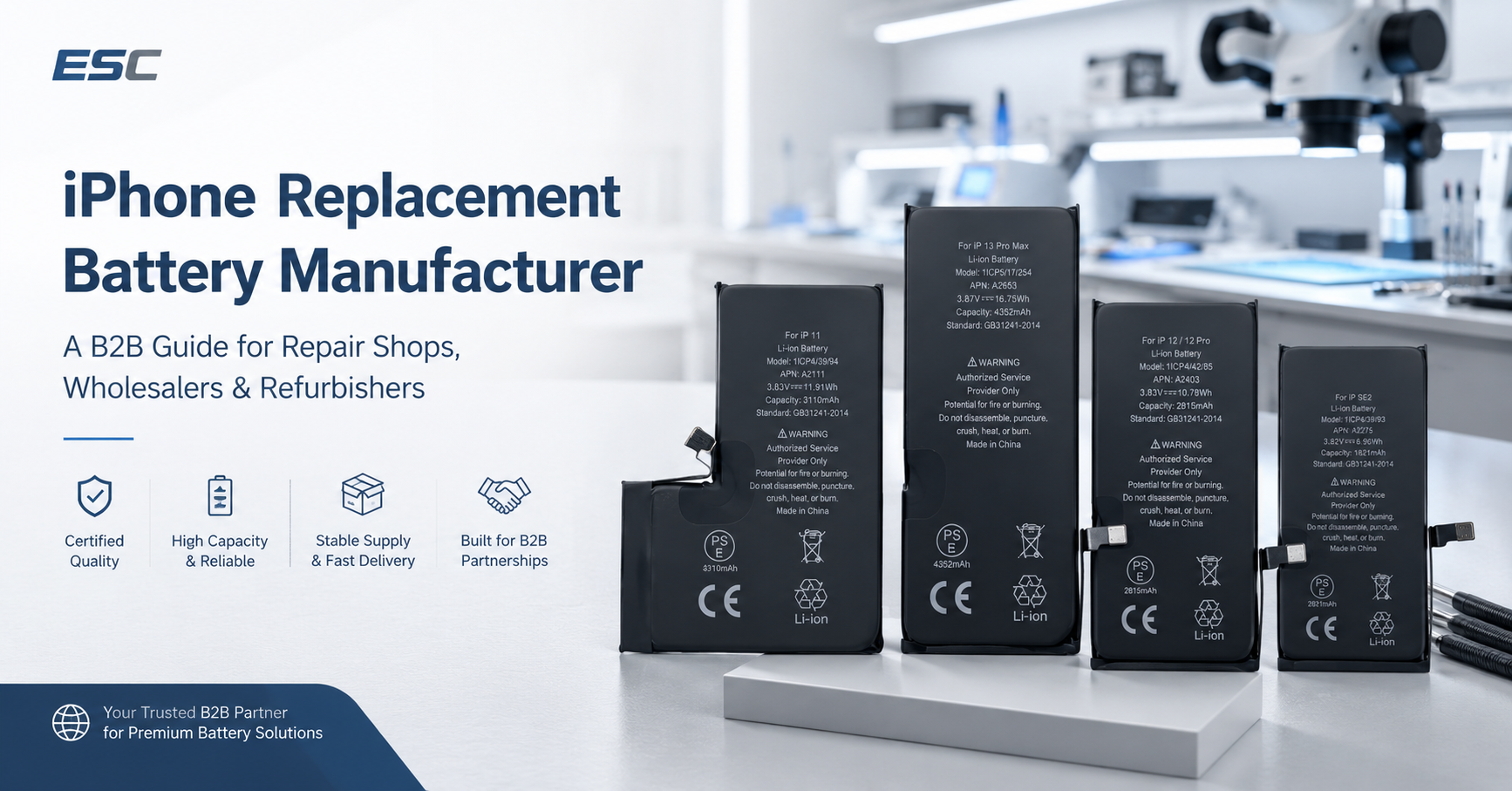
Different iPhone models can have different battery shapes, connector positions, flex cable directions, rated capacities, board designs and repair-display behavior.
A manufacturer that cannot control model accuracy and batch consistency will create repair failure, inventory confusion and warranty pressure.
Who This Product Is For — and Who It Is Not For
Best-Fit Buyers
ESC iPhone replacement batteries are suitable for:
Professional phone repair shops
iPhone repair specialists
Repair chains
Refurbished phone factories
Used phone exporters
Spare-parts wholesalers
Regional battery distributors
E-commerce repair-kit sellers
Private label battery brands
After-sales service networks
Not Ideal For
This product category is not ideal for buyers who:
Do not confirm exact iPhone model numbers
Only compare batteries by the lowest price
Do not test samples before bulk orders
Cannot manage lithium battery shipping requirements
Expect one battery type to fit several iPhone generations
Want to describe aftermarket batteries as original Apple batteries without proof
Expect no-pop-up or Battery Health display results on every model without conditions
Professional buyers should treat iPhone replacement batteries as technical service parts, not simple accessories.
Why iPhone Battery Replacement Creates After-Sales Risk
iPhone battery replacement may look simple, but after-sales risk often comes from model matching, battery data behavior, charging stability, installation quality and customer-facing display results.
1. Wrong Model Matching
iPhone model names can look similar, but battery design can differ significantly.
An iPhone 13 battery is not the same as an iPhone 13 Pro battery.
An iPhone 14 Plus battery is not the same as an iPhone 14 Pro Max battery.
A battery that appears close may still have a different connector, different flex cable direction, different thickness or different adhesive layout.
Wrong model matching can cause:
No power
No charging
Poor fit
Screen pressure
Back cover lifting
Connector damage
Battery percentage jumping
Customer returns
2. Fake or Exaggerated Capacity
Some batteries show attractive printed mAh values, but actual tested capacity may be lower.
For repair shops, fake capacity creates fast-drain complaints.
For wholesalers, it creates downstream warranty claims.
For e-commerce sellers, it creates negative reviews.
Printed capacity should be treated as a starting point, not final proof.
3. High Internal Resistance
High internal resistance can cause weak discharge performance, sudden shutdown, heat, percentage jumping or poor runtime under load.
A battery can show normal voltage before installation and still perform poorly after real use.
4. Weak PCM Protection
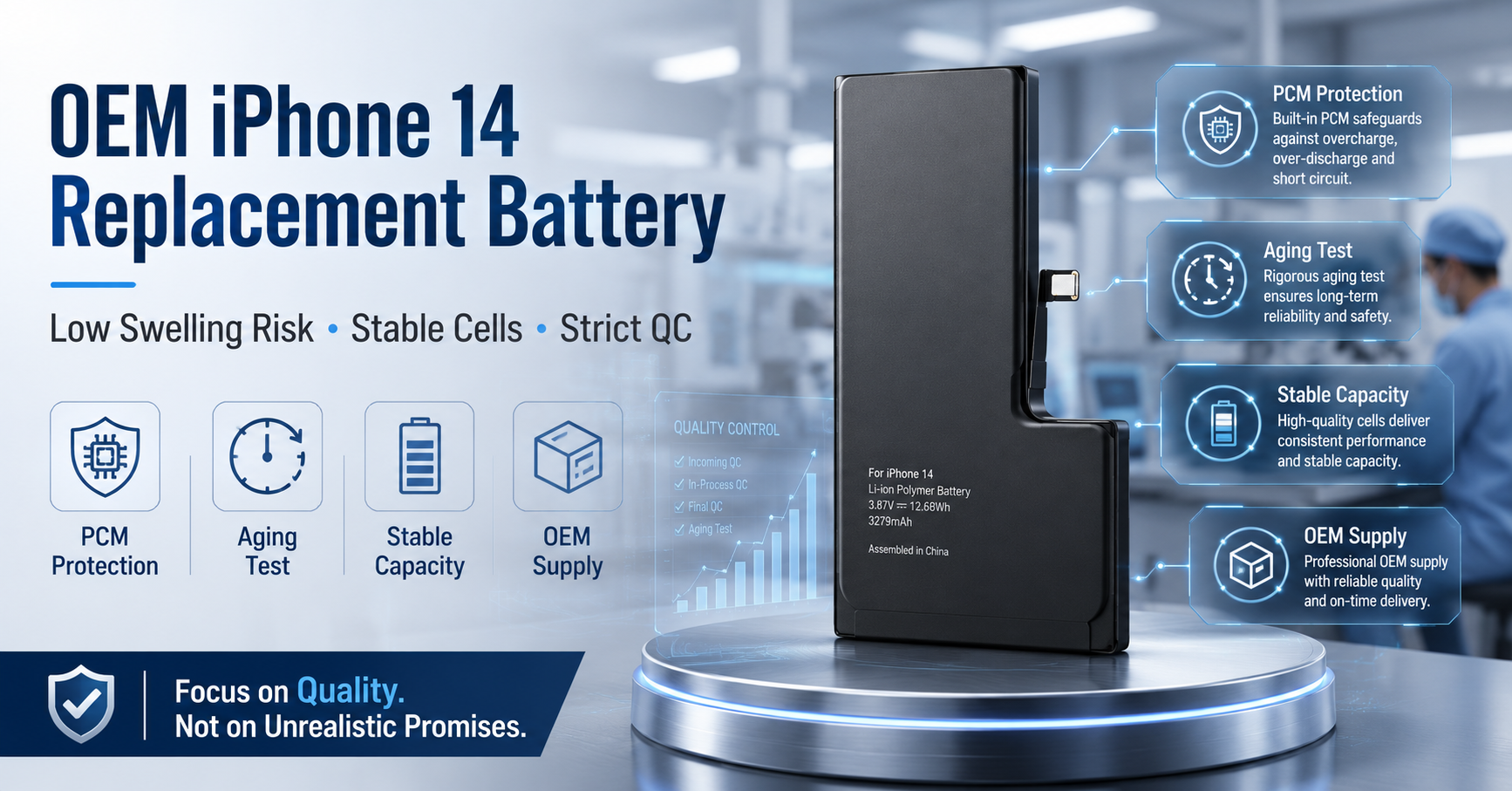
The PCM protection board helps manage over-charge, over-discharge, over-current and short-circuit risks.
Weak or inconsistent PCM design can create no-charging issues, abnormal heat, poor stability or safety risk.
5. Battery Health and Warning-Message Pressure
For iPhone repairs, the customer may judge the repair by what the phone displays after installation.
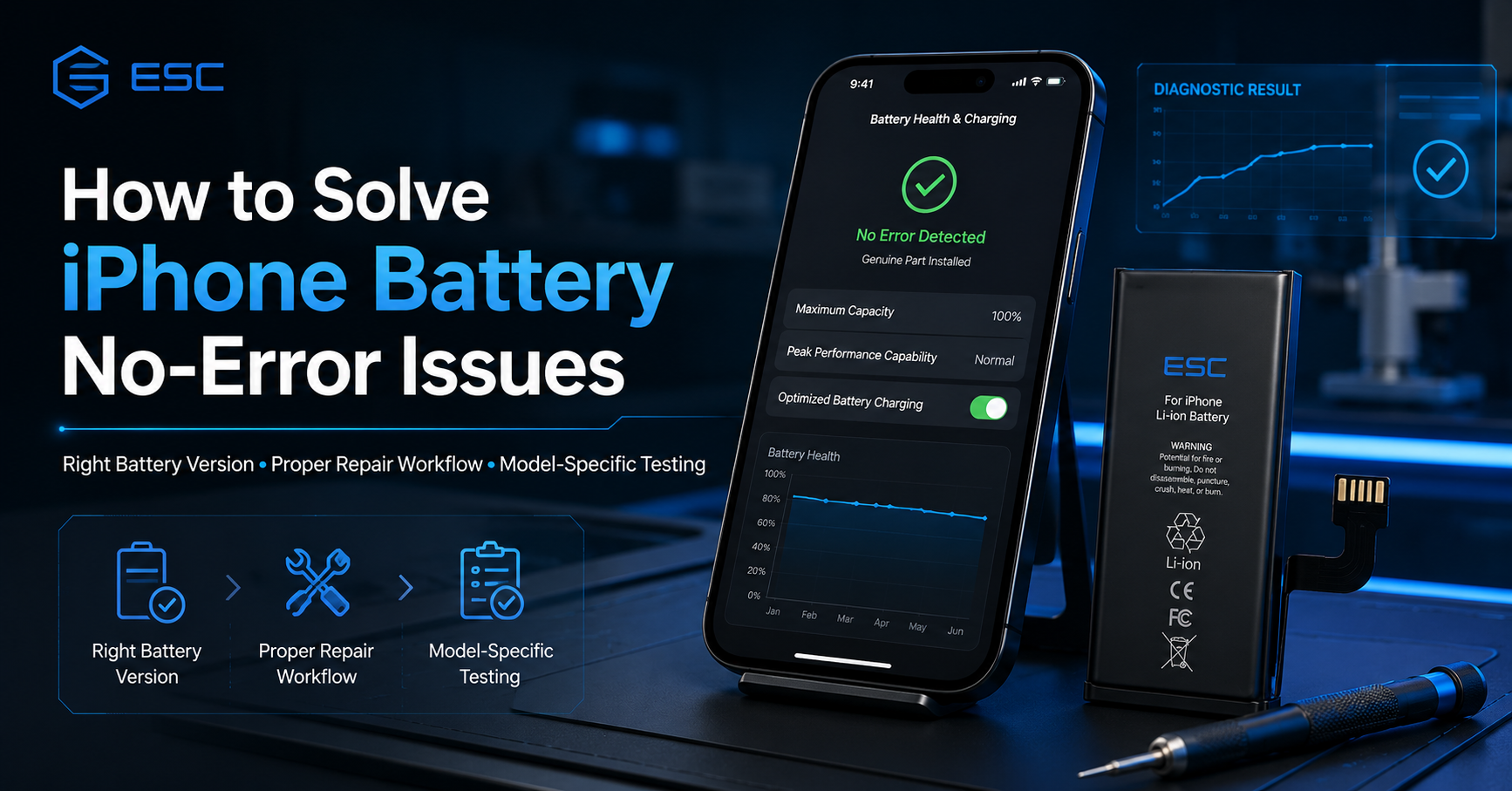
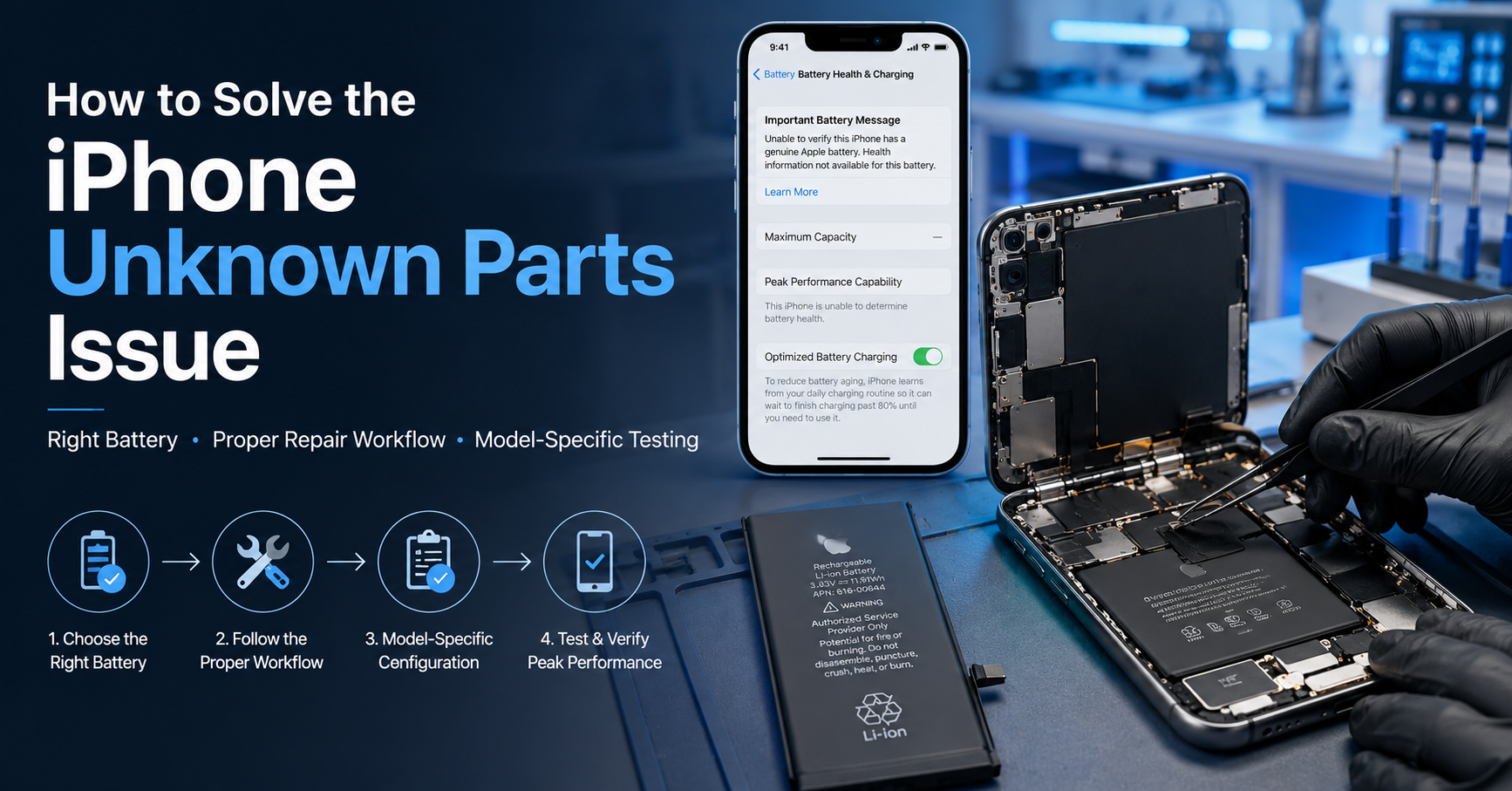
If Battery Health does not show as expected, or the phone displays Unknown, Service or other warning status, the customer may think the repair failed.
This creates communication pressure for repair shops and resale pressure for refurbishers.
6. Poor Packaging
iPhone batteries are thin pouch-style components.
Poor packaging can damage the cell body, flex cable, connector or insulation area during shipping.
A good battery can become a bad repair part before it reaches the technician.
How iPhone Replacement Batteries Work
An iPhone replacement battery is usually a Li-ion polymer battery pack designed for a specific iPhone model.
It normally includes:
Battery cell
Protection circuit module
Flex cable
Connector
Insulation layers
Adhesive area
Battery data / fuel gauge section
Printed model label
Safety and recycling markings
The cell stores energy.
The protection circuit helps manage electrical safety.
The connector and flex cable link the battery to the iPhone motherboard.
The battery data section affects how the phone reads battery-related information.
The physical shape allows the pack to fit inside the phone body.
For repair shops, all of these parts matter.
A stable cell alone is not enough if the connector is weak.
A high printed capacity is not useful if the battery does not fit the correct model.
A clean package is not enough if the battery creates post-install customer complaints.
Key Specifications Buyers Should Check
| Checkpoint | What to Check | Why It Matters |
| Compatible model | Exact iPhone model and battery code | Avoids wrong installation |
| Battery type | Li-ion polymer | Confirms basic battery category |
| Rated capacity | Printed mAh and tested capacity | Helps verify runtime expectation |
| Nominal voltage | Model-specific voltage value | Confirms electrical compatibility |
| Charge limit voltage | Maximum charge voltage | Affects charging behavior |
| Internal resistance | Batch consistency range | Reduces fast-drain and shutdown complaints |
| Connector type | Position, direction and fit | Prevents no-power and no-charging issues |
| Flex cable quality | Length, thickness and strength | Affects installation reliability |
| PCM protection | Over-charge, over-discharge, short-circuit protection | Improves safety and stability |
| Battery Health behavior | Display status after installation where supported | Reduces customer doubt |
| Packaging | Anti-pressure, connector protection, model label | Reduces shipping damage |
| Documents | MSDS, UN38.3, RoHS, CE, PSE, KC or market files | Supports shipping and compliance |
| Warranty policy | Claim process and evidence requirements | Controls after-sales cost |
This table should be used before every iPhone battery bulk order.
iPhone Battery Product Types: What Buyers Should Understand
A professional manufacturer should not treat all iPhone battery customers as the same.
Different buyers need different product levels.
| Battery Type | Main Features | Best For | Buyer Risk to Control |
| Standard Capacity Battery | Original-capacity style replacement | Daily repair demand | Price pressure and basic quality |
| High Capacity Battery | Higher printed or tested capacity where structure allows | Premium repair and longer runtime demand | Fake capacity and heat behavior |
| Diagnostic-Compatible Battery | Supports post-install checking workflow where applicable | Repair shops and refurbishers | Model and process limitations |
| No Pop-Up Battery Option | Designed to reduce warning-message friction on supported models | Customer-facing repairs | Overpromising display results |
| Battery Health Display Battery | Helps support clearer Battery Health presentation where supported | Refurbishment and premium repair | Software and installation dependency |
| OEM Pulled / Used Status Battery | Used-status display for selected repair scenarios | Specific refurbishment projects | Source clarity and condition control |
| Private Label Battery | Custom label, box and warranty card | Brand buyers and distributors | Packaging consistency and warranty control |
This structure allows wholesalers to build a tiered product line instead of competing only on low price.
iPhone Battery Model Coverage: What Wholesalers Should Plan
A broad iPhone catalog is useful only if it matches real repair demand.
Wholesalers should not stock every model equally.
They should prioritize fast-moving models according to local repair volume, device age and customer expectations.
| iPhone Series | Typical Market Demand | Buyer Priority |
| iPhone 11 Series | Mature repair demand | Cost control and stable supply |
| iPhone 12 Series | High repair volume | Model accuracy and repeat stock |
| iPhone 13 Series | Strong repair and refurbishment demand | Capacity consistency and packaging |
| iPhone 14 Series | Higher customer expectation | Better QC and Battery Health communication |
| iPhone 15 Series | Newer repair market | Diagnostic behavior and careful compatibility |
| iPhone 16–17 Series | New arrival / premium market | Clear model support and cautious product claims |
| Pro / Pro Max Models | Higher resale value | Strict fit, connector and display behavior |
| Mini / Plus Models | Variant-specific demand | Exact SKU separation |
For repair shops, model fit is the first priority.
For wholesalers, inventory planning is the first priority.
For refurbishers, batch consistency is the first priority.
Standard Battery Supplier vs Professional iPhone Battery Manufacturer
| Item | Basic Low-Price Supplier | Professional iPhone Battery Manufacturer |
| Main selling point | Low unit price | Stable supply and lower after-sales risk |
| Model control | Often broad or unclear | Exact model and battery code matching |
| Capacity claim | May focus on printed mAh | Requires tested capacity and batch consistency |
| Connector fit | May vary by batch | Controlled connector and flex layout |
| Battery Health support | Often unclear | Clear model-by-model explanation where supported |
| Packaging | Basic protection | Connector protection and carton labeling |
| Documentation | Often unclear | MSDS, UN38.3 and market documents where needed |
| After-sales | Case-by-case | Clear claim and replacement process |
| Best for | Very low-cost markets | Repair shops, refurbishers and wholesalers |
A low-price battery may look attractive at the purchase stage.
But a professional manufacturer is more valuable when the buyer measures total business cost.
Cost and Risk: Why the Cheapest Battery Can Be Expensive
For B2B buyers, the real cost of a battery includes more than the purchase price.
It includes:
Technician rework time
Customer complaint handling
Warranty replacement cost
Shipping replacement cost
Negative reviews
Downstream buyer claims
Lost repeat orders
Brand reputation damage
A battery that saves a small amount per unit can create higher total cost if it causes frequent returns.
Repair shops and wholesalers should measure battery quality by total repair outcome, not only by quotation.
Quality Control Process Buyers Should Expect
A professional iPhone replacement battery manufacturer should have a practical QC process.
Incoming Cell Check
The manufacturer should check cell appearance, voltage and basic consistency before assembly.
Battery Assembly Check
Connector, flex cable, insulation and PCM should be inspected during production.
Electrical Testing
Key electrical checks should include:
Voltage
Internal resistance
Capacity sampling
Charging behavior
Discharge behavior
Short-circuit protection
Over-discharge protection
Over-charge protection
Appearance and Fit Check
The manufacturer should check:
Battery shape
Label placement
Connector condition
Flex cable alignment
Surface flatness
Adhesive position
Packaging fit
iPhone-Specific Installation Check
For selected iPhone models and battery types, buyers may request:
Real-device installation test
Battery Health display check
Restart behavior check
Charging behavior check
Standby drain check
Parts and Service History status check
Diagnostic workflow test where applicable
Final Packaging Check
Before shipment, batteries should be checked for model labels, batch labels, carton marks and connector protection.
For B2B buyers, QC is not just a factory process.
It is after-sales risk control.
Certifications and Shipping Documents
iPhone replacement batteries are lithium batteries. International buyers should not ignore documentation.
Common documents and compliance references may include:
MSDS
UN38.3
CE
RoHS
PSE
KC
IEC62133
Battery transport documents
Market-specific files
Buyers should not rely only on logos printed on product images.
A serious manufacturer should provide documents according to model, shipment type and destination market when required.
If a buyer plans to sell into regulated markets, document matching becomes part of the sourcing decision.
Capacity and Lead Time: What Wholesale Buyers Should Ask
Before placing an iPhone battery bulk order, buyers should ask:
Which models are in stock?
What is the MOQ per model?
Can mixed-model orders be supported?
What is the sample lead time?
What is the bulk order lead time?
Can private label packaging be arranged?
Can carton marks and barcode labels be customized?
What documents can be provided for shipping?
How are warranty claims handled?
Can diagnostic or no-pop-up battery options be tested before bulk orders?
For wholesalers and repair chains, supply continuity is often more important than one-time sample quality.
A battery manufacturer must be able to repeat the same product quality in the second, third and fourth shipment.
OEM and Private Label Support
Private label buyers need more than batteries.
They need a complete retail and wholesale package.
ESC can support private label iPhone battery projects with:
Custom battery labels
Retail boxes
Barcode labels
Warranty cards
Instruction sheets
Carton marks
Mixed-model packing
Product series planning
Repair-shop product positioning
A private label battery series can be structured into:
Standard iPhone Battery Series
High Capacity Series
Diagnostic Battery Series
No Pop-Up Battery Series
Battery Health Display Series
Refurbishment Battery Series
E-commerce Kit Series
For brand buyers, packaging and consistency are part of the product value.
Application Scenarios
Repair Shops
Repair shops use iPhone replacement batteries for phones with fast drain, swollen batteries, no charging, sudden shutdown or short runtime.
The main value is faster repair and fewer customer returns.
Refurbished Phone Factories
Refurbishers use iPhone batteries before resale.
The main value is batch stability, resale confidence and lower return risk.
Wholesalers and Distributors
Wholesalers need multiple iPhone models in stock.
The main value is clear model labeling, mixed packing and stable repeat supply.
E-Commerce Sellers
E-commerce sellers need retail-ready packaging and clear compatibility information.
The main value is fewer wrong-model returns and better product reviews.
Private Label Buyers
Private label buyers need reliable batteries and brand-ready packaging.
The main value is local market differentiation and long-term brand trust.
Repair Chains
Repair chains need standardized battery products and repair instructions.
The main value is consistent repair results across multiple stores.
How to Choose the Right iPhone Replacement Battery Manufacturer
1. Start With Your Repair Mix
Do not buy based on a full catalog alone.
Start with the iPhone models your customers actually repair most often.
If iPhone 12–14 repairs are your main volume, prioritize those models first.
If your market is moving toward iPhone 15–17, focus on model accuracy, repair-display behavior and cautious claims.
2. Confirm Exact Model Mapping
Ask the manufacturer for:
Compatible phone model
Battery model code
Capacity
Connector position
Product photo
Packaging label
Battery type
MOQ
Lead time
Do not accept vague model descriptions.
3. Test Samples Before Bulk Orders
One good photo does not prove a stable battery line.
Test several samples from the same batch.
Check fit, charge, discharge, internal resistance, standby drain and real phone performance.
For iPhone diagnostic batteries, also check display behavior after installation.
4. Review Packaging Before Shipping
Packaging should protect:
Battery pouch
Flex cable
Connector
Label surface
Insulation area
Carton structure
Shipping damage can turn good batteries into customer complaints.
5. Check After-Sales Response
Ask the manufacturer how claims are handled.
A clear after-sales process is more valuable than a vague warranty statement.
Common Mistakes Buyers Should Avoid
Mistake 1: Buying Only by Model Name
iPhone model families have many variants.
Always confirm exact model and battery code.
Mistake 2: Trusting Printed Capacity Only
Printed mAh does not prove actual capacity.
Buyers should test capacity and internal resistance.
Mistake 3: Ignoring Connector Fit
Connector alignment affects installation success.
Poor connector fit can cause no-power and no-charging issues.
Mistake 4: Overpromising No-Pop-Up or Battery Health Results
No-pop-up and Battery Health display behavior may depend on model, iOS version, repair method and battery solution.
Buyers should test supported models before making claims to customers.
Mistake 5: Skipping Documentation
Lithium battery shipping often requires proper documents.
Buyers should request MSDS and UN38.3 where needed.
Mistake 6: Moving to Bulk Orders Too Quickly
Sample testing saves money.
Bulk ordering without validation increases after-sales risk.
Internal Links Suggested for ESC Website
iPhone Battery Product Category
iPhone Diagnostic Battery Solutions
iPhone No Pop-Up Battery Guide
Show Battery Health iPhone Battery
Phone Battery Wholesale Program
Private Label Phone Battery Supplier
How to Test iPhone Battery Capacity
Why Replacement Phone Batteries Drain Fast
Phone Battery Packaging and Shipping Guide
FAQ
What is an iPhone replacement battery manufacturer?
An iPhone replacement battery manufacturer produces model-specific replacement batteries for iPhone devices, mainly serving repair shops, refurbishers, wholesalers, distributors and private label buyers.
How do I choose a reliable iPhone battery manufacturer?
Check model accuracy, tested capacity, internal resistance, connector fit, PCM protection, Battery Health behavior where supported, packaging quality, documents, sample testing support and after-sales response.
Are iPhone replacement batteries original Apple batteries?
Not necessarily. Unless verified by official documentation, replacement batteries should be described as aftermarket or compatible replacement batteries.
Which iPhone battery models should wholesalers stock first?
Wholesalers should prioritize models with local repair demand, usually iPhone 11–15 series first, then add iPhone 16–17 series according to market adoption and repair volume.
How can I avoid fake capacity iPhone batteries?
Request samples, test actual capacity, compare discharge behavior, check internal resistance and avoid relying only on printed mAh values.
Why does an iPhone replacement battery drain fast?
Fast drain may come from low actual capacity, high internal resistance, weak cell quality, motherboard leakage, background apps, poor signal, charging IC issues, battery calibration issues or installation problems.
What is PCM protection in an iPhone battery?
PCM protection helps manage over-charge, over-discharge, over-current and short-circuit risks. It is a basic safety function for replacement phone batteries.
What documents are needed for iPhone battery shipping?
Common documents may include MSDS, UN38.3 and battery transport documents. Depending on destination market, buyers may also request CE, RoHS, PSE, KC or IEC62133-related documents.
Can iPhone replacement batteries support private label packaging?
Yes. A professional manufacturer can support custom labels, retail boxes, barcodes, warranty cards, instruction sheets and carton marks.
Should I choose standard capacity or high capacity iPhone batteries?
Standard capacity batteries are suitable for daily repair demand. High capacity batteries can be offered as a premium option if the manufacturer provides realistic capacity data and stable testing results.
What is the difference between an iPhone battery supplier and manufacturer?
A supplier may only trade finished products. A manufacturer should have stronger control over cell sourcing, assembly, QC, packaging, customization and batch consistency.
Can ESC support iPhone replacement battery wholesale projects?
Yes. ESC supports iPhone replacement battery sourcing for repair shops, refurbishers, wholesalers, e-commerce sellers and private label buyers, including sample testing, model selection, packaging support and wholesale supply.
Conclusion
Choosing an iPhone replacement battery manufacturer should not be based only on price.
For repair shops, refurbishers and wholesalers, the real value is a battery program that supports accurate model matching, stable capacity, reliable connector fit, safe PCM protection, strong packaging, proper documents and repeat supply.
A reliable manufacturer helps buyers reduce returns, protect repair-shop reputation and build a stronger iPhone battery product line.
ESC supports iPhone replacement battery sourcing for repair shops, refurbishers, wholesalers, e-commerce sellers and private label buyers.
Contact ESC to request iPhone battery model options, sample testing support, packaging solutions and wholesale pricing.
CTA:
Request iPhone replacement battery samples from ESC and test the models your repair business sells most.