

The Hidden Cost of Conventional Charging
Most users never realize that every charging cycle silently affects their device’s long-term health.
Traditional single-port adapters often deliver inconsistent voltage or overheat during extended sessions, accelerating battery degradation.
As power-hungry devices — from smartphones to laptops — demand faster recharging, this problem grows more severe.
Dual-port fast chargers, built on PD 3.1 (Power Delivery) and GaN (Gallium Nitride) platforms, have transformed this equation.
They deliver smart, temperature-controlled power that adapts to each device’s needs, minimizing stress and extending lifespan.
According to Battery University, batteries maintained within 20 °C – 35 °C and charged under stable current conditions can last up to 40 % longer than those exposed to high-temperature charging.
Why Dual-Port Designs Matter for Battery Longevity
Dual-port chargers combine two independent circuits — typically USB-C PD 3.1 and USB-A QC 4.0 — allowing simultaneous charging without voltage drop or overheating.
| Design Feature | Function | Impact on Battery Health |
|---|---|---|
| Smart IC Power Management | Detects device type & allocates power dynamically | Prevents over-current damage |
| Dual Independent Output Modules | Each port regulates voltage independently | Ensures steady current supply |
| GaN Semiconductor | Increases efficiency (> 93 %) | Reduces heat buildup |
| Thermal Balance Sensors | Real-time temperature feedback | Maintains safe range (≤ 45 °C) |
| Adaptive Charging Algorithms | Adjusts wattage per battery condition | Minimizes cycle wear |
This architecture enables adaptive current distribution, ensuring that neither port competes for power — a key advantage over single-port systems that force devices to “negotiate” limited energy.
Lower Heat = Longer Battery Life
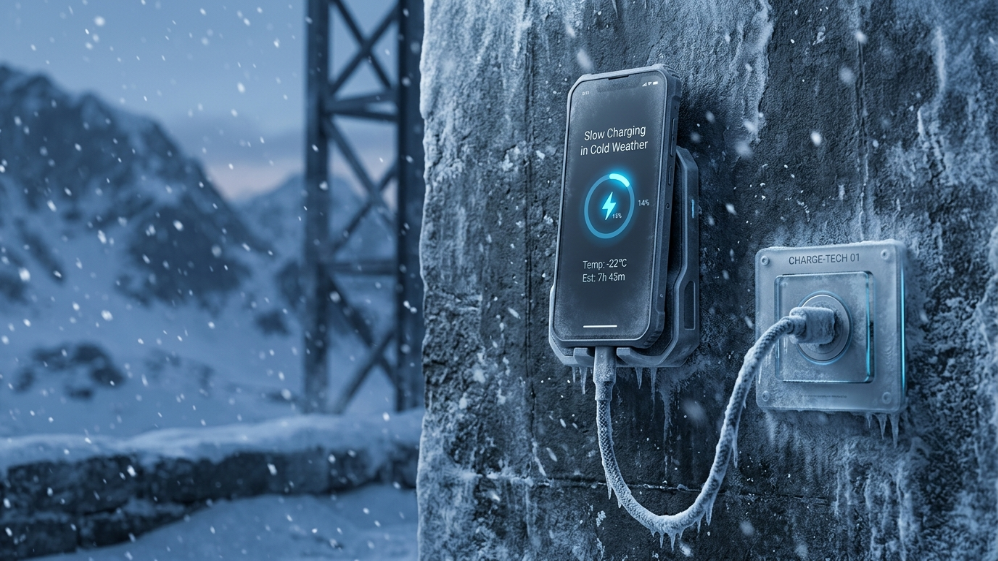
Heat is the enemy of every lithium-ion cell.
When internal temperatures rise above 45 °C, the electrolyte starts to degrade, causing capacity loss and voltage instability.
Dual-port GaN chargers mitigate this risk in three ways:
-
High Efficiency Conversion:
GaN components waste less energy as heat, achieving up to 95 % conversion efficiency — compared with 85 % for legacy silicon. -
Parallel Thermal Paths:
Each port has its own thermal control loop, distributing heat evenly rather than concentrating it in a single output. -
Temperature-Aware IC Control:
Built-in sensors automatically reduce current when temperatures exceed safe thresholds, preserving both charger and battery integrity.
IEEE research confirms that maintaining cooler charging environments can double battery life cycles in mobile devices.
Smarter Power Allocation for Multi-Device Safety
Dual-port chargers excel in smart load balancing — a process that dynamically allocates power based on connected devices’ requirements.
Example Scenario (Using a 65 W GaN Charger):
| Connected Devices | Port 1 Output | Port 2 Output | Total Power | System Response |
|---|---|---|---|---|
| Laptop + Phone | 45 W (PD) | 20 W (QC) | 65 W | Stable, balanced |
| Two Phones | 25 W + 25 W | 50 W | 90 % efficiency | Low heat |
| Phone + Smartwatch | 20 W + 5 W | 25 W | 95 % efficiency | Safe trickle charge |
This intelligent voltage negotiation ensures optimal current for every connected device — preventing both undercharging and overload.
The result is consistent battery performance and fewer cycle losses over time.
Material & Build Quality: The Unsung Protectors
Premium dual-port fast chargers adopt:
-
Flame-retardant PC or Aluminum Alloy Housing – enhances safety and heat dissipation.
-
Graphene Cooling Layer – reduces surface temperature by up to 8 °C.
-
Gold-plated Connectors – resist oxidation and signal loss.
-
Energy Star-Compliant ICs (Energy Star) – reduce standby consumption below 0.1 W.
For OEM clients, these material choices are not merely cosmetic — they align with global compliance standards (CE, UL, RoHS) and reinforce long-term brand reliability.
Common Misconceptions About Dual-Port Charging
Myth 1: “Charging two devices halves the power.”
— False. Smart ICs distribute current dynamically to keep both ports efficient.
Myth 2: “Dual-port chargers run hotter.”
— Modern GaN models run cooler due to lower conduction loss and improved airflow design.
Myth 3: “They shorten battery life by constant fast-charging.”
— Actually, adaptive PD protocols shift to trickle mode at 80 % capacity, reducing stress.
OEM Insight: Designing for Battery Health
For brands sourcing from professional dual-port fast charger suppliers, key specifications to request include:
| Parameter | Recommended Range | Benefit |
|---|---|---|
| Output Power | 30 – 100 W (PD 3.1 + QC 4.0) | Supports multi-device use |
| Operating Temp | 0 – 45 °C | Prevents cell degradation |
| Housing Material | Aluminum + Graphene Coating | Extended durability |
| IC Type | GaNFast / Navitas | 95 % efficiency |
| Safety Certs | CE / UL / Energy Star / PSE | Global market access |
Integrating these standards into OEM production not only extends device lifespan but also increases consumer trust and after-sales satisfaction.
The Bigger Picture: Sustainable Charging
Using dual-port chargers also contributes to environmental sustainability:
-
Fewer chargers needed per user → lower electronic waste.
-
High energy efficiency → reduced grid consumption.
-
Universal compatibility → one charger serves multiple generations of devices.
This aligns with the EU’s 2026 directive mandating standardized USB-C PD charging for all consumer electronics — a future where the dual-port fast charger becomes the default ecosystem tool.
Conclusion: Smarter Power, Healthier Batteries
Dual-port fast chargers are no longer about speed alone — they’re about stability, intelligence, and sustainability.
Through GaN efficiency, PD protocol optimization, and thermal safety design, they preserve battery capacity, extend product lifespan, and elevate user confidence.
To partner with a certified dual-port charger supplier offering PD 3.1 & GaN OEM solutions, visit
ESC Charge Official Website
and discover how precision power delivery supports both innovation and reliability in modern charging.