
Large-Scale Magnetic Power Bank Programs Reveal Practical Constraints
Magnetic power banks often perform well during early demonstrations. Devices align, charging initiates, and the product appears convenient and compact. These impressions, however, rarely capture what happens once the product is distributed across a large user base and subjected to repeated daily use.
At scale, several constraints become visible. Magnetic alignment tolerance begins to affect charging stability when users attach devices at slightly different angles. Heat concentrates around the wireless charging coil during extended sessions, raising surface temperature more quickly than expected. Over time, minor variations between production batches translate into uneven charging behavior across the field. These issues are expensive to correct after deployment and difficult to manage through customer support alone.
This is the environment in which a custom magnetic power bank must be evaluated—as a controlled supply solution rather than a novelty accessory.
How AOVOLT Develops Magnetic Power Banks for OEM Programs
AOVOLT structures magnetic power bank projects around long-term usability rather than visual appeal alone. Development begins by understanding how the product will be handled, attached, removed, and reattached throughout a typical usage cycle.
From that starting point, several concrete advantages are built into the OEM process:
-
Magnetic alignment tuned for real handling behavior
Magnet strength and positioning are calibrated to allow consistent attachment while avoiding excessive force that can accelerate wear or misalignment over time. -
Wireless charging layout planned for sustained sessions
Coil placement, shielding, and enclosure materials are selected to manage heat distribution during prolonged charging rather than short demonstrations. -
Configuration locked after validation
Once sampling confirms acceptable charging behavior and thermal response, key components and assembly parameters are fixed to prevent variation during volume production.
These measures allow a custom magnetic power bank to maintain predictable behavior as production scales.
Technical Considerations That Matter in B2B Magnetic Power Bank Projects
For B2B buyers, magnetic charging introduces technical trade-offs that must be understood early. Charging stability depends on consistent alignment between the coil and the receiving device, especially when users reposition devices during use. Safety margins depend on how heat generated by wireless charging is dispersed across internal structures rather than concentrated in a single zone. Capacity must be evaluated based on usable energy under wireless discharge conditions, which differ from wired output.
Compatibility across device ecosystems further complicates evaluation. Different devices respond differently to magnetic alignment and wireless power negotiation. These factors shape the real performance envelope of a custom magnetic power bank in field deployment.
| Evaluation Area | Generic Magnetic Power Bank (Common Market Baseline) | AOVOLT OEM Program (Controlled Build) |
|---|---|---|
| Wireless energy conversion | Often 70–80% in real use, drops sharply when alignment shifts | Tuned coil + layout can reach up to 88% under validated alignment windows |
| Misalignment impact (speed loss) | Small angle shift can cause 15–30% power drop, plus repeated reconnect behavior | Magnet layout + coil positioning reduces “attach angle” sensitivity; output remains within a narrower band across daily handling cycles |
| Thermal trend (surface temperature) | Continuous wireless sessions frequently push surface temp beyond comfort thresholds; throttling becomes aggressive | Thermal layers and heat-spread design keep surface temperature under 40°C in multi-device charging builds |
| Output capability range (portfolio) | Wireless output usually limited to low, fixed profiles | Magnetic wireless portfolio covers 22.5W–45W class products, enabling broader OEM positioning |
| “Rated vs usable” capacity gap | Low-cost designs can show extreme gaps; a labeled 10,000mAh unit may deliver < 5,500mAh usable output in practice | Usable energy is validated as part of OEM sampling; discharge behavior is checked under wireless load, not only at nominal cell rating |
| Batch consistency (repeat orders) | Component substitutions cause silent performance drift after initial sampling | BOM lock + process control after sample approval; repeat orders track the same validated behavior |
| Quality gate (shipment stability) | Random inspection; no uniform stress screening | 100% aging test as a standard quality gate; reduces early-life defects in bulk delivery |
| Warranty / buyer risk buffer | Often vague or short | 12 months warranty as a program baseline for OEM supply |
This is the reason a custom magnetic power bank should be evaluated with repeat-order metrics, not only with one-off sampling impressions.
Device Ecosystem Compatibility and Adaptation Strategy
AOVOLT validates magnetic charging behavior across major device ecosystems to reduce deployment risk.
Apple devices reveal alignment sensitivity during battery state transitions, particularly when accessories are attached and removed frequently. Samsung devices stress wireless charging stability during adaptive power changes. Huawei devices highlight fallback behavior when alignment or negotiation is inconsistent.
By validating across these ecosystems, AOVOLT ensures that a custom magnetic power bank performs predictably even when user behavior and device mix cannot be controlled.
B2B Risk Management, Compliance, and Transportation Readiness
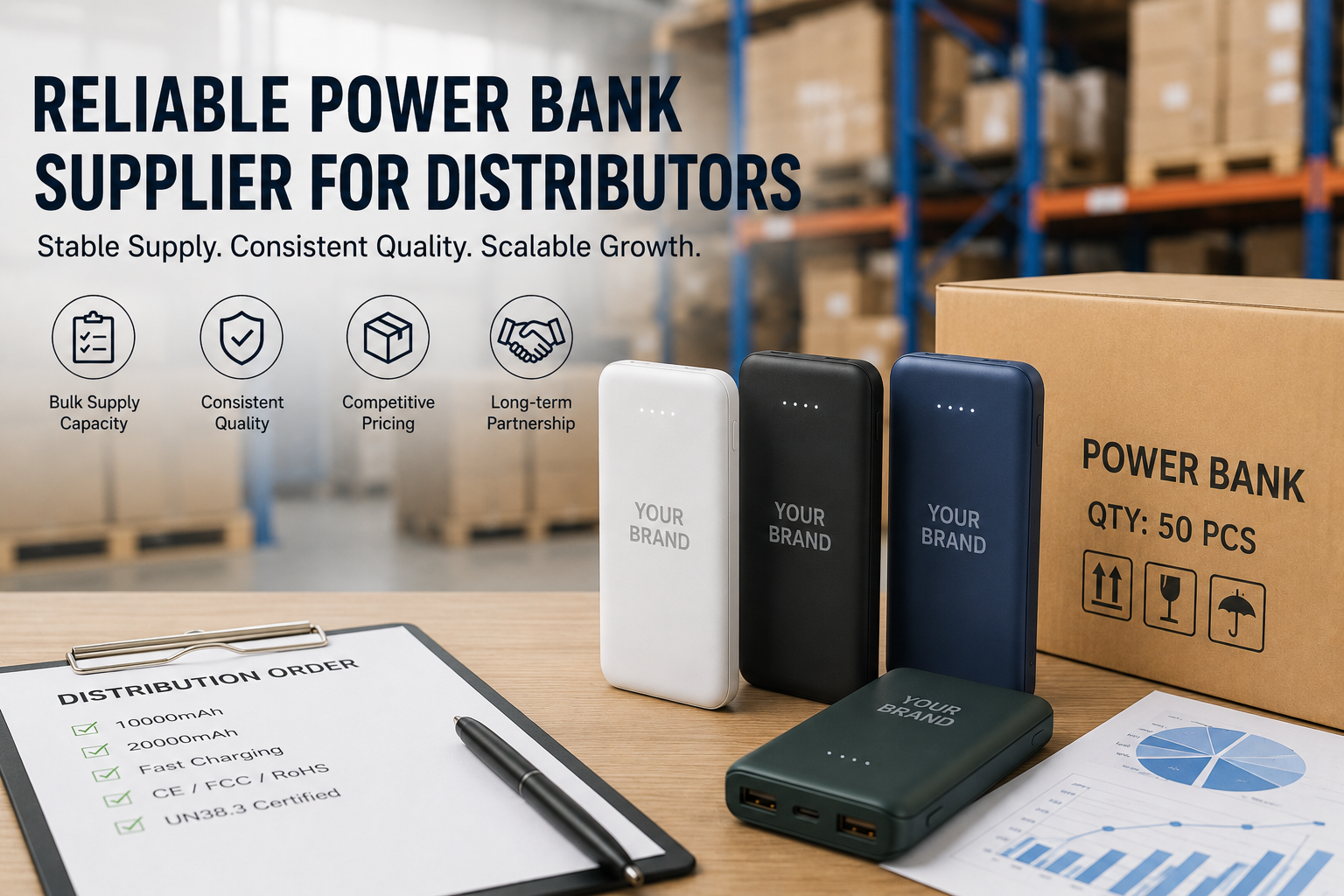
In B2B distribution, the unit cost is rarely the real risk driver. The risk sits in shipment interruption, document gaps, and “can’t-clear” cases that stall inventory for weeks. For lithium power banks, buyers typically need a full export-ready pack that includes UN38.3 and MSDS, plus market-facing compliance such as CE / FCC / RoHS depending on destination and channel requirements .
AOVOLT treats compliance and logistics as a project stage, not a last-minute task. Documentation scope, labeling language, and packaging specs are aligned during sampling so the mass-production schedule is not forced into rework loops. For programs with tight launch windows, the ability to move fast matters too: your customized solution workflow highlights 7–15 days lead time as a practical delivery expectation for OEM/ODM projects . That timeline only holds when compliance items are fixed early—otherwise the “paperwork tail” becomes the bottleneck.
For a custom magnetic power bank program, transport readiness is also tied to thermal behavior and charging stability in real use. If a design runs hot, buyers will see higher complaint rates and higher after-sales cost even when the paperwork is complete. That is why the shipping-ready checklist must include both documents and validated operating behavior.
Flexible B2B Cooperation Models and Next Steps
AOVOLT supports a range of B2B cooperation models, including branded OEM programs, phased order expansion, and long-term supply agreements. Sampling, validation, and production are managed as connected stages to preserve performance benchmarks throughout the supply cycle.
The goal is simple: ensure that the first shipment and the last shipment behave the same in real use. That consistency defines a reliable custom magnetic power bank partner.
To explore available magnetic power bank products, visit:
https://www.esccharge.com/products/power-bank
For customized sourcing and project-level cooperation, see our solution overview:
https://www.esccharge.com/solution/customized-solution